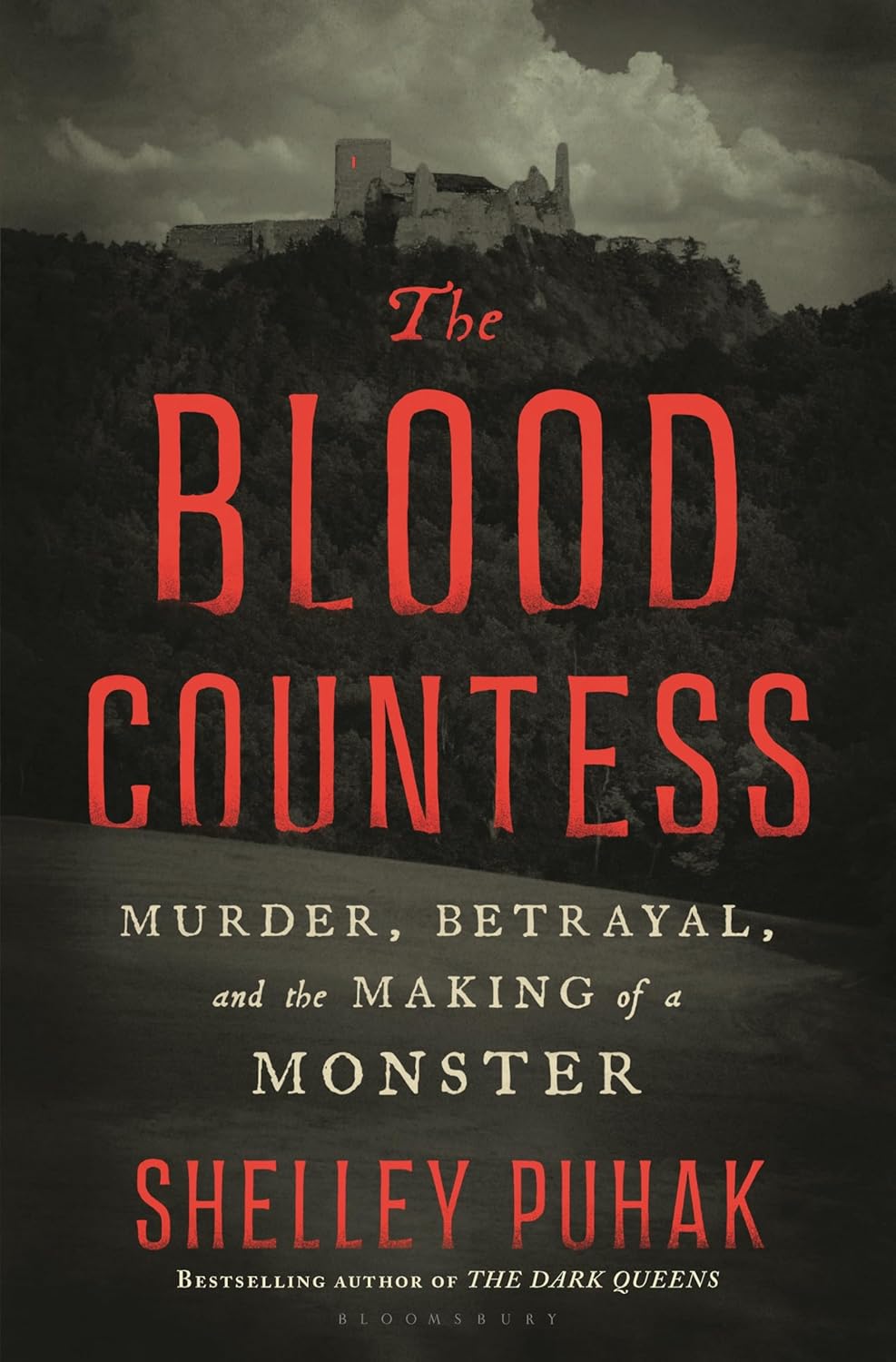
The Blood Countess: Murder, Betrayal, and the Making of a Monster
- By Shelley Puhak
- Bloomsbury Publishing
- 304 pp.
- Reviewed by Diane Kiesel
- April 3, 2026
Was Elizabeth Bathory really a serial killer and sadist?
Was the Baroque period’s Countess Elizabeth Bathory a real-life, female version of Bram Stoker’s Count Dracula, possibly torturing and killing as many as 650 virgins? Or was she more akin to 17th-century Salem’s Rebecca Nurse, falsely accused of witchcraft by an hysterical Massachusetts community?
To the cognoscenti, Bathory is a cult figure. She has been the subject of novels and poems. For her murderous deeds, she scored a mention in The Guinness Book of World Records. Her likeness has been plastered on T-shirts, and her former castles are macabre tourist traps. But given the paucity of documentation about her crimes and the proliferation of embellished accounts of her bloody behavior, it’s impossible to know whether she was a villain or a victim.
Author Shelley Puhak has launched an exhaustive effort to find the truth. Her new book, The Blood Countess, is an amazing demonstration of diligent scholarship. She climbed through archives in Austria, Hungary, Romania, and Slovakia — much of them filled with faded writings in multiple languages — to examine old rumors about the butchering Bathory through a 21st-century lens. In doing so, she raises an important question: Was the countess’ real crime that she was a too-wealthy, too-powerful woman in a man’s world?
Keeping track of the Bathory clan and its position in Transylvanian politics is mind-numbing. To understand how Elizabeth died a prisoner in her own tower, one needs to get in the weeds with the dizzying array of bickering Catholics, Calvinists, Lutherans, Ottomans, Hapsburgs, nobles, priests, and Hajduk outlaws who roamed the countryside and this tale. It’s tedious but necessary.
In 1560, Elizabeth was to the Hungarian manor (or, more accurately, manors) born. She controlled 17 castles across 500 miles of the old Ottoman Empire. Her social standing solidified with her marriage to soldier/aristocrat Count Francis Nadasdy, aka “the Black Lord” (because of his dark hair and beard), who owned a third of Royal Hungary. While the Black Lord was battling the Turks who lusted after his land, Elizabeth stayed home supervising the harvests, maintaining the beehives, paying the bills, managing the servants, and, Martha Stewart-style, arranging the elaborate weddings of her daughters.
Despite her wealth and social standing, Elizabeth was just a few men away from disaster, as demonstrated by her downfall after the Black Lord died in 1604, leaving her a 43-year-old widow with three children, acres of land, and mountains of debt. When her brother died less than two years later, Elizabeth’s world unraveled. As Puhak writes:
“Without the protection of any male relative — father, husband, brother, or adult son — she made for a very attractive target.”
A taste of future troubles came when Elizabeth traveled 430 miles with a huge retinue of servants and guards to bury her brother. At a dinner on one of her brother’s estates, a grown German woman with a son refused to wait tables; as a task usually reserved for young, unmarried girls, it was beneath her. Enraged, Elizabeth (according to rumors) either a) flogged her; b) humiliated her by forcing her to suckle a log; c) sliced the flesh off the woman’s backside; d) burned her with a hot iron; e) cut off her breasts; or f) had her killed.
Puhak suggests these conflicting, increasingly outlandish allegations were either part of a Hapsburg propaganda campaign or — because of pervasive illness at the time — were descriptions of barbaric medical practices then in vogue, like blood-letting or cauterizing wounds with a hot iron. Nonetheless, nothing came of these rumors other than to start Elizabeth down the road to ruin.
Lurking in the background to confound readers is a detailed story of the political tug-of-war between Elizabeth’s 18-year-old nephew, Gabriel, who was elected prince of Transylvania, and Hungary’s new royal governor, George Thurzo, who had designs on Elizabeth’s lands and needed to get rid of the young prince to gain control of them. Failing to read the handwriting on the castle wall, Elizabeth chose to retire to a small manor house, Čachtice, in what is today western Slovakia, rather than live in her girlhood home, the castle at Sarvar in Hungary, where she’d amassed a strong and loyal security force. The result was that, on December 29, 1610, Thurzo and his henchmen stormed in to arrest her for mass murder.
“Thurzo would later claim that he surprised Elizabeth in the middle of a torture session,” writes Puhak, “but that was a lie.”
Over the next four years, until Elizabeth died in her sleep, Thurzo and his compatriots would try mightily to gather evidence against her using every method at their disposal, including torturing servants and burning a few at the stake, to no avail. Rumors flew about Elizabeth’s dastardly deeds, but no solid evidence of widescale slaughter at the Bathory castles surfaced. No bodies were found, no hidden torture chambers were revealed, no missing-persons reports made by grieving families were uncovered, and few, if any, reliable eyewitnesses came forward to reveal provable details about Elizabeth’s alleged crimes. At most, there were six confirmed deaths at various Bathory manor homes, possibly due to illness and exacerbated by the 17th century’s miserable medical care.
Diane Kiesel is a former judge of the Supreme Court of New York. Her latest book, When Charlie Met Joan: The Tragedy of the Chaplin Trials and the Failings of American Law, was published last year by the University of Michigan Press.