The Blood in Winter: England on the Brink of Civil War, 1642
- By Jonathan Healey
- Knopf
- 432 pp.
- Reviewed by Stephen Case
- December 12, 2025
A brilliant account of how the seeds of battle were sown.
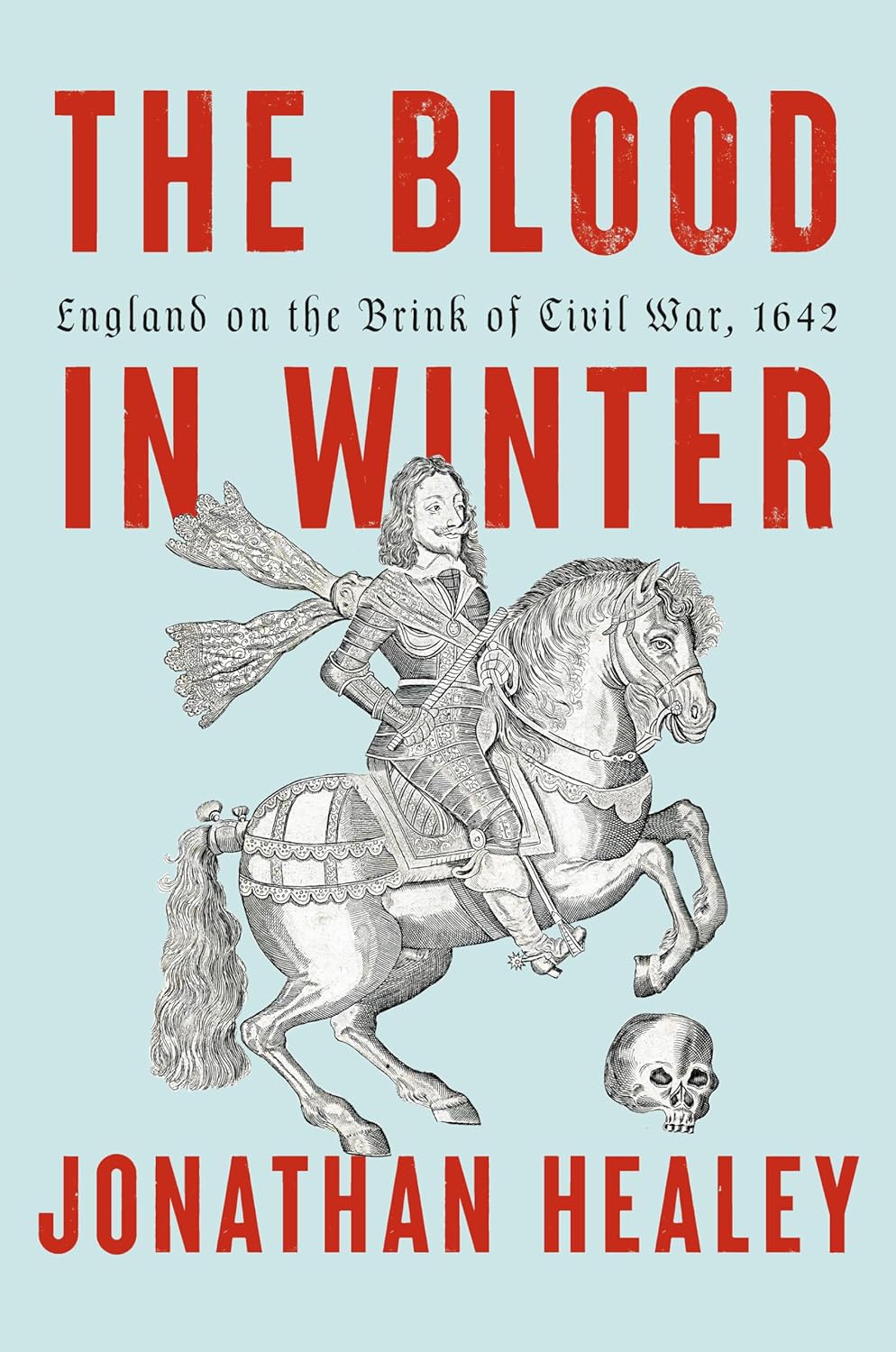
Should one feel sorry for beleaguered King Charles I of England? Such empathy will come easily for readers of the excellent The Blood in Winter by Oxford don Jonathan Healey. Inheriting the British throne in 1625, Charles was immediately besieged by uppity members of Parliament seeking to chip away at his monarchical powers. These attackers never gave up, and their persistence led, in the summer of 1642, to civil war and (sadly for him) Charles’ beheading in 1649.
As tensions rose in January 1642, Charles, in an effort to reassert his absolute rule, charged five Members of Parliament with high treason. To arrest them, His Majesty himself, accompanied by armed men, knocked on the House of Commons’ door. Absent, the alleged traitors were never taken into custody. Who tipped them off that the king was coming?
Well, Lucy Hay, Countess of Carlisle, played an enthralling role. Twice painted by Sir Anthony Van Dyck in “stunning” and “suggestive” images, “She was what one smitten courtier…called ‘the killing beauty of the world,’” writes Healey. “Spurning opposition from her father, the youthful Lucy had married a well-connected Scot, James Hay, a man described by the king’s sister as ‘Camel-face.’”
The then Prince Charles, his father, King James I, and other notables had attended Lady Carlisle’s wedding (although marriage didn’t deter her from having a long-term affair with Charles’ senior minister, the Duke of Buckingham). After Buckingham’s assassination in the 1620s, and her husband’s later death, Lady Carlisle continued her close, personal relationship with Charles’ wife, Queen Henrietta Maria.
Given her ties to the royal family, did the wealthy, well-connected Londoner really tip off the rabble-rousers about to be seized by Charles? Apparently, yes.
“[W]e can say with pretty good assurance…that [Lady Carlisle] did betray the king,” states Healey, who cites considerable evidence to support his view.
The author’s picture of the noblewoman is but one of his many arresting portraits of participants in the intrigue. Brilliantly written, the book recounts numerous sub-dramas in the unfolding road to bloody war. This is not to mention Healey’s many engaging descriptions of London itself and its rowdy crowds of protesters, both royalist and rebel. This reviewer, fascinated by the engrossing detail of Healey’s accounts, wished he had sources describing the Washington, DC, events of Jan. 6, 2021, that were even half as good.
Another intriguing individual was Giovanni Giustinian, the Venetian ambassador. Extracts from Giustinian’s reports pepper the book; the perspicacious dispatches reveal that the envoy received amazing intel from high-in-the-government circles. His observations and forecasts about the looming fight proved astonishingly accurate. One admires Giustinian’s skill in developing and exploiting sources and wonders whether today’s best diplomats are even half as good as he.
Conversing with the Dutch ambassador in February 1642, Charles lamented the ground he’d ceded to the pretentious, power-seeking lawmakers. Among the beaucoup concessions rivetingly reported by Healey, the king consented to the beheading of his military leader in Ireland not following conviction after a trial, but because Parliament passed a law requiring it. Also, he agreed to allow Parliament to set its own schedule, something that was previously the monarch’s prerogative.
Perhaps most galling in Charles’ view was that Parliament, three months earlier, had enacted and publicized a “Grand Remonstrance” listing 200 grievances and proposals for further (some would say radical) modifications to how power was allocated between the Crown and the legislature.
The Dutch envoy told the king that even Charles’ own son-in-law, heir apparent to the throne in Holland, would not mediate for him. (This man, William II of Orange, married Charles’ daughter Mary when he was 14 and she was 9. The couple produced William III of Orange, who would wed the daughter of King James II of England, and later, in the Glorious Revolution of 1688, become king of England, Scotland, and Ireland.)
Healey’s book follows on from his earlier The Blazing World: A New History of Revolutionary England, 1603-1689. That work, a comprehensive survey lauded by reviewers, of necessity had to omit some of the particulars of 1642. Not so The Blood in Winter, which reels off nonstop, captivatingly rich information about the immediate lead-up to the English Civil War. Those new to the story may, at first, find their heads spinning from the barrage of unfamiliar names, but Healey’s prodigious skill quickly makes everything fall into place, producing, in the end, a highly rewarding reading experience.
Stephen Case is co-author of Treacherous Beauty: Peggy Shippen, the Woman behind Benedict Arnold’s Plot to Betray America and serves as treasurer of the Independent.