The Bookshop: A History of Bookselling from the Dawn of Print to the Twenty-First Century
- By Andrew Pettegree
- Basic Books
- 320 pp.
- Reviewed by Dennis Drabelle
- October 16, 2026
Tome-peddling has never been the most lucrative pursuit.
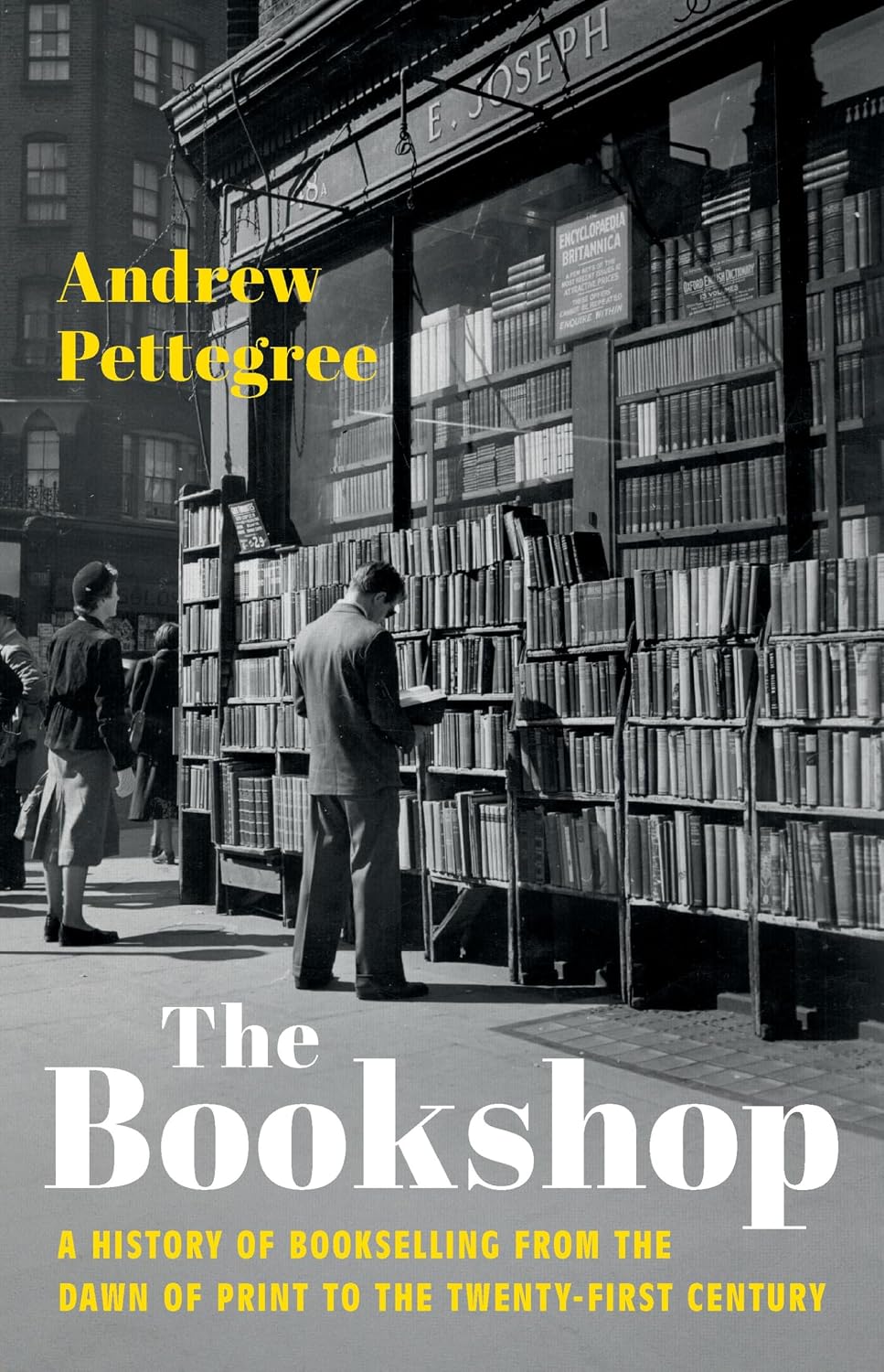
Let us begin, brothers and sisters, with a memorial service. R.I.P. Savile and the Old Forest in Georgetown, Borders on the edge of the GW campus, Globe at 17th and Pennsylvania, Chapters on K Street, Olsson’s and Lambda Rising just off Dupont Circle, Atticus on U Street, and dozens more throughout the District, Northern Virginia, and the Maryland suburbs. Some of these establishments sold new books, others secondhand ones; what they all had in common was going out of business during this reviewer’s half-century as a Washingtonian.
Other shops have sprung up since those exits, and online bookselling has become a convenience for millions of readers, but as historian Andrew Pettegree shows in his brisk and lively history The Bookshop, bookselling has always been an iffy livelihood.
The book as we know it was made possible by the advent of the printing press in the 16th century, and one of its most charming periods ended circa 1800. Until then, Pettegree explains, it was commonplace for bookshops to sell their wares unbound, with “folding the sheets and choosing appropriate covers…left to the client and their bookbinder.” I like to imagine a customer placing an order like this: “I’ll have my Paradise Lost on marble-edged paper with Moroccan leather binding and copper clasps.”
Less fussy readers would have frequented book stalls, often clustered around the local cathedral, where you took books as you found them. The most prominent remnants of this selling style are the open-air bouquiniste stands along the Seine in Paris, and Pettegree recounts the brouhaha that arose when the authorities tried to exile them for the duration of the 2024 Olympics:
“The [negative] reaction was instant and effective…and the banks of the river retained their centuries-old status as a magnet for booklovers.”
Another downscale purveyor of books was the traveling salesperson, who might knock on your door and tempt you into purchasing, say, the Personal Memoirs of U.S. Grant, several-hundred-thousand copies of which were hawked thusly after its publication in 1885. The self-sufficient bookstore didn’t become dominant until early in the 20th century; before then, readers were likely to do their browsing at stalls, the book tables in department stores, or the racks in drugstores.
Paperbacks, once considered déclassé (they were typically how-to books or lurid novels), came into their own in the mid-20th century thanks in large part to students’ need for cheap editions — my own high school in St. Louis had an in-house paperback-book store starting in 1960. With the advent of Penguin and other reputable lines, the classics became available to the masses at cut rates. Pettegree also chronicles the conversion of books into prestige items as collectors sought first editions and glossy reprints from such outfits as the Folio Society. Books and bookishness as sources of civic pride went official with the designation of Edinburgh, Scotland, as the first UNESCO City of Literature in 2004.
Inevitably, Pettegree dwells on the rise of Amazon, the brainchild of Jeff Bezos, whose interest was not so much in books per se as in their easy packability for delivery when he started what he envisioned as an all-purpose e-commerce venture. “Though Bezos always had huge ambitions for Amazon,” Pettegree writes, “he could surely not have anticipated that by 2024 Amazon would have commandeered close to 50 per cent of the new book market.”
Meanwhile, Abebooks.com was simplifying the hunt for used books, and Bezos’ acquisition of that clearinghouse made him the bookiest billionaire of them all. This calls into question a stunt he pulled earlier this year, too late to be covered by Pettegree: the 86-ing of Book World, once an integral part of the Washington Post, which Bezos has owned since 2013. As an ex-toiler in that section, I have an ax to grind here, but doesn’t Amazon’s origin story make the travesty of an alleged world-class paper without book reviews even more glaring?
As Pettegree notes, rumors of the death of physical books have been exaggerated. The Kindle remains handy for travelers’ in-flight reading, but its soullessness is such that its paper-based older siblings “still command more than 80 percent of the marketplace.” Against the odds, brick-and-mortar bookstores have held their own, too.
And, so, brothers and sisters, let us not disperse without wishing long life to Politics and Prose, Barnes & Noble, Second Story, and Lost City in the District, Old Town Books in Alexandria, One More Page in Arlington, Kensington Row in Maryland, and many others out there still fighting the good fight.
Dennis Drabelle was a contributing editor of the now-defunct Washington Post Book World from 1984 to 2015.