The Boundless Deep: Young Tennyson, Science and the Crisis of Belief
- By Richard Holmes
- Pantheon
- 448 pp.
- Reviewed by Raima Larter
- February 17, 2026
A fascinating look at the poet’s private doubts.
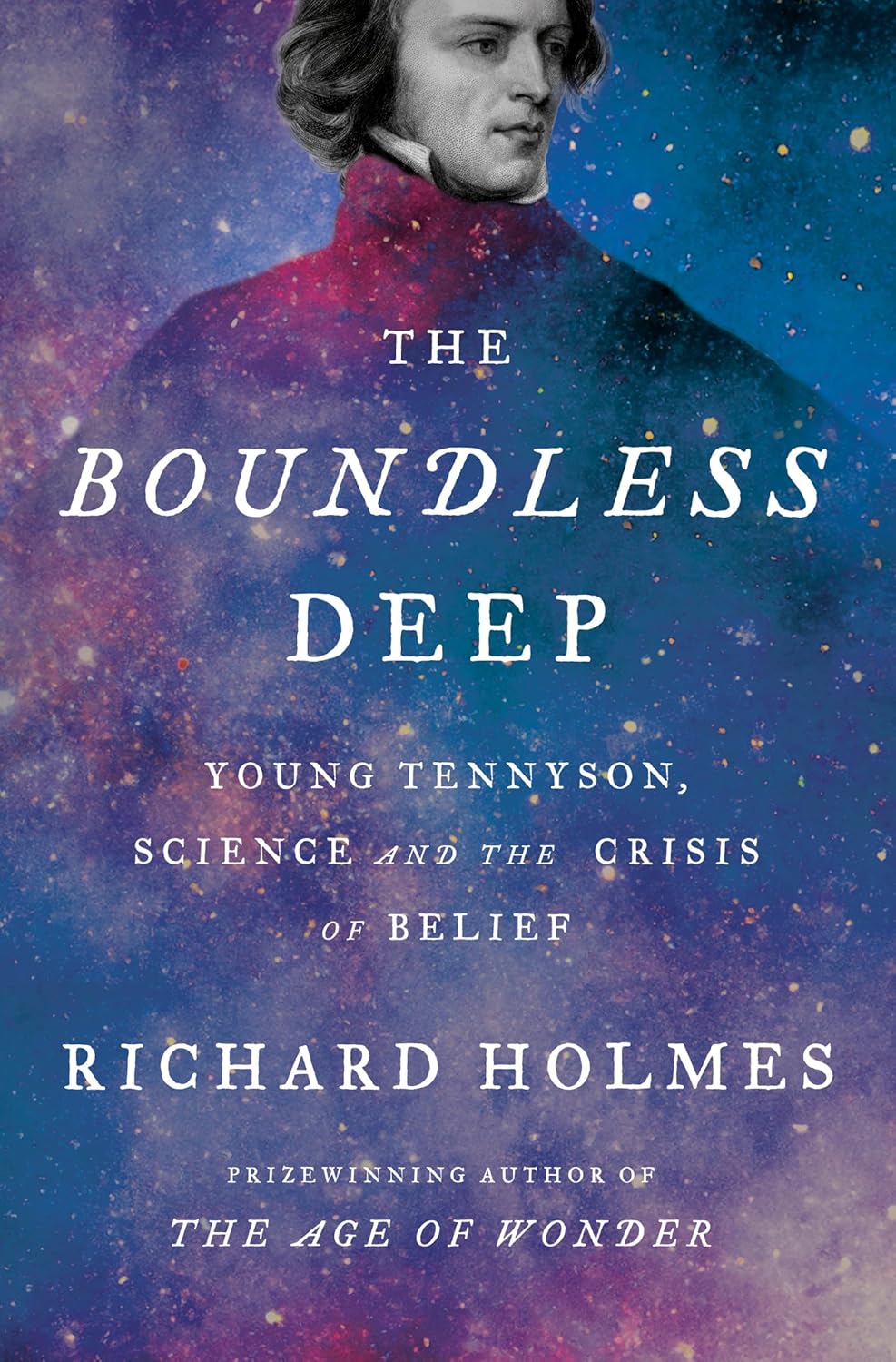
Most of us, maybe all, have read or even memorized the poetry of Alfred, Lord Tennyson, poet laureate of the British Empire, the man immortalized in stone at Trinity College, Cambridge, standing next to Sirs Isaac Newton and Francis Bacon. In other words, some sort of higher being different from us mere mortals.
But after reading Richard Holmes’ The Boundless Deep, I no longer see Tennyson this way. I now feel as if I know Alfred, as his family and friends called him, a young man not unlike many others I’ve met. This is the story of a middle child in a large family of 11 boys and girls, the son of the vicar of Somersby, a small town 15 miles from the sea — a human being whose life was shaped by forces that many have experienced but who channeled those influences into stunning poetry.
Holmes tells Alfred’s story from the year of his birth (1809, the same as Edgar Allan Poe and Charles Darwin) through childhood and university. During all this time, Tennyson wrote luminous and amazing poetry that incorporated many of the wonders of new scientific discoveries, sometimes veering fully into science fiction, such as in his poem “The Kraken,” about a monstrous leviathan in the deep.
Holmes describes Tennyson’s work from this pre-laureate era like this:
“The poetry of young Tennyson, before the beard made him a Victorian, continuously displays this kind of unsuspected and suddenly modern magic. It emerges from those essentially ‘vagrant years’ 1829-1849, before he married and became Poet Laureate and was involved with a small group of friends…who tried to sustain him; and the women with whom he was variously in love.”
As the author demonstrates, these were difficult years indeed. Tennyson’s father, Dr. George Tennyson, grew depressed and violent, descending into alcoholism before eventually dying. Alfred, a student at Trinity by then, had to leave school and try to make his way. There were many problems to contend with, including the mental illness of his younger brothers, the loss of the family home when a new rector was installed at Somersby, the death of Alfred’s best friend, and on and on. Through it all, he wrote.
Alfred tried to help with his family’s problems, especially those of his siblings, but ended up living what we would describe as a couch-surfing existence, accepting help and lodging from his school friends, as well as from a wealthy aunt who frequently gave him money.
Despite being no longer enrolled at university, Alfred continued his studies by reading widely. He was especially interested in the new scientific discoveries in astronomy, geology, biology, and chemistry. The first fossils were uncovered at about this time, showing that Earth had once been populated by great lizard-like creatures that came to be known as dinosaurs and, more to the point, that these creatures had all gone extinct — raising the possibility that, one day, humans could, too.
Coupling the fossil evidence that brought into serious question the age of the planet with new astronomical evidence that what seemed to be single stars were actually entire galaxies, produced for Tennyson and many others a huge crisis of faith. While the celestial discoveries were exciting and exhilarating, the geological ones induced terror of a “cruel, meaningless, godless physical world,” as Holmes describes it, that would later show up in Tennyson’s famous phrase, “Nature, red in tooth and claw.” Holmes discusses the prevailing sense of spiritual crisis this way:
“This deep division eventually became the two sides to Victorian science, an intellectual and spiritual schizophrenia, which Tennyson had somehow glimpsed in the slumbering Kraken, and would go on to express so powerfully and explicitly in his later poetry.”
Holmes makes an excellent case that science had a major influence on the poet, but he also shows us how young Alfred’s personal life had a possibly even bigger impact. This seems especially true when considering Alfred’s father, who preached the gospel while descending into alcoholism and violence. This could lead anyone to question their faith.
Overall, The Boundless Deep is a terrific book. It reads like a novel and was hard to put down. Full of sweeping historical context, it offers deep investigations into the life of an important literary figure who might otherwise remain as motionless and cold as that Trinity College statue. At the same time, Holmes’ work introduces us to a talented young man who, in the end, was really not so different from the rest of us.
Raima Larter is a former chemistry professor who has published numerous short stories, four novels, and even a bit of poetry. Her nonfiction book, Spiritual Insights from the New Science: Complex Systems and Life, was published in 2021. She is currently working on her fifth novel and serves as the nonfiction editor at Utopia Science Fiction Magazine.