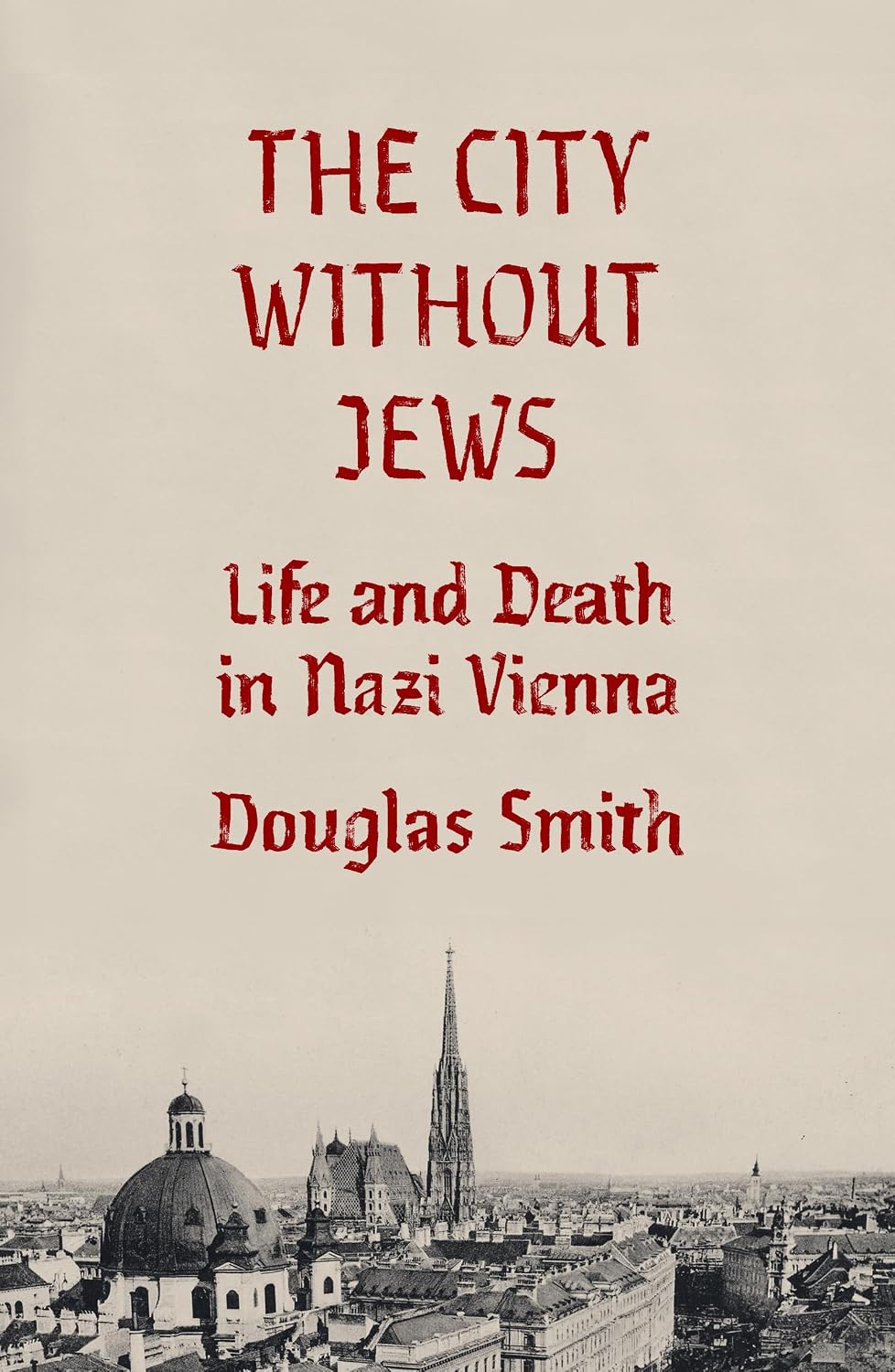
The City Without Jews: Life and Death in Nazi Vienna
- By Douglas Smith
- Farrar, Straus and Giroux
- 560 pp.
- Reviewed by Diane Kiesel
- October 7, 2026
A survivor’s diary is mined to great effect in this gut-wrenching history.
Once upon a time in Vienna — 1922, to be exact — author Hugo Bettauer published a satirical novel, The City Without Jews: A Novel of Our Time. It was the improbable story of how antisemitic local officials, who blamed Jews for every societal ill, took away their legal rights, their social status, and their money. Jews were marched to railway stations and shipped off; those refusing to go were threatened with death. Soon, the city was Jew-free and the Aryan population was elated — until the economy tanked, crime exploded, and cultural life crumbled.
Realizing its terrible mistake, the government reversed course, Jews were welcomed home, and everyone lived happily ever after. The book became an international bestseller. A little more than a decade later, Bettauer’s fantasy became reality as Vienna’s Jews were deported to death camps by Hitler and his Austrian cheerleaders. Shockingly, Bettauer had gotten it right except for one crucial fact: After the Holocaust, few Viennese Jews survived to make their way home. And those who did were not welcomed back.
Historian Douglas Smith takes the title of Bettauer’s novel for his new nonfiction work, The City Without Jews: Life and Death in Nazi Vienna, about the fate of Vienna’s Jews in World War II. Through the microcosm of the family of a Jewish nurse, Mignon Langnas, Smith describes the wider systematic destruction of a people. Based on Mignon’s diaries (started on July 18, 1939, and continued for six years), her letters from Vienna to those who escaped, and Smith’s own meticulous research, this book is hard to put down, yet almost too painful to read. What begins as the drip, drip, drip of petty indignities overflows with descriptions of the torture poured upon the Jews of Vienna. The details land like acid in the eyes and heart of the reader.
The city was home to 200,000 Jews before the war. Nearly 124,000 were able to flee Austria by 1940, but an estimated 66,000 others were murdered in death camps. Quoting Austrian historian Gerhard Botz, Smith writes:
“Vienna was always a few steps ahead of Germany in the process of persecution of the Jews…[and] they could also count on much broader support among the non-Jewish population.”
And therein lies Smith’s sordid tale.
Vienna’s Jews were assimilated and successful; they comprised the majority of the city’s lawyers, dentists, and newspaper editors. They owned most of the stores, movie theaters, and advertising agencies. Mignon’s extended family arrived in Vienna before World War I; in 1928, she married her husband, Leon, who ran a successful lumberyard. They had two children.
On March 12, 1938, Hitler’s troops occupied Austria in an action known as the Anschluss. Two weeks later, in a speech at the Leopoldstadt railway station in Vienna, Hermann Göring bragged, “We don’t like Jews and they don’t like us. We will make them glad to go away.” The local populace couldn’t have agreed more. First, there was public humiliation: Nazi youth groups forced Jews to scrub graffiti from buildings and dog feces off sidewalks on their hands and knees. Within days, Jews were fired from businesses, removed from public office, and beaten by thugs. Jewish children were kicked out of schools, Jewish families tossed out of apartments. Eventually, they were deported east. A prescient, lucky few quickly slipped over the border to Italy or Yugoslavia. For those who remained, the immigration process took years and a family’s every remaining Reichsmark.
With the help of relatives, friends, and the IKG — a Jewish organization forced to comply with Holocaust architect Adolf Eichmann’s order to get Jews out of Vienna or else — Mignon’s family left one by one. But she remained with her sick, elderly parents. Strangled by red tape and thwarted by most of the world’s nations (that didn’t want them, anyway), Jews made heartbreaking, expensive, and often futile efforts to emigrate, many of which are related by Smith in harrowing detail. Leon eventually made his way to New York, where Mignon’s sister Nelly had settled. On December 6, 1939 — one of the few dates she omitted in her diary entries — Mignon put her young children on a train for Genoa on the first leg of a journey to join their father. “[I]n time,” writes Smith, Mignon’s son “lost all memory of his mother.”
In 1941, Mignon was hired to fill a nursing shortage first at a Jewish old-age home and then at a hospital. (Oddly, these institutions were allowed to remain open.) She seemed to have had a visa for her own exit, but administrative snafus, her desire to remain with her now-widowed father, and a possible love affair with a family friend may have contributed to her staying behind. She would improbably survive multiple Nazi efforts to deport her, as well as Allied bombings of Vienna, scarlet fever, starvation, and Soviet Army “liberators” intent on raping women wherever they could find them.
It was not until June 24, 1946, that an ailing Mignon arrived in America after languishing in displaced-persons camps in Europe. Once in New York, she encountered children who barely knew her and a distant spouse who worked long hours in a Brooklyn factory. Her health declining, she died in 1949, at age 46.
As for Bettauer and his bestselling novel: On March 10, 1925, he was shot to death in his Vienna office by a young, unemployed storm trooper who provided “muscle” for the emerging Nazi Party in that city. The assassin put forth an insanity defense at trial, was acquitted of murder, and, two years later, walked out of an asylum a free man when he no longer demonstrated signs of “mental disturbance.”
A warning, if ever there was one.
Diane Kiesel is a former judge of the Supreme Court of New York. Her latest book, When Charlie Met Joan: The Tragedy of the Chaplin Trials and the Failings of American Law, was published in 2025 by the University of Michigan Press.