The Colonel and the King: Tom Parker, Elvis Presley, and the Partnership that Rocked the World
- By Peter Guralnick
- Little, Brown and Company
- 624 pp.
- Reviewed by Arthur Ivan Bravo
- August 13, 2025
How well do we know the Svengali behind the singer?
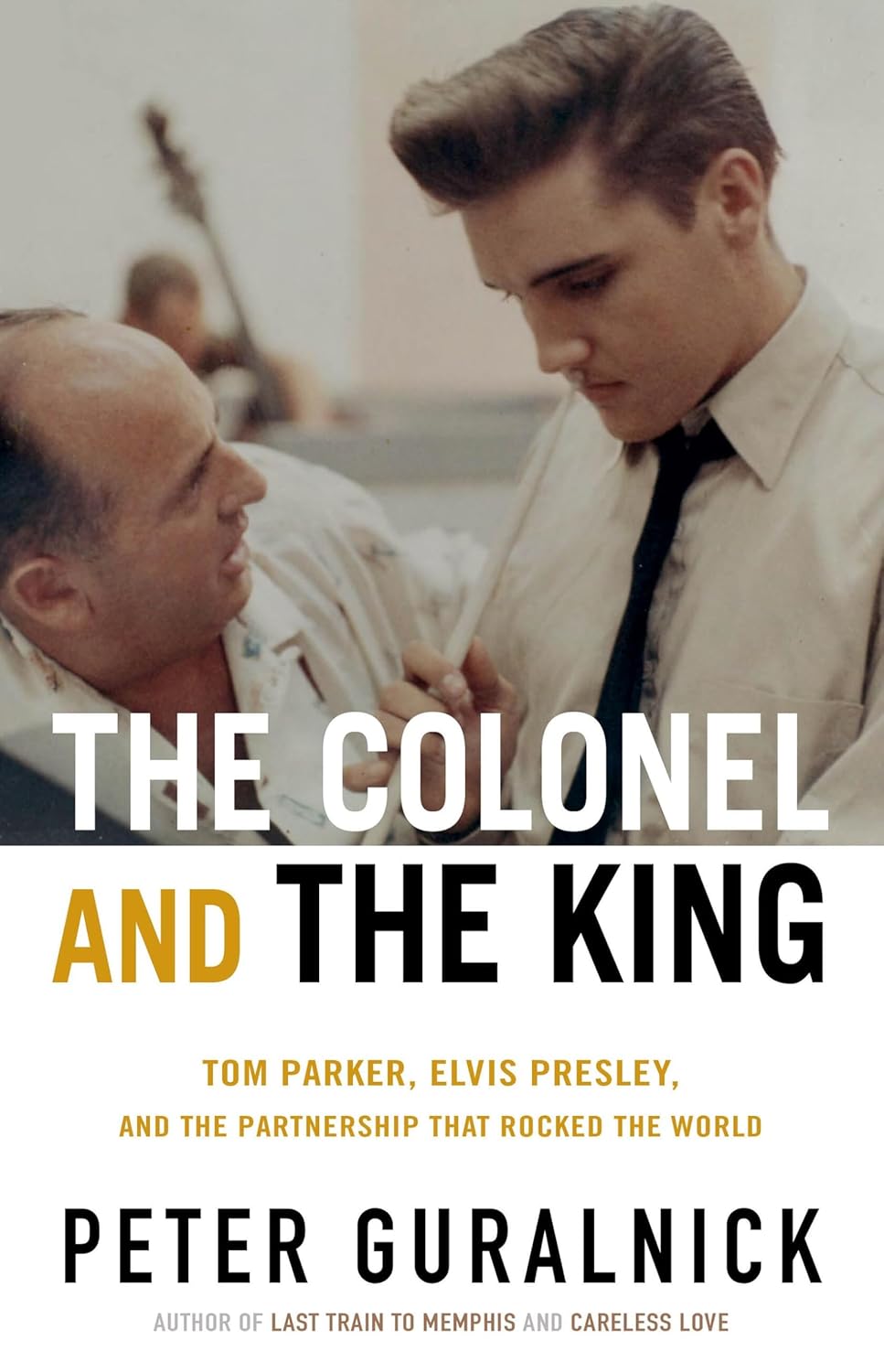
Few American performers have been as documented or discussed as Elvis Presley. Likewise, few voices would dare claim to have made a notable contribution to Presley’s legacy. One of them belongs to Peter Guralnick. For over half a century, the music critic and historian has documented the early history of what came to be known as rock ‘n’ roll, that most singular cultural phenomenon. But ever since publishing a two-volume biography of Elvis in the 1990s, Last Train to Memphis: The Rise of Elvis Presley and Careless Love: The Unmaking of Elvis Presley, Guralnick has largely focused on the King.
In his work, Guralnick has shed light on previously neglected or unknown aspects of Elvis’ life and legacy, and he does so again in The Colonel and the King. A main point of contention in this revisionist history is just what role Elvis’ infamous manager, Tom Parker (aka “the Colonel”), truly played in his protégé’s ascendance. Was the Colonel — as per his commonly held reputation — a self-serving, conniving opportunist who prioritized his own profit over Elvis’ aspirations? Or was he actually the only person who could’ve taken the young performer to such unprecedented heights?
While Guralnick’s prior works reveal his opinion of Parker — that the Colonel was, contrary to the ill-repute accorded to him, not only a devoted promoter of his client but also a genuine personal friend, of sorts — his new book functions as a more fully realized account of the controversial, arguably misunderstood figure.
The tome is divided into two parts, “Book One: How Much Does It Cost If It’s Free: The Improbable Story of Colonel Tom Parker” and “Book Two: The Letters.” The former takes its name from the Colonel’s own never-completed autobiography, while the latter collects much of his archived correspondence, which Guralnick contextualizes for readers.
The author’s elementary prose lends itself to the matter-of-fact nature of recounting and interpreting the Colonel’s countless letters, a major means of communication for his business dealings (and the primary driver of this book). The finer details of contracts are strategically negotiated over and over; the services of associates are solicited; vast amounts of money are demanded, moved around, and spent; favors are asked; and advice is given.
The only part of the Colonel’s biography that can’t be fleshed out from his letters is the early part — possibly the one readers might be most curious about, given that it hasn’t been covered much before. Alas, it isn’t here, either. Still, Guralnick does what he can with the limited, sometimes conflicting information available, much of it intentionally obscured by Parker himself.
“He was a strange child,” the author writes sardonically. Born Andreas Cornelis van Kuijk in Holland in 1909 to a large family of peddlers, Parker felt estranged from his family at a young age (although we’re never told why). His youthful adventures as a runaway found him enthralled by the “carny” way of life, both its nomadic and showman aspects. After making his way to the U.S. and doing a stint in the military, Parker was free to indulge his interests while simultaneously reinventing himself. Here, the narrative moves quickly, following Parker from the carnival to a stretch as a dogcatcher to his life in entertainment. By the time the Colonel becomes a promoter for country-music songwriter Hank Snow, a star in his own right, Guralnick’s narrative kicks into full gear, anticipating Elvis.
While the prose is relatively straightforward throughout, it’s unrelenting (and occasionally exhausting) in relaying facts. By the end of the book, readers will feel like they’ve been taken along on a whirlwind tour of Elvis and the Colonel’s rarified world — the times, the celebrities, the TV shows, the social mores — and given the privilege of seeing it up close.
But even more than this, they’ll hopefully be inspired to consider Parker in a new light. It truly may have been that the Colonel — a foreigner and onetime outcast — not only dreamt up (and brought to life) the modern pop star but also revolutionized the entertainment industry. That he might, despite this book’s best efforts, remain something of an enigma was likely by design of the man himself.
Arthur Ivan Bravo is a teacher, writer, and Ph.D. student in anthropology at SUNY Albany. He is based in New York City.