The Creek, the Crone, and the Crow: A Novel
- By Leah Weiss
- Sourcebooks Landmark
- 304 pp.
- Reviewed by Olesya Salnikova Gilmore
- May 20, 2026
Could a witch’s gift transform a dying Appalachian village?
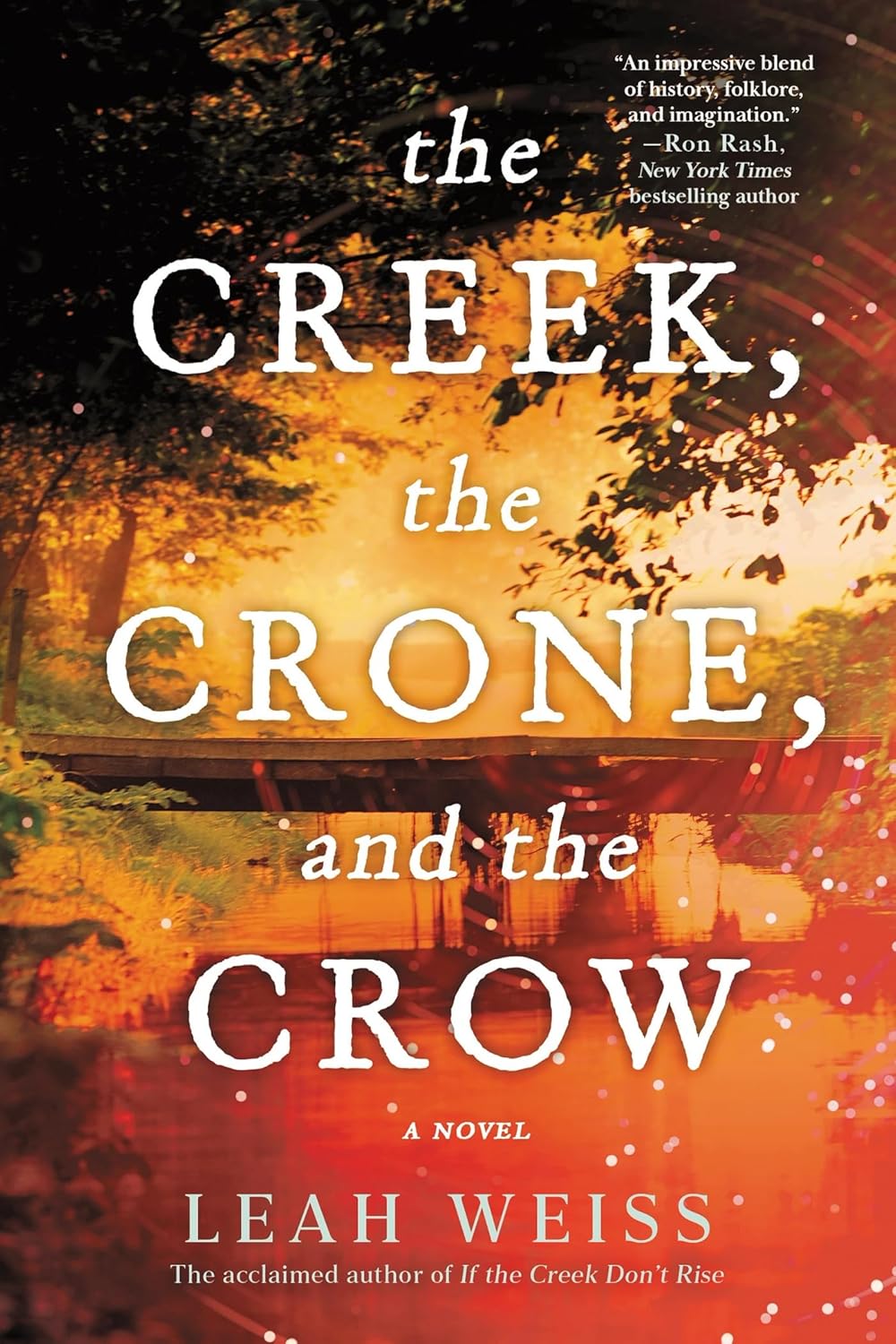
It’s the summer of 1980 in Leah Weiss’ The Creek, The Crone, and the Crow, and North Carolina’s last one-room schoolhouse is on the brink of closure, testing the Appalachian community of Baines Creek. This includes teacher Kate Shaw — who, after living there 10 years, still doesn’t believe in local superstitions — and outsider Lydia Brown, who’s seeking to reclaim her ability to speak to the dead. When Baines Creek’s resident healer/witch, Birdie Rocas, dies, she leaves Kate a collection of books full of folk teachings and remedies. She also leaves behind clues to the region’s mysterious history, which Kate must decipher with help from Lydia.
The mystery isn’t really a mystery at all, but the novel is a wonderful portrait of a time and place and culture told with truth and, more importantly, love. The reader can’t help but root for Kate and Lydia to find the answers to the riddle — and to their own past traumas. They and the other characters make Baines Creek come alive as a real place, one you could point to on a map and visit (though the road there might be bumpy).
Kate mostly functions as the link between Lydia and Baines Creek, providing the “rational, outsider” perspective, even though she’s seen the power of her neighbors’ superstitions with her own eyes. She’s surprised when the community shuns her because of her skepticism. To me, this makes her the most uneven character. And Weiss’ use of dual points-of-view — Kate’s and Lydia’s — a device I usually enjoy, is sometimes confusing. Both women tell the story in first-person narration, but their word choice, tone, and voice are far too similar. And I never felt like I was fully in either’s head.
But what’s lacking in Kate’s sections can mostly be found in Lydia’s. Her journey sweeps us up in its agony, wonder, and self-discovery. It’s Lydia we ultimately cheer on because she’s been visited by the dead before, and even though she seems to have lost her ability to commune with them, she believes in the old witch’s teachings — and in herself. Lydia is also coming to terms with her family alongside her niece, a lovable if eccentric teen and fellow psychic. This lends purpose, relatability, and soul to Lydia’s character. She’s actively working on overcoming her personal tragedies through the witch’s project.
The heart of this project — preserving Birdie’s mystical Appalachian folkways so they don’t disappear — is admirable, as the old customs span continents, centuries, and generations. Still, I was hoping for a larger story, maybe one related to the school’s closure. One-room schoolhouses make up a small but fascinating fragment of U.S. history, and their shuttering in isolated hamlets like Baines Creek had real consequences on the rural communities they served.
Regardless, the author’s world is rich, intricate, and filled with moments of aching beauty. The pain her characters experience just by living is as heartbreaking as their resilience is inspiring. Weiss tells the story in crisp prose that mirrors the insular culture she’s portraying, one which, on the outside, might seem poor and “untamed,” but which really has a long, noble history and a complex belief system that mingles folklore and mysticism with actual healing.
The magic, then, of The Creek, the Crone, and the Crow is in its portrayal of proud people who, however imperfectly, strive to preserve and pass down a vanishing way of life. The outside world may dismiss their unusual ways, but the women of Baines Creek — including the once-doubting Kate — know there’s true magic in them.
Olesya Salnikova Gilmore is the author of The Fortune Tellers of Rue Daru, The Haunting of Moscow House, and The Witch and the Tsar, and is a recovering lawyer. Originally from Moscow, she lives in Chicago and writes in a variety of genres, including fantasy, gothic suspense, mystery, and historical. She loves exploring European history and folklore. Her work has appeared in LitHub, CrimeReads, Reactor/Tor, Writer’s Digest, the Independent, and elsewhere.