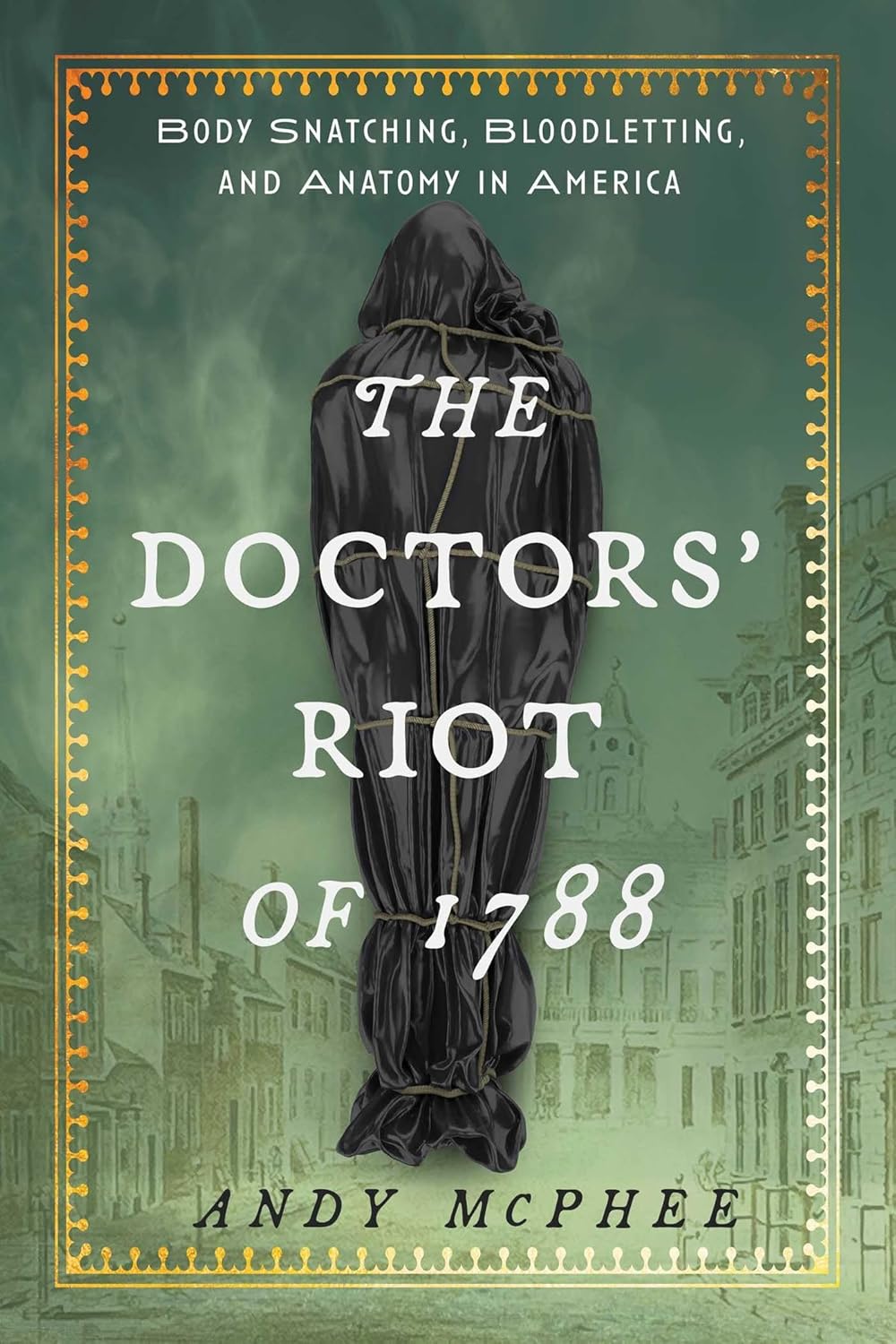
The Doctors’ Riot of 1788: Body Snatching, Bloodletting, and Anatomy in America
- By Andy McPhee
- Prometheus Books
- 248 pp.
- Reviewed by Diane Kiesel
- February 23, 2026
Extraneous details bury the thrills in this corpse-stealing tale.
In 1818, a teenage Mary Shelley imagined a fictional monster stitched together by a scientist from dead body parts. The resulting novel, Frankenstein; or The Modern Prometheus, was written to scare her bored friends during a rainy Swiss summer. But Shelley’s horror story was partially true: From the Middle Ages until the mid-19th century, newly buried cadavers were often snatched from graves and sneaked into classrooms and laboratories.
The purpose of this ghoulish undertaking wasn’t to create monsters but to teach fledgling doctors about human anatomy. But the public didn’t necessarily appreciate the advances in healthcare that dissecting bodies might provide and grew furious at the desecration of the dead. In one instance, the simmering anger boiled over, resulting in a mob attack on what was then the new, state-of-the-art New York Hospital in Manhattan. This melee is the subject of Andy McPhee’s The Doctors’ Riot of 1788.
Before X-rays, CT scans, and MRIs, the only way to know what the inside of a body looked like was to cut one open and poke around. Most of the inventory came from fresh graves few cared about — those holding executed convicts, Blacks, and the poor of any color. But on April 13, 1788, after body snatchers broke into the final resting place of a prosperous white woman, all hell broke loose.
Ideally, a book about dissecting bodies should get to the heart of the matter early on. Unfortunately, the details of the titular riot aren’t revealed until page 124. After the first chapter, which sets up the conundrum between respect for the dead and the need to advance science, McPhee takes a long detour into the history of colonial America that could’ve been recounted in a few pages (if not paragraphs). It’s hard to fathom how lengthy passages about the Revolutionary War, the weaknesses inherent in the Articles of Confederation, and the drafting of the Constitution move the narrative forward.
Buried (so to speak) elsewhere in the book are interesting, albeit stomach-churning, facts that would’ve packed a stronger punch without the filler. For example, in describing medical practices of the day, the author informs us that poor George Washington might have survived his head cold in December 1799 had his doctors not tortured him with an enema and drained five pints of his blood. We also learn that 18th-century patients had their infected legs hacked off while relying on a few chugs of whiskey as the only available anesthesia.
Also interesting is that, at the end of the 18th century, there were only four American medical schools (the College of Philadelphia, Columbia, Harvard, and Dartmouth), and the students attending them were mostly teenage boys expected to BYOB (Bring Your Own Body). And that body had to be found fast: Before embalming became commonplace after the Civil War, corpses broke down quickly, and McPhee describes in harrowing detail the process of human decomposition that begins moments after death.
In a nutshell, body temperature drops 1.5 degrees Fahrenheit per hour; full rigor mortis sets in within 12 hours; and cells and tissues rapidly collapse, causing the skin to peel off, the face to puff up, and the abdomen to pop open, emitting a foul-smelling gas. Then come the flies and maggots. Thus, competent body snatchers yanked the coffin from the ground shortly after burial, pried open the lid, pulled out the deceased, dumped it into a sack, and got away fast. Pros earned between $5 and $25 a body; all the medical students got for their trouble was a cadaver to share with classmates.
Meanwhile, the riot. On that April day in 1788, a young boy playing outside with friends observed a severed arm dangling from a window of New York Hospital. It was later determined to belong to the boy’s recently departed mother. A group of medical students had snatched her body and were cutting it up in the classroom of Dr. Richard Bayley. The boy’s distraught father formed a posse with his neighbors, stormed the building, and destroyed the laboratory, forcing Bayley and his class to flee for their lives.
Mayor James Duane and the sheriff arrived in the nick of time, and Bayley and his students were secured in the city jail for safe-keeping. But the mob was not satisfied. It later made its way to the jail, where the mayor and a volunteer militia, as well as Gov. George Clinton, Revolutionary War hero Baron von Steuben, and none other than Alexander Hamilton, who lived nearby, were waiting to fend them off. Efforts to negotiate a peaceful end failed when somebody tossed a brickbat at von Steuben, who yelled, “Fire Governor! Fire!” as he went down. Several rioters were killed, and many others were injured in the brawl, which lasted about three days.
Body snatching was largely eliminated after embalming became routine following the 1867 discovery of formaldehyde. Once corpses could be preserved, there was no need to quickly crack into a coffin, allowing legislatures to enact laws for the legal and orderly acquisition of cadavers for scientific research. One day, with technological advances like virtual and augmented reality, even legal dissections for educational purposes may become a thing of the past.
Diane Kiesel is a former judge of the Supreme Court of New York. Her latest book, When Charlie Met Joan: The Tragedy of the Chaplin Trials and the Failings of American Law, was published last February by the University of Michigan Press.