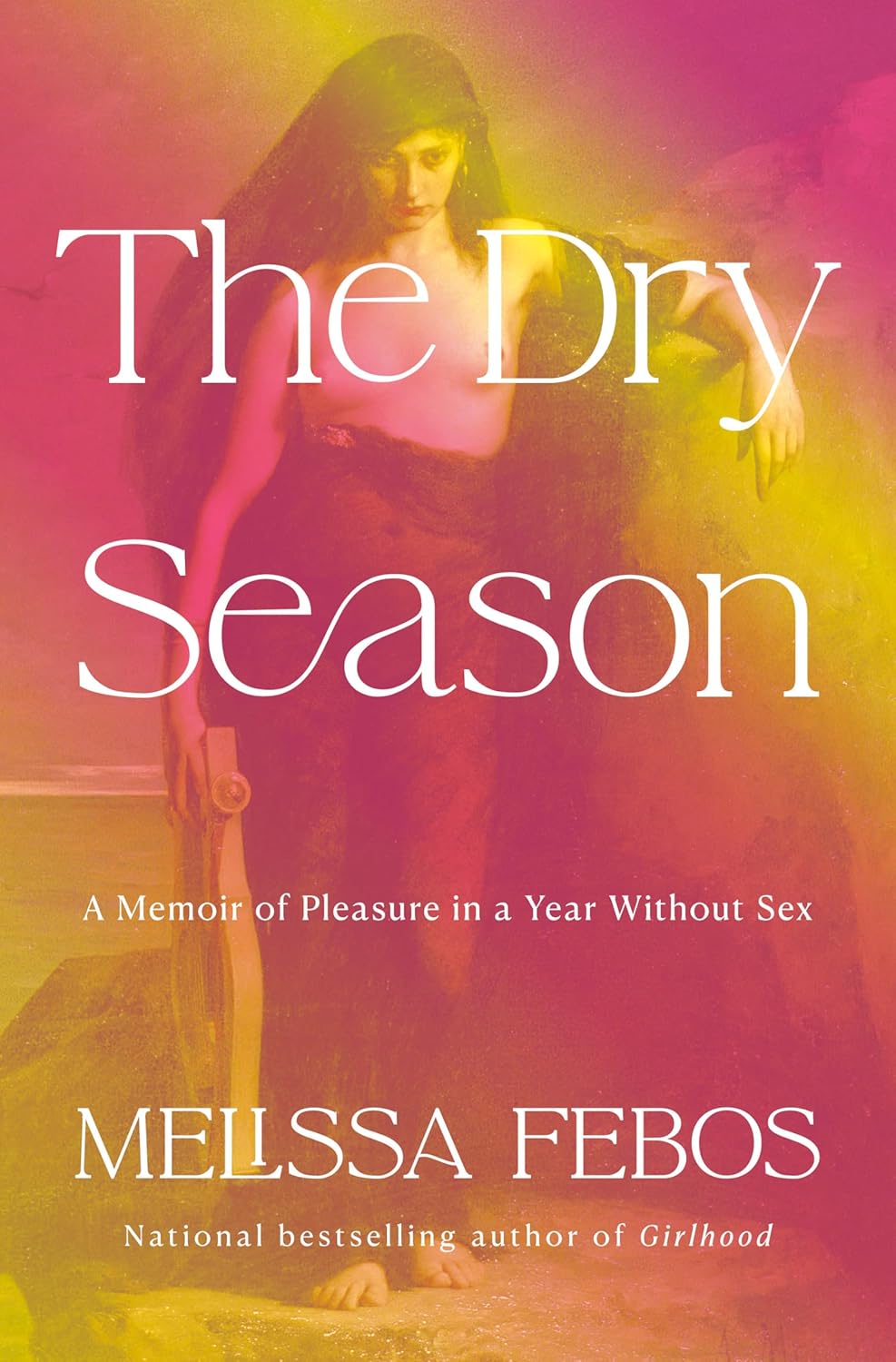
The Dry Season: A Memoir of Pleasure in a Year Without Sex
- By Melissa Febos
- Knopf
- 288 pp.
- Reviewed by Jennifer Bort Yacovissi
- July 21, 2025
There’s nothing dry about the author’s latest offering, and fans are in for a treat.
I came late to Leslie Jamison, first reading The Empathy Exams in the run-up to Donald Trump’s 2017 inauguration. I came even later to Jenny Lawson and Let’s Pretend This Never Happened, which I only read in 2024. And I am latest of all to Melissa Febos, a memoirist of note who immediately put me in mind of these other two — though I soon discovered that Febos is an even more supercharged example of a woman who contains multitudes.
Just consider that the author was once addicted to heroin and working as a professional dominatrix at a New York dungeon while attending college and grad school, where she maintained excellent grades. She got clean at 23 and moved from sex work to academia.
Leaving aside Body Work, her memoir/writing-advice book, I think of Girlhood — a collection of searing essays that illuminate many crucial elements of Febos’ life — as the survey course that offers a larger context of her life, whereas the others dive deeply into specific eras, in roughly chronological order. (Girlhood also gives the reader comfort to know that she has survived and thrived beyond some of her more harrowing experiences.) Whip Smart delves into her work as a professional dominatrix and her addiction; Abandon Me interrogates her obsessive, destructive relationship with an abusive partner; and now comes The Dry Season: A Memoir of Pleasure in a Year Without Sex.
On hearing that Febos was undertaking the experiment of trying to remain celibate, initially for three months and eventually for an entire year, a friend on an extended dry spell of her own glared and said, “Fuck you, Melissa.” It’s true that it’s a bit hard to sympathize with someone who needs to make a project out of avoiding sex, but, by Febos’ own admission, she’d been in relationships from one to the next, “a daisy chain of romances,” since age 15. Her pattern was to use a small infidelity — a kiss or an extended flirtation — committed with the target of her next relationship as the pretext to leave her current one.
It’s also useful to understand that Febos experienced her early puberty as a kind of trauma. “At eleven, my body had erupted. I went from athletic and unselfconscious to feeling ungainly and oversexualized. My body was an embarrassment and also a magnet whose drawing power I could not control.” Her body became community property — subject to whatever treatment the men and boys she encountered felt like thrusting upon it, and her. What 11-year-old is equipped to handle such a transformation?
From there, much of her experience with relationships, whether with men or women, focused less on her feelings for them than on how and what she was able to make them feel. Proving her lovability was her reward.
Over years, she hones her skill of being able to seduce others into wanting her, and she enjoys that feeling. “The pleasure of the dance” is a high, one that still calls to her six months into her celibacy — as she illustrates in an extended description of a charged but wordless flirtation she engages in with a fellow traveler.
She checks out whether she is a sex addict, but it’s clear that this is not her issue; she is not like those who “habitually compelled by this ecstasy were almost robotic in their pursuit, like sex Roombas.” She also considers whether masturbation is on or off the table; it’s on, because, again, it’s not the chase to orgasm that’s the problem. She needs to rewire her response to other people.
As Febos commits more firmly to her year of celibacy, she begins working on an inventory of every relationship she’s ever been in to interrogate the patterns she finds there, and with the intention of sharing the inventory with someone she selects as her “spiritual advisor.” With her experience of addiction and recovery, she understands that she has an unhealthy tendency to make other people her higher power.
In addition, and in some ways part of what guides her in developing her inventory, she researches other women throughout history, such as the beguines, who practiced celibacy (though, to be fair, what they really practiced was an escape from patriarchy):
“Exempt from the servitude of marriage and motherhood, their world and their futures grew far beyond the circumscribed limits of female life at that time.”
Saint Catherine of Siena, Mother Ann Lee and the Shakers, the Dahomey Amazons, and — the one who most captures her imagination — Hildegard of Bingen. The latter’s family tithed her to the church and, at age 8, she was locked into a room in service to a disturbed teenage anchoress and cut off from the rest of the world for the next 30 years. Febos weeps to imagine the moment that Hildegard finally steps out of her confinement into a green, fecund land that wraps her in welcoming arms: sensuality without (necessarily) sex.
Perhaps unsurprisingly, Febos discovers that what she’d been thinking of as “the dry season” is in fact filled with that same sensuous blossoming: of creativity, of space, of time, of freedom from the confines of another person’s desires, demands, and emotional baggage. Being truly by herself for the first time as an adult in her mid-30s becomes a spiritual awakening. She also knows that she has no plans to remain celibate and so needs to learn how to be with another person while maintaining this level of selfhood.
Readers of Girlhood already know how this particular era in Febos’ many-part history concludes: with her reading, reaching out to, and then meeting the poet who becomes her life partner, Donika Kelly, just at the end of Febos’ celibate year. In her acknowledgements, she makes an excellent point:
“Thank God we didn’t meet until I was ready.”
What is it about Febos’ writing that I find so compelling? In this instance, maybe it’s the juxtaposition of memoir as academic dissertation with memoir as blunt can we talk? observations (e.g., “This is why it’s easy to mistake some women who have gone through menopause for lesbians; they have both stopped giving a fuck what men think about them”). Perhaps it’s just that she really knows how to frame and tell a story. Whatever it is, I’m ready to read whatever comes next.
Jennifer Bort Yacovissi’s debut novel, Up the Hill to Home, tells the story of four generations of a family in Washington, DC, from the Civil War to the Great Depression. Her short fiction has appeared in Gargoyle and Pen-in-Hand. Jenny reviews regularly for the Independent and serves on its board of directors as president. She has served as chair or program director of the Washington Writers Conference since 2017, and for several years was president of the Annapolis chapter of the Maryland Writers’ Association. Stop by Jenny’s website for a collection of her reviews and columns, and follow her on Bluesky at @jbywrites.bsky.social.