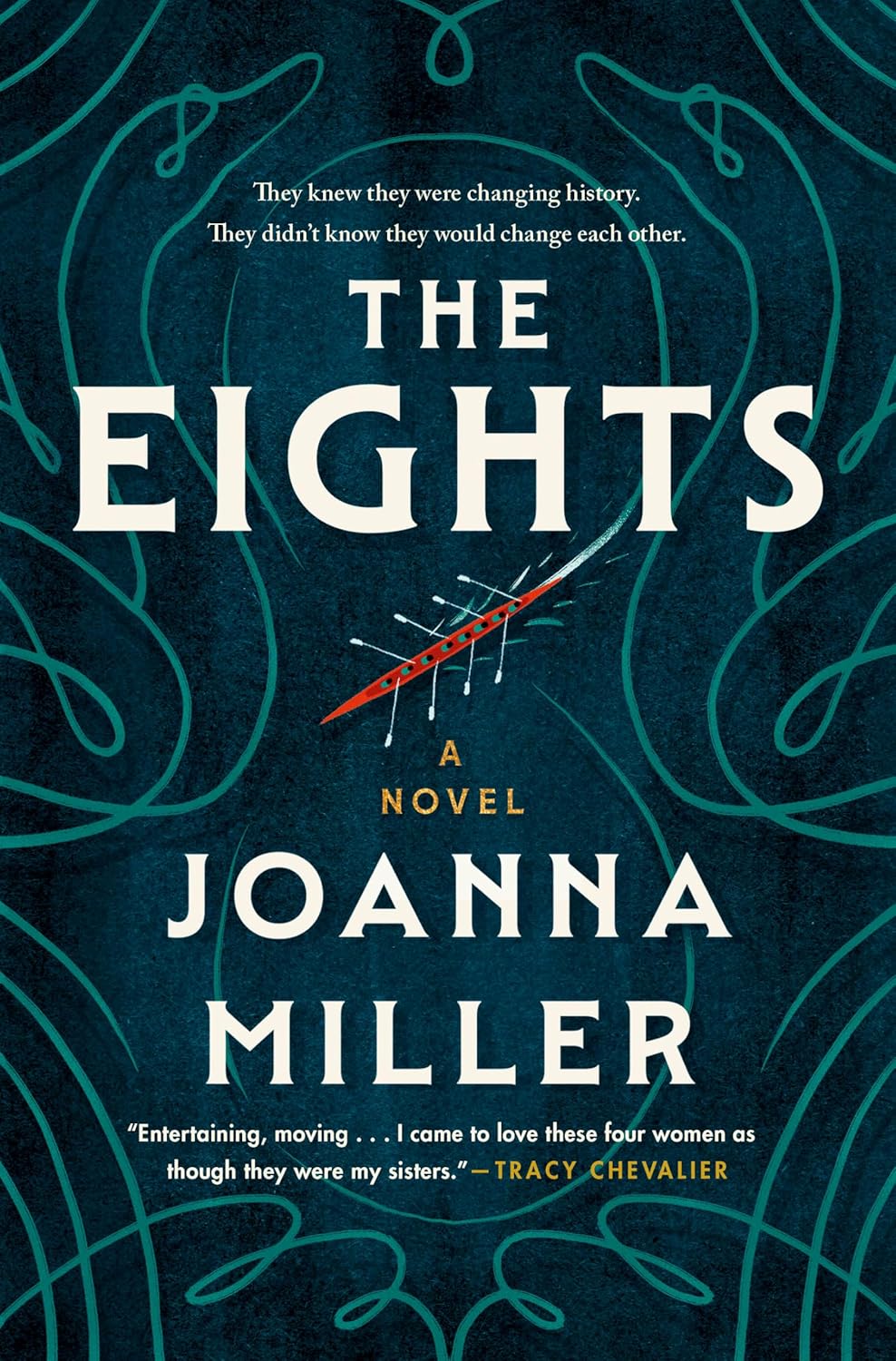
The Eights: A Novel
- By Joanna Miller
- G.P. Putnam’s Sons
- 384 pp.
- Reviewed by Kristin H. Macomber
- May 6, 2025
Four remarkable young women tackle Oxford in the early 1920s.
True story: Nearly 50 years ago, I was inexplicably accepted to a college that I’d applied to on an irrational whim. It was an institution whose students had been exclusively male for more than three centuries and which, over time, had begun allowing women and men to share classes and be housed together in coed dorms — the last bit just five years before I showed up.
To my “feminist child of the 1970s” mind, the fact that my acceptance letter was likely the result of a new and enlightened gender-blind admissions policy seemed like a continuation of the progress I’d grown up reading about all my life. The times, they were a-changing, and I was a lucky beneficiary.
What I hadn’t appreciated back then was how long it’d taken for women to get even the smallest amount of traction in their efforts to gain equal rights and opportunities. Nineteenth-century activist Lucretia Mott herself described the opposition women faced as an expected series of impediments, because “any great change…shakes the very foundation of privilege.” It took reading Joanna Miller’s new novel, The Eights, for me to fully comprehend how hard it was to be female in 1920 and to matriculate into Oxford University, an institution that had been strictly male for over 1,000 years.
The story of the so-named Eights (a group labeled by their residential corridor number, not their rowing prowess) begins by introducing four young women who are members of Oxford’s first class of fully accredited female undergraduates. We encounter the four as they’re preparing for their ceremonial matriculation, each in her own state of nervous knots.
First up is Beatrice Sparks, whose opening-day anxiety is fixated on her required costume, which includes an ill-fitting gown and a silly little cap. The daughter of a famous suffragette, Beatrice has grown up amongst history-makers but has lived her life as a bystander, not an active participant in the issues of the day. She’s hoping her years in college will make her mother proud — or, at least, will make her mother take notice of her.
Next, we meet Marianne Gray, who is wracking her brain to figure out how to extract herself from the commitment she’s made to attend Oxford. She has a long list of reasons for renouncing herself and returning home to continue in a life of servitude at her father’s parish — a job she inherited on the day she was born, after her mother died in childbirth. Like so many others, Marianne is sure she’s the admissions office’s biggest mistake.
Then comes Dora Greenwood, who cannot help but think of the men in her life who should by all rights be here in her place — beginning with her adored brother, George, who was killed in action in Germany, followed by her beau, Charles, whom she would’ve married by now if he hadn’t also vanished from her life when she received a second heartbreaking missive from the Western Front.
The last to join her Corridor Eight cohorts is Ottoline Wallace-Kerr, who goes by Otto, and who intends to use Oxford as an escape hatch from her family’s aristocratic rules, which prioritize a suitable marriage above all else. The fact that Otto’s parents are confident she’ll not last long at this little academic dalliance, despite her uncanny skill at mathematics, is the source of her fierce determination to prove them wrong.
The Eights share a curious bond: Not a single one of them has ever had a friend like any of the other three. And in all those ways that college housing assignments and instructions from proctors to stick together as they learn their way around develop, the four become fast friends and devoted caregivers, despite their differences. If this sounds like a Sisterhood of the Traveling Pants made-for-fiction premise, so be it, because the author’s use of this narrative device works wonderfully well. The Eights paints a detailed panorama of life on the British home front, both during and immediately after the War to End All Wars, as viewed through the eyes of remarkable young women whom, I promise, you’ll come to care deeply about.
The chronology of Oxford’s academic calendar supplies the novel with its framework, annotated along the way by official notices, letters, telegrams, schedules, rules, and reminders. The ephemera, in turn, serve as chapter headings, providing insights into the regulations and expectations that defined and constrained campus life for women. Bottom line: The rules were ridiculous, and the treatment female students got from their male professors and classmates ranged from condescending to intolerant. The mere fact that a public debate posing the question of whether women had a legitimate place at university was considered necessary confirms the perilous status of Oxford’s female students.
Miller’s writing is crisp and pleasantly informative, and her way with dialogue is terrific. Her care in accurately presenting her characters’ academic experiences is formidable, as well. But the element she imbues The Eights with most generously is a deep appreciation for the history and treasures of Oxford itself. I found myself googling images of the museums and libraries where her characters were meeting and studying to further visualize what the author was conjuring on the page. In a recent Instagram post on this subject, Miller wrote, “One thing I have learned writing The Eights is the setting is everything to measure an author — it sparks ideas, creates atmosphere, shapes the story, and informs characters.”
Indeed, these women are fully formed and completely believable. As the shyest of them finds herself thinking:
“It is no wonder that the noun friend is derived from an ancient root word meaning to love, that it is etymologically bound to the word free.”
These marvelous women give her the freedom and confidence to know that what she is doing is right and that she is no mistake. Amen for the Sisterhood of Corridor Eight.
Kristin H. Macomber lives in Cambridge, MA. She came for college and forgot to leave.