The English Masterpiece: A Novel
- By Katherine Reay
- Harper Muse
- 304 pp.
- Reviewed by Anne Eliot Feldman
- July 22, 2025
Who’s behind a fake Picasso on display at the Tate?
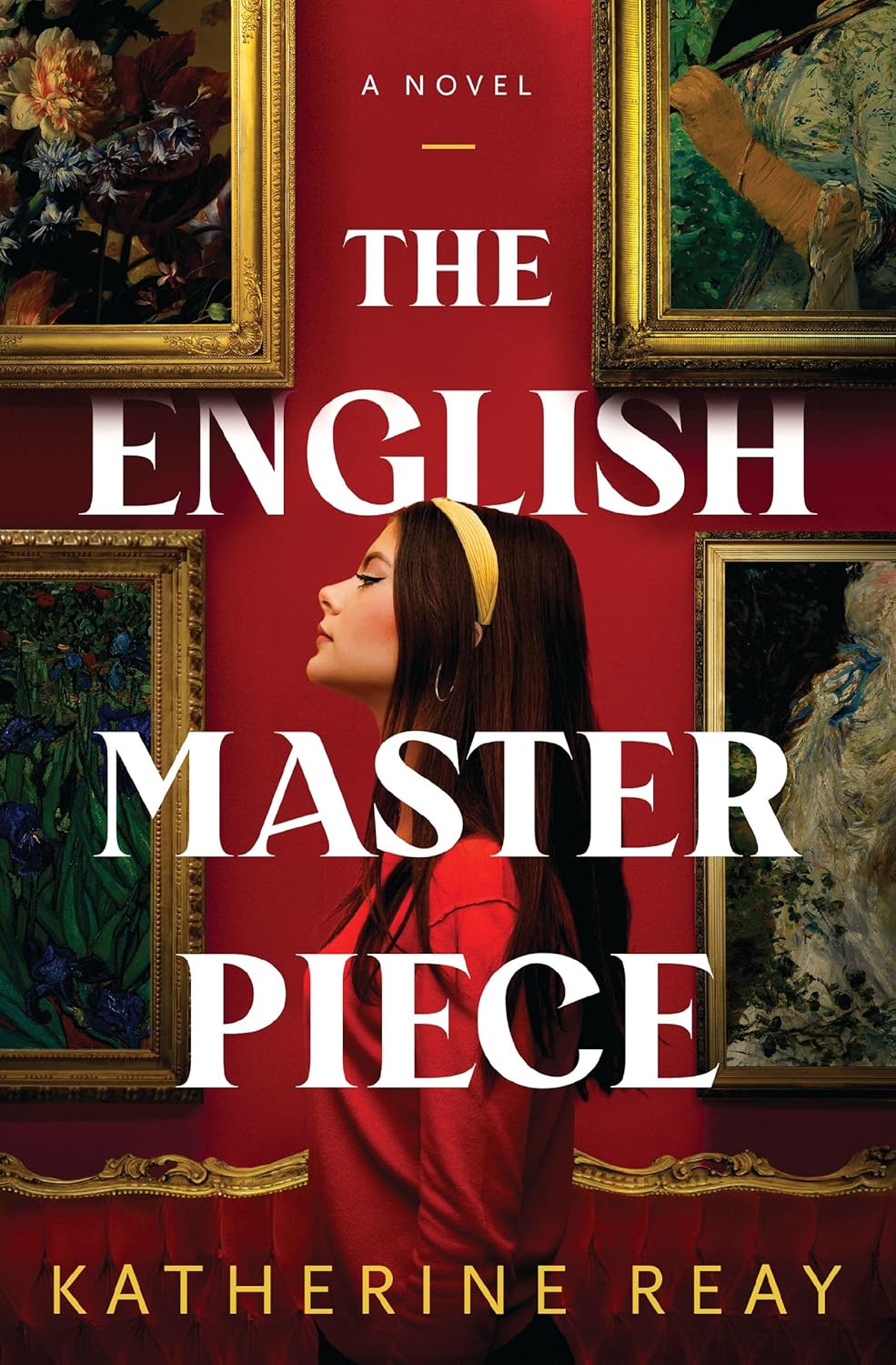
Award-winning author Katherine Reay prefaces her new historical novel, The English Masterpiece, with two provocative quotes that expose the heart of the story:
“Art is a lie that makes us realize the truth.” – Pablo Picasso
“Everything is expressed through relationships.” – Piet Mondrian
Picasso’s death in April 1973 prompts Diana Gilden, the keeper of Modern Collections at London’s Tate Gallery, to hastily pull together an exhibit of his best work. Helping her is Lily Summer, for whom two things matter: Being just like her polished boss and becoming an artist in her own right. Her recent promotion to assistant keeper of Modern Collections — “keeper” being the British term for curator — and her key role in helping Diana assemble Picasso’s favorites on a tight deadline make her optimistic about achieving both goals.
For the exhibit’s opening day, Lily has splurged on a fancy off-the-rack dress rather than wear one of the handmade ones her mother sews. A little champagne buzz fuels her optimism as she peruses the collection, where “some of the works feel like old friends. Others I am truly meeting for the first time.” Things could not be better…until they fall apart. Surrounded by press and museum higher-ups, Lily stops at a painting whose owner — along with the Tate’s director himself — had bullied Diana into including in the exhibit. Created in 1930, it is a perfect execution of Picasso’s surrealist period. But something feels off to Lily:
“I clamp my hand over my mouth, shocked at the obvious truth…as I center myself before Woman Laughing once more. I can’t pull my eyes from it. My mind reels. Then unable to think, hold back or move forward, I call out, ‘That’s a forgery.’ The world around me stops.”
If the accusation is true, who’s to blame? The piece’s owner? Diana? Lily? Or has someone else duped them all? Lily blames her hopeful nature — “the bright audacity of it” — for her impulsive outburst, and the fallout feels immense. Gone in an instant is the trust that fueled her relationship with Diana. Her chance of becoming an artist feels eviscerated, too. Writ large, Lily has put the Tate’s very reputation at risk. Her boss and the painting’s owner now look (at best) inept or (at worst) like frauds. Lily grows determined to find the truth.
When the insurance inspector — an art major who hails from a long line of cops — shows up to interrogate Lily, she defends her instinct about the forgery. “Every Picasso is a chase,” she tells him. “Within any piece he did not know where he’d end up. Whoever painted Woman Laughing did.” Despite the attraction they share, the inspector suspects Lily of perpetrating the deception. This isn’t crazy since many of her own paintings — done in a utility closet of the art school where she worked as a teen — are copies of the greats’ best works.
As the mystery unfolds, Reay uses dual POVs — Lily’s told in first-person and Diana’s in third — to explore multiple issues, including family conflicts and coming-of-age trials. Among other tribulations, Lily’s failed attempts to lean on her much-older sister and mother for support during the ordeal force her to address the generational trauma stemming from their having lived through the Blitz decades before her birth.
For her part, Diana endured her own upheaval during World War II, fleeing Germany as a child when her parents defied the Nazi regime. Her husband, Heinrich, 30 years her senior, offers her “that set-aside space, free from the pain of war, deprivation, and desperation,” but the forgery scandal threatens everything. As it explodes around her, Diana “ponders the inability of a person to take in all the information — the sights, scents, sounds, and textures — when one feels in jeopardy.”
Having these two points-of-view adds satisfying depth and pacing to the novel. The art notes, too, are rich, from discussions of the frenzied greatness that was Picasso to illuminating discourse regarding the painstaking nature of Morellian analysis, “looking for repetitive things an artist does unconsciously, things forgers might overlook.” And Reay’s detailed research skillfully invokes everyday mainstays from the early 1970s, including runs in nylon stockings, sticking typewriter keys, the widespread dependence on landline phones, and the A-to-Z street atlases necessary for navigating London’s nooks and crannies.
The English Masterpiece unfolds with nuance, depth, and a brewing romance tucked in as a bonus. Throughout her search for answers, Lily gracefully displays the vulnerability that comes from sharing your dreams and letting people in, exemplifying how — as her generous and unassuming mentor tells her — “freedom takes courage.”
With a B.A. from Colgate University, an M.A. from Georgetown University, both in Russian area studies, and a UCLA certificate in fiction writing, Anne Eliot Feldman has worked in the Library of Congress and the defense industry. She’s currently at work on a writing project of her own.