The Final Score
- By Don Winslow
- William Morrow
- 304 pp.
- Reviewed by Art Taylor
- February 4, 2026
The expert crime writer offers six riveting, not-quite-novella-length tales.
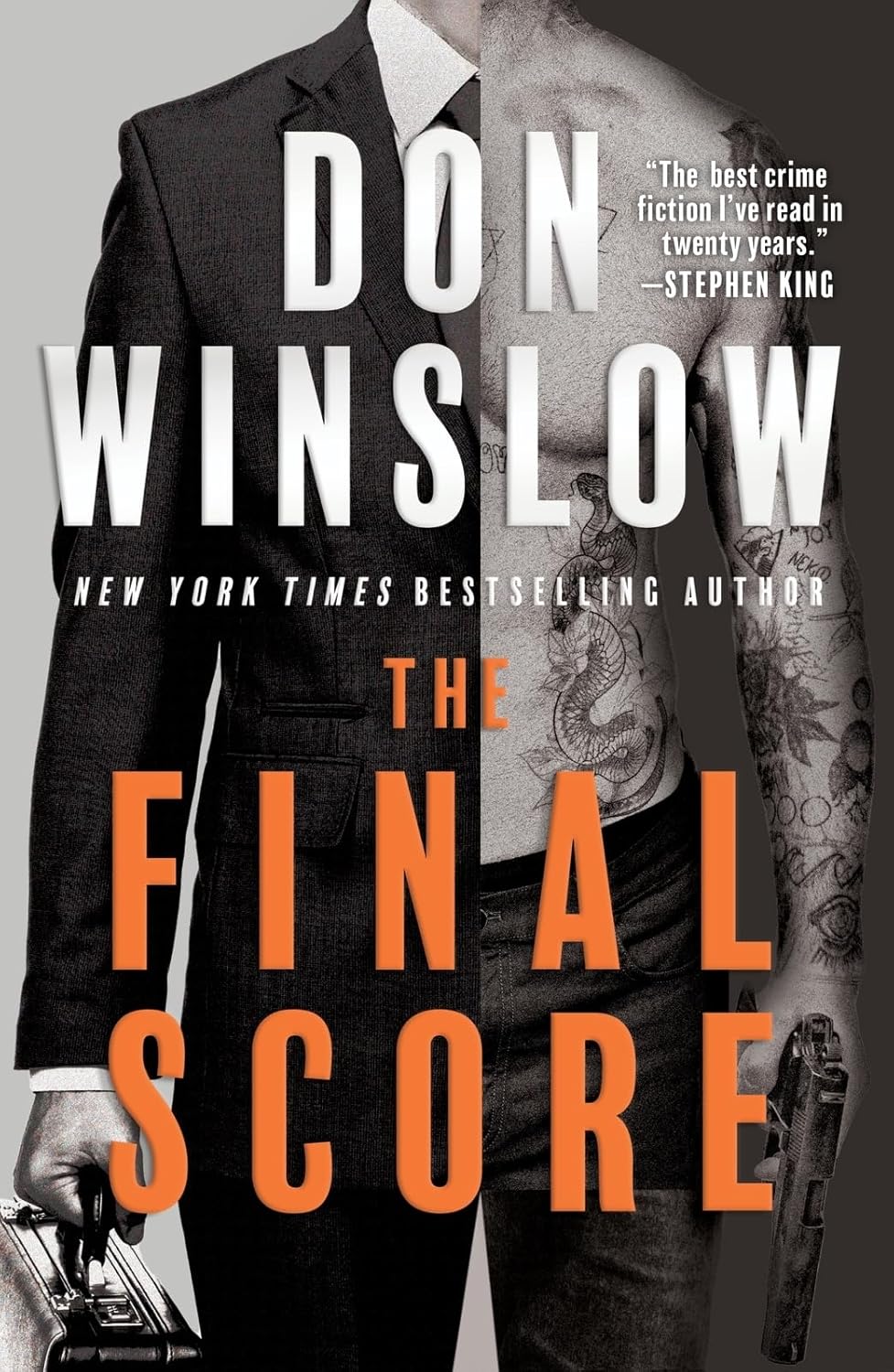
The title page of Don Winslow’s new collection, The Final Score, carries the phrase “Six Short Novels,” and I’ll admit I spent an inordinate amount of time puzzling over that last word, novels. I’ve got some vested interest in this, I’ll admit, as a short-story writer myself and an advocate of the form.
Winslow’s earlier collection Broken (2020) carried the same subtitle, and in an interview with CrimeReads, he explained that while writing his “big fat books…some other ideas came to me, ideas that weren’t epic. I didn’t think any would support a full novel, but they were more substantive than I might have wanted for short stories.” He said he was aiming toward novellas he’s admired, that “middle range.”
That description doesn’t seem to be a slight against short stories as unsubstantive, it’s worth stressing. As guest editor of last year’s Best American Mystery and Suspense, Winslow called the short story “among the most difficult of literary forms to write” and explained that it “isn’t just a truncated novel condensed into fewer words but a focused and therefore powerful concentration of all the requirements of the novel” — a concentration that “requires fewer, and therefore more deft, brush strokes than the broader canvas of a novel.”
(For full disclosure, another vested interest: Winslow selected one of my stories for BAMS, so I wanted to sample his own short(er) fiction to see how his aesthetic sensibilities might have led him my way.)
So what makes the six entries in The Final Score more like novels — more substantive than stories?
Word or page count doesn’t seem enough of a “broader canvas.” The shortest offering, “The Sunday List,” is 36 pages, and even the longest, “Collision,” at 91, doesn’t seem novel-length along the lines of an actual short novel like The Great Gatsby (a little over 47,000 words, 180 pages in the Scribner edition).
And it’s not the broader canvas of time or an intricate range of conflict, either, often the distinctions of a novella. The title story covers the arc of a single heist job — one final score, against a casino laundering cartel money — by a robber out on bond and expecting to be put away for life. Another story, “The Lunch Break,” follows a few days in a lifeguard’s stint babysitting a spoiled Hollywood actress. And a third, “True Story,” takes place over the course of a single meal (though, in this case, breakfast rather than lunch).
In many ways, “True Story” — matching a tight scene time with a sprawling narrative — stands as the collection’s tour de force. Told entirely in dialogue, it ranges through anecdote after anecdote about small-time criminals and bigger ones, too, with a running joke about names as the stories interweave: “Lenny the Barber or Lenny No Socks?” “Bobby Bats or Bobby Five Fishes?” “Louie Cacciatore or Louie Doughnuts?” Sharp little tales roll out one after the other, building the momentum of the larger plotline — about Lenny No Socks — toward a twisty finish.
Twists are a key aspect of Winslow’s work generally. The heist in “The Final Score” ends with a satisfying shift in plans. “The Sunday List” — a class-driven tale about a teenager delivering liquor on Sundays to earn college-tuition money — holds a couple of unexpected turns, one of them through a coda 50 years after the main action. And “The Lunch Break” follows that lifeguard and insufferable actress toward twin layers of surprise — one plot-driven, about a shadowy stalker, and the other character-driven, featuring redemption and reward.
It’s no spoiler to say that some stories end happily, but to the collection’s credit, there’s a wide range of tones and outcomes. “The North Wing” and “Collision” earn special mention, since both center around prison life and deal with heavy moral choices for each protagonist.
In “The North Wing,” a cop struggles with the fallout of his cousin killing a young woman in a drunk-driving incident and weighs what to do to keep the boy from the horrors of the penitentiary. “Don’t go down with your cousin, Doug thought, by pissing people off or by looking like you’re trying to evade justice. You’re a police officer, and you have to do things by the book.” Choices have consequences for every character.
“Collision” follows high-powered hotel exec Brad McAllister from a life of luxury with a picture-perfect family through a chance encounter that sends his life spiraling — including a long stint in prison, where he has to not only defend himself but also learn to strike first, strike smart. How far will he go to protect himself, his family, his future? “I’ll do what I have to do.”
“Collision” is a sprawling rollercoaster of triumphs and tragedies — an epic, really. But would it have been a great novel if those scenes had been fleshed out further, the page count doubled or tripled, the whole story untruncated? The question seems moot. It’s a killer short story — call it a novella even, that middle ground — complete unto itself and proof, like all the stories in The Final Score, that deft brushstrokes can make for powerful fiction.
Art Taylor is the author, most recently, of The Adventure of the Castle Thief and Other Expeditions and Indiscretions. In 2025, the Short Mystery Fiction Society awarded him the Edward D. Hoch Memorial Golden Derringer for Lifetime Achievement. He’s a professor of English and creative writing at George Mason University.
.png)