The Final Solution to the Jewish Question: A Love Story for the Living
- By Dara Horn
- Avid Reader Press
- 384 pp.
- Reviewed by Eugene L. Meyer
- September 3, 2026
Can antisemitism truly be vanquished? The author thinks so.
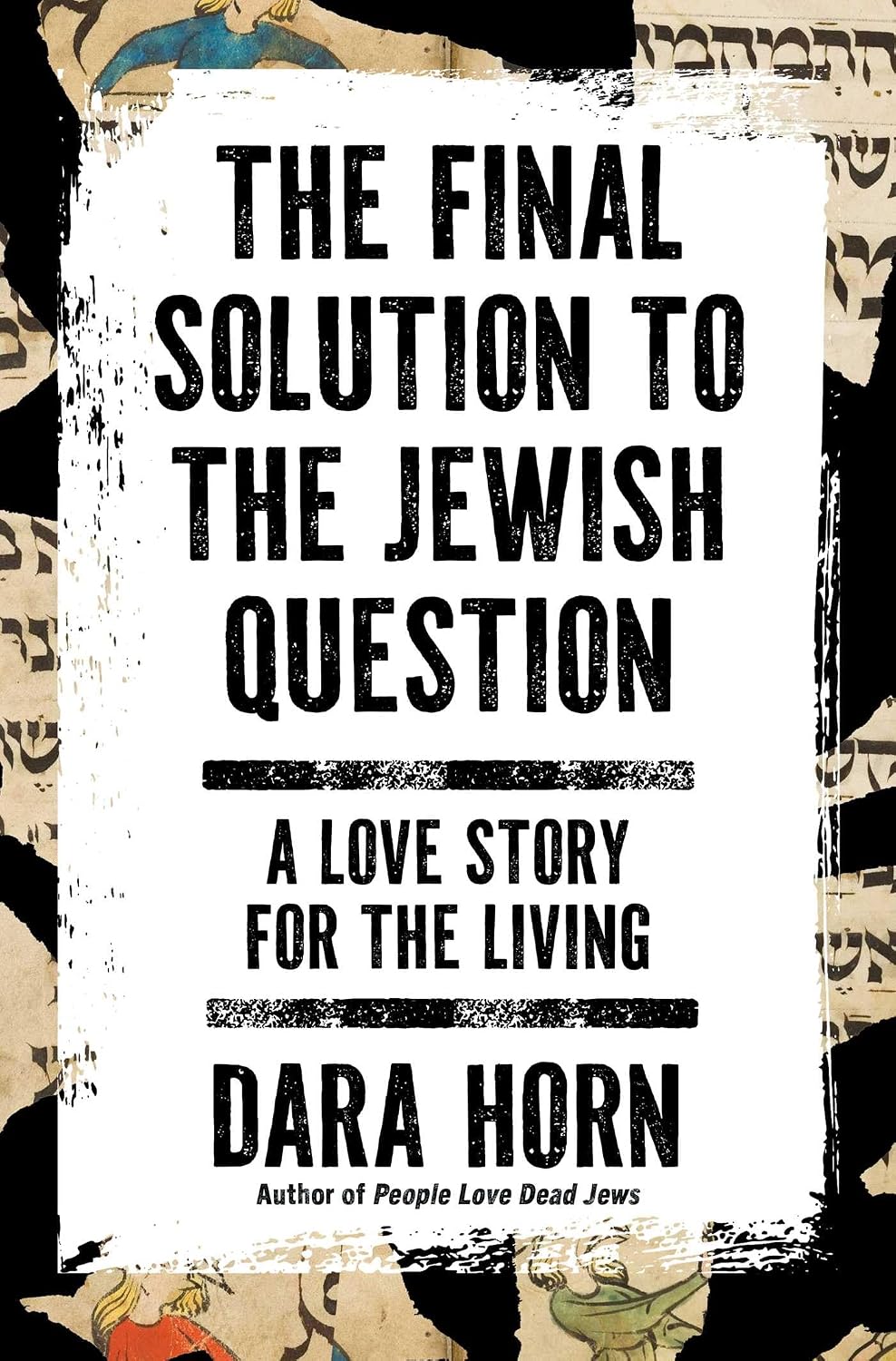
Dara Horn’s sequel to her last book, People Love Dead Jews, promises to provide, as its sardonic title suggests, The Final Solution to the Jewish Question. But before offering it, she must first walk us through thousands of years of antisemitism, from ancient civilizations up to and including today. It’s a painful trip through the historical swampland of Jew hatred, a seemingly never-ending catalog of lies and scapegoating that led to the deaths of 6 million Jews in the Nazi Holocaust and remains a poison that persists.
Following this tortuous path can easily lead to depression and despair, emotions she shares in abundance from both the historical record and her own journey through this hate-filled swamp. Efforts to combat this plague with so-called “Holocaust studies,” earnestly embraced by institutions and individuals, she writes, are at best useless and at worst counterproductive.
Horn, an essayist and novelist, has written an important book, even as its subject seems almost overwhelming and the solution maddeningly elusive. Here, the theme of her last book — society’s acceptance and even veneration of “dead Jews” as victims — is portrayed as little more than misplaced virtue-signaling and is both a starting and ending point for what her subtitle calls “A Love Story for the Living.”
But before we can see her light at the end of the tunnel, we must peer into the darkness — and deal with millennia-spanning layers of Jew hatred that grow with each new technological innovation. Thus, she recounts how the printing press published the infamous “blood libel,” based on a boy’s disappearance and death in 1415 in Trent, Italy. Jews were wrongfully accused of killing the child in a ritual sacrifice. Despite all evidence to the contrary, the allegation lived on.
The charge was not only repeated but formally adopted by the Catholic Church, which canonized the child and did not renounce the libel until 1965. The internet, with its social-media offshoots (including TikTok), has served to expand the dissemination of such canards masquerading as fact.
These new outlets have also helped spread the spurious charge that Jews in Israel are “colonizers,” European interlopers with no ancestral roots in the Holy Land. In response, Horn describes the racial, religious, and ethnic diversity of Israeli Jews and places Zionism in the context of the many nationalist movements to emerge in the late 19th and early 20th centuries.
In America, there has long existed a sort of genteel, country-club antisemitism reflected in the exclusion of Jews from elite schools, jobs, clubs, and hotels, such as depicted in the 1947 film “Gentleman’s Agreement.” But violent acts of antisemitism, at least, seemed in remission.
Then, in the 2000s, came an epidemic of antisemitic graffiti scrawled on public schools, synagogues, and elsewhere. Words escalated into violence with the massacre of 11 worshipers at Pittsburgh’s Tree of Life synagogue in October 2018. The shooter was an unapologetic, right-wing antisemite.
Later, attacks on Jews came from the left with calls to “free Palestine” and “globalize the intifada.” These battle cries grew louder following the Oct. 7, 2023, Hamas slaughter of 1,200 Israeli Jews and the taking of 251 hostages. Jews in Israel were accused of being colonizers despite their documented historical roots in the region.
The Netanyahu government’s military response in Gaza and the West Bank has also inspired violence against American Jews. Horn makes no excuses for Israeli excesses or expansionist aims, but she decries the demonization of all Israelis that crosses from the political to the personal and also paints the planet’s 15 million Jews with the same broad brush.
Today, country-club antisemitism has receded. Instead, there is an avalanche of incidents not just protesting the Israeli government but targeting all Jews, regardless of their nuanced opinions on the conflict in Gaza. This has led to heightened security at Jewish institutions and synagogues, paid for by worshipers. Even Horn needed an armed guard when speaking at Harvard, her alma mater, after she served on its antisemitism advisory committee, whose suggestions, she writes, were rejected or ignored. Without mentioning the president by name, she duly notes the hypocrisy of the Trump administration enabling antisemitism via its various associations while defunding universities for doing too little to combat it.
Calling herself “the Antisemitism Lorax,” Horn does not minimize campus attacks on Jews, nor does she shy away from referring to the Hamas attack as a “massacre.” But neither does she regard as simple rhetoric the call to “globalize the intifada.” This slogan is repeatedly invoked in attacks on Jews who wear identifiable religious symbols, like Star of David jewelry or a skullcap, exercise their right to demonstrate for the release of Israeli hostages, or, as happened in May 2025 at the Capital Jewish Museum in Washington, DC, when a young couple was gunned down, merely assert their right to exist.
In this ongoing wave of antisemitism, Horn attempts to reframe the discussion and find a positive path — though it takes most of the book to get there. Rather than wallow in the weeds of victimhood, she at last suggests literally a course correction to counter the disease of Jew hate: Instead of emphasizing victimhood, highlight Jews’ resilience.
To help turn the tide, Horn founded a nonprofit she calls the Tell Institute, adopting the Hebrew word for layers of history. The institute focuses on the lesser-known aspects of Judaism to educate others exposed mostly to stereotypes and conspiracy theories. She wants it known that Judaism is foundational to all the world’s great religions and that its humanitarian values are universal.
Charitably, when it comes to contemporary antisemitism, Horn sees more ignorance than malice at work. The opposite of hate, she says, is empathy and curiosity — the willingness to be “open to every person with the courage to ask questions.” Her goal is to spread the gospel of truth to those who’ve accepted the lies and tropes embedded in too many American minds.
Her plan is to share the rich culture, values, and traditions that characterize Judaism — not just how Jews have suffered. In a sense, this is counter-cultural because it contrasts sharply with the downbeat Holocaust studies that emerged from the ashes of World War II.
Yet, even as the author publishes her “love story for the living,” antisemitic incidents continue, with no distinction made for the wide spectrum of views held by American Jews toward Israel and, indeed, toward that country’s foundational creed of Zionism.
As this review is written, Brad Lander, a Democratic congressional candidate in New York who is running as a critic of Israel and the pro-Israel lobby AIPAC, was heckled outside Madison Square Garden for being a “Zionist.” Lander was there to protest an event organized by the Hindu-nationalist RSS, an anti-Muslim movement. “We don’t want no Zionists here,” protestors shouted at him.
Can such stereotypes, such blanket hate, be erased? Or at least neutralized among a passive public that is fed and believes the lies? Ever the optimist, Horn refuses to cede ground to antisemites. She finds solace and inspiration in her book’s concluding scene. Her young son, reciting his Torah portion at his bar mitzvah, “stands before the open scroll, unbowed. He keeps reading.” She continues:
“The people who refuse to bow to tyrants are the final solution. They always will be.”
But, for all that, there’s still a sense of desperation that Horn resists but cannot entirely overcome in her love story for the living.
Eugene L. Meyer, a member of the board of the Independent, is a journalist and author of, among other books, Five for Freedom: The African American Soldiers in John Brown’s Army. Meyer was for 16 years the editor of B’nai B’rith Magazine and has been featured in the Biographers International Organization’s podcast series.
.png)