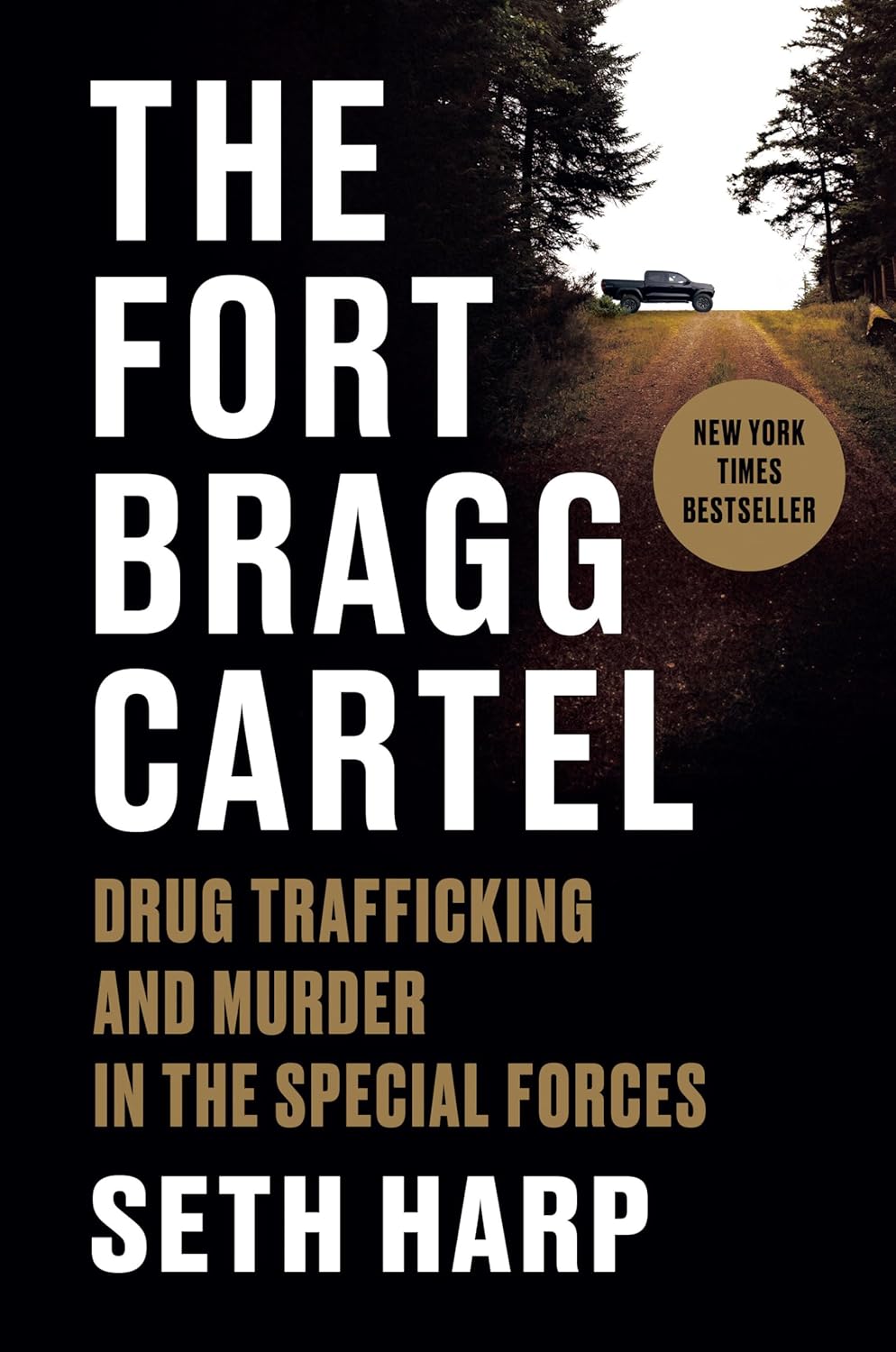
The Fort Bragg Cartel: Drug Trafficking and Murder in the Special Forces
- By Seth Harp
- Viking
- 368 pp.
- Reviewed by William Schwartz
- September 5, 2025
What’s behind the shocking criminality at a U.S. Army base?
During a 2023 initiative to remove Confederate names from federal entities, North Carolina’s Fort Bragg was rechristened Fort Liberty. Earlier this year, President Trump reversed the action, decreeing the base’s name was again Fort Bragg (yet insisting it was no longer in honor of its original namesake, Confederate Gen. Braxton Bragg, but rather PFC Roland L. Bragg, a World War II hero). What little national coverage of the incident there was tended to focus on the original action’s “woke” angle, but this wasn’t the reason behind the rebrand.
Rather, as Seth Harp lays out somewhat sordidly in The Fort Bragg Cartel, the renaming was a desperate attempt to call attention away from the fact that the storied U.S. Army base is home to a disturbingly large number of murders, overdoses, drug deals, and officials who bend over backward to give the benefit of the doubt — if not actual clandestine cooperation — to the Special Forces soldiers involved in the crimes.
To this day, a quick Google search of Fort Bragg yields numerous crimes reported by local news outlets. The one I recently did brought up two completely different sex-crime incidents, one of them involving 30 children. Sadly, none of this is new to the author, himself a Gulf War vet. The Fort Bragg Cartel largely collates years of Harp’s reporting for Rolling Stone.
As in that reporting, the book never quite gets all the way to a smoking gun. Instead, what Harp does is recount some of the many extremely implausible but true occurrences — including the day a soldier on a bad trip shot his best friend multiple times in what he claimed was self-defense — that were accepted at face value by corrupt authorities who ignored the much wider network of criminal activity and drug trafficking clearly at play.
Looming over everything is the war in Afghanistan, which fueled the creation of some of the elite fighting units now housed at Fort Bragg. Beyond just a response to the shock of Sept. 11th, the war was rationalized as necessary in order to defeat that country’s draconian fundamentalist rulers, the Taliban. But how did the Taliban end up in control if it was so awful? According to Harp, it aggressively opposed opium cultivation — rampant in the poppy-rich nation — which was its main claim to ideological legitimacy. In this, the Taliban has remained consistent; since America’s formal withdrawal from Afghanistan a few years back, the Afghan opium trade has been nearly eliminated.
That’s not the official story, though. The United States government has long asserted that the Taliban actually funded itself via opium. This explanation was necessary not only to justify America’s continuing operations in Afghanistan, but also to explain why opium distribution began surging worldwide in the aughts. These events, officials claim, directly led to the opioid epidemic in America, a scourge for which we have many theoretical explanations and few concrete ones. Where, if not the Taliban, was the raw material for all these drugs coming from?
From us, it appears.
While Harp can’t prove that members of U.S. Special Forces took advantage of their privileged status to import drugs and build a domestic cartel using the same thuggery employed during a typical day’s work in the endless War on Terror, well, think Occam’s razor. If there’s a more obvious explanation for what’s long been going on at Fort Bragg/Liberty/Bragg, nobody has come forward to offer it.
At best, you could argue that maybe the soldiers accused of the astonishingly violent incidents at the base are all mentally unbalanced (every single one of them), and that there’s no unifying theme behind their needlessly hostile behavior, drug abuse, and paranoia. Of course, that then begs the question: If these soldiers (presumably) weren’t unstable at the outset, what was it about their training that changed them? Is it possible that once they realized the abstract idea of “commando heroism” is utterly inconsistent with the realities of everyday life, they sought their thrills elsewhere — maybe with bullets or needles? Or both?
William Schwartz is a freelance writer living in Southern Illinois. He has reviewed wide varieties of media, including South Korean dramas, upscale graphic novels, vintage videogame media, and much more.