The Fortune Tellers of Rue Daru: A Novel
- By Olesya Salnikova Gilmore
- Berkley
- 416 pp.
- Reviewed by Nicole Yurcaba
- April 6, 2026
Mystical Russian expats untangle dark family secrets in 1920s Paris.
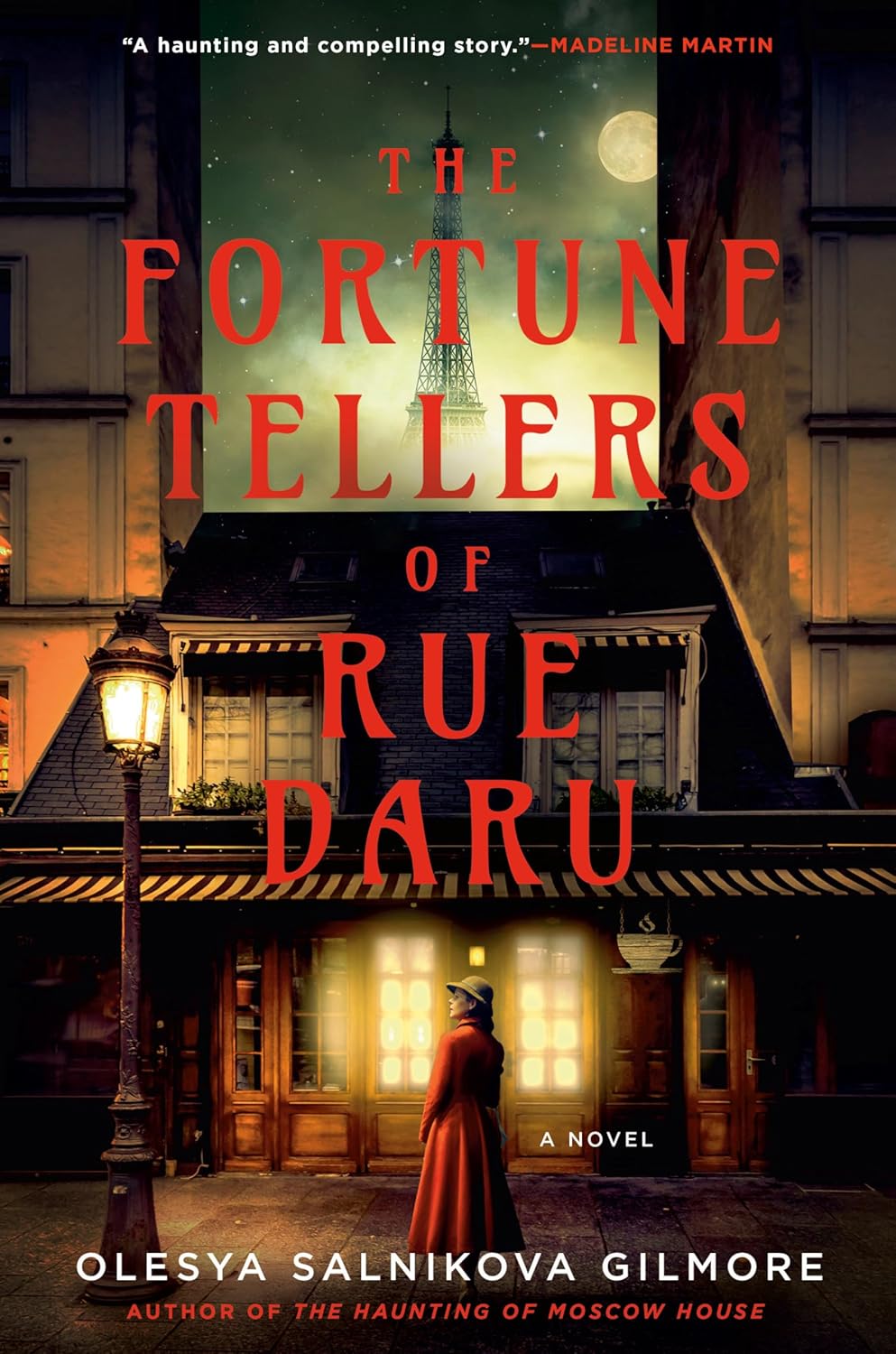
Set in 1920s Paris, Olesya Salnikova Gilmore’s The Fortune Tellers of Rue Daru follows Zina, the granddaughter of the mysterious and elusive Russian émigré fortune teller Valya. Zina lives in the shadow of her mystical grandmother, whose legacy and reputation precede her. Having grown up without her mother, Svetlana — whose brutal death left the girl in Valya’s care — Zina has tried desperately to learn the truth about her mother’s murder.
One day, quite unexpectedly, a woman named Olga and her brother, Alec, appear at Samovar, the tearoom operated by Zina and her grandmother. The strange visits propels Zina and Valya headlong into the dark realm that exists between the living and the dead, in which Zina’s affinity for communicating with spirits proves to be both a blessing and a curse. As Zina discovers the harrowing truth about Svetlana’s killing, a series of family secrets unravels, but the revelations they offer Zina finally give her a deeper sense (and appreciation) of the talents that make her unique.
Zina’s own life story begins with two main questions: Who killed her mother, and who is her father? She’s spent years trying to extract the answers from Valya, but the older woman has remained tight-lipped. Valya has also insisted on keeping her granddaughter from leaving home even though the now-grown Zina is fully capable of setting out on her own and establishing her own business.
Neither will Valya reveal what happened to the family in their native Russia. When Olga and Alec emerge, and when a dangerous spirit — that of the Grand Duke, an associate of the assassinated Romanovs — begins ravaging Zina’s and Valya’s lives, Valya must confront her past and her daughter’s murder. This time, however, her usual reliance on a blend of old-world remedies, spiritualism, the occult, and her faith may not be enough to keep the evil forces at bay.
In turn, Zina faces difficult choices, including about how best to use her gifts — which others don’t understand — and about how far she’ll go to find answers about her mother and, ultimately, herself. Thus, one of the novel’s many philosophical conceits is its discussion of the secrets families keep and the generational trauma that can result. Zina is a powerful representation of someone who — by acknowledging the past grief and violence in her family — wants to break the cycle.
Another of the narrative’s themes is female agency. Early 20th-century Paris, with its blend of liberal social freedoms and conservative politics, offers Zina and Valya space to thrive as independent businesswomen. It’s a far cry from the hardscrabble, violence-ridden life Valya left behind in Russia. Hers is truly a rags-to-riches story, and she is the embodiment of female agency.
Author Gilmore’s lack of prominent male characters is noticeable; when men do appear, they’re secondary and, at times, underdeveloped. The book’s focus on the Russian diaspora in early 1900s France — which reached a population of approximately 40,000 — is another interesting choice. At that point in history, Paris was an epicenter of stateless Russian nobles, intellectuals, doctors, and artists. Gilmore illustrates how some of these elites took menial jobs to earn a living in their adopted home, while others — like the Grand Duke’s family — attempted to reconstruct their economic power and social status by any means necessary, including murder.
As far as mysteries go, The Fortune Tellers of Rue Daru is a masterful one that avoids many of the genre’s tropes. And its strong feminist bent, which speaks loudly to its contemporary audience, elevates it beyond the realm of a stereotypical supernatural thriller. Both Zina and Valya are heroines, and readers will root for them as they use their resilience, strength, and determination to survive dark forces that most people cannot — or refuse to — see.
Nicole Yurcaba (Нікола Юрцаба) is a Ukrainian American of Hutsul/Lemko origin. Her poems and reviews have appeared in Appalachian Heritage, Atlanta Review, Seneca Review, New Eastern Europe, Euromaidan Press, Chytomo, and the New Voice of Ukraine. Her poetry collection, The Pale Goth, is available from Alien Buddha Press.