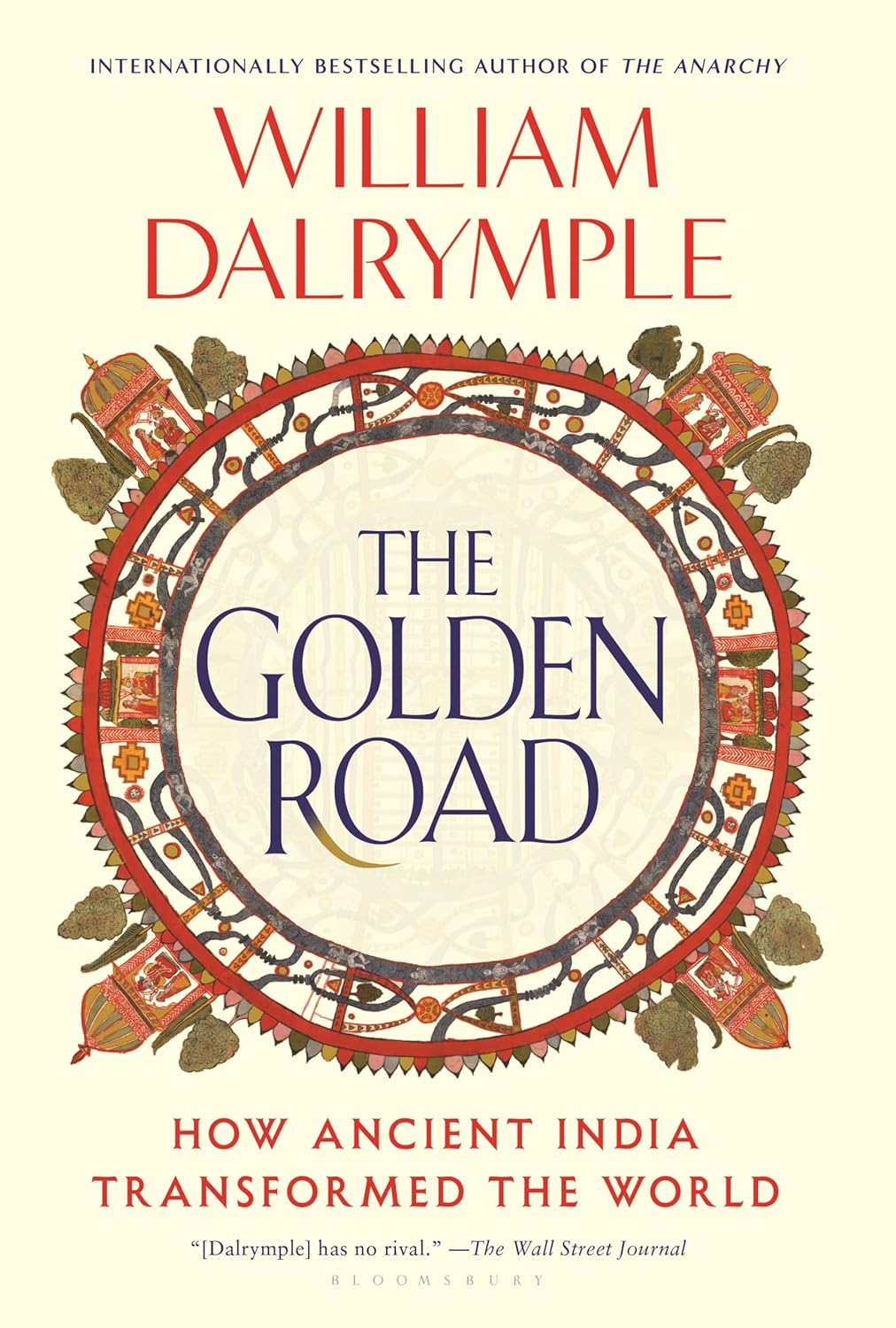
The Golden Road: How Ancient India Transformed the World
- By William Dalrymple
- Bloomsbury Publishing
- 432 pp.
- Reviewed by Elizabeth J. Moore
- June 20, 2025
A sweeping new assessment of the Subcontinent’s star player.
For many centuries, India seemed to be mostly on the receiving end of outside influences. Dominated first by Persian-speakers in medieval times, and then by the British from the 18th century to the end of World War II, India in popular perception has only in recent history become a global political, cultural, and economic leader.
Actually, history is repeating itself. In his latest book, The Golden Road, India scholar William Dalrymple asserts that the country was the most consequential power of the ancient world, with “Indian learning, Indian religious insights, and Indian ideas…among the crucial foundations of our world.”
The period 250 BCE to 1000 CE saw the peaceful spread of Indian art, architecture, mathematics, science, language, and belief systems across a region spanning the Red Sea to Indonesia. The “Indosphere,” as Dalrymple terms it, was integral not only to the development of ancient Asia, but would have echoes centuries later in Europe.
India’s early clout can be chalked up in part to geographic accident. “Thanks to the winds of the Asian monsoon,” explains the author, “India lies at the center of a great network of navigable sea roads and maritime trade routes.” These were far superior to slow, hazardous overland caravans, and India parlayed its early shipbuilding and sailing acumen to become an indispensable trading partner with the Roman Empire, and later — after the fall of Rome — with the rest of Asia.
Trade was not just economics. It was instrumental in carrying Indian intellectual and cultural innovation — including the tenets of two major religions, Buddhism and Hinduism, that originated in India — beyond its own territory. Scholars from across the ancient world flocked to such Indian bastions of study as the Buddhist monastery at Nalanda, while Buddhist and Hindu missionaries and traders spread across Central Asia, China, and Southeast Asia.
They brought with them Indian ideas regarding not only religion but also art, architecture, and science. Sanskrit became the common means of communication across ancient Asia. Such was the power of Indian influence that outside admirers matched or exceeded the Indians themselves in their artistic and architectural endeavors — for example, in the construction of the unparalleled Hindu temple of Angkor Wat in what is now Cambodia.
But it did not last. India’s predominance ended with an influx of Persianized Turks fleeing the Mongol invasion of Central Asia in the 13th century. Writes Dalrymple:
“Ill-spoken and destructive foreigners with no sense of beauty or decorum had arrived in the Indic heartlands, overthrowing not just the political but also the civilizational order.”
The great centers of learning fell, Persian (and, centuries later, English) superseded Sanskrit as the lingua franca, and India’s cultural influence on the outside world diminished.
The Indosphere is still with us in many ways, however. In Dalrymple’s reckoning, “Over half of the world’s population today lives in areas where Indian ideas of religion and culture are, or once were, dominant.” But that’s not the extent of it.
It is thanks to Indian mathematicians that we have the decimal system and ten-digit, zero-to-nine counting that revolutionized higher mathematics, banking, and accounting worldwide. Indian astronomers calculated Earth’s spherical shape many centuries before Columbus ostensibly proved that the world is round. Chess — both the board game and the symbol for strategy — is of Indian derivation. And Buddhism remains a major religion across Asia.
All this raises the question of why ancient Indian history has been so roundly forgotten. A lack of evidence is not the problem; Dalrymple uses as support of his thesis an abundance of tangible remains — Buddhist and Hindu temples, place names, murals, and sculptures, various texts, buried coins, and more — from the Red Sea to Indonesia.
One explanation is mythologizing by China, which “has become very good at telling the story that it was always the center of the Asian world.” In particular, it has parlayed the legend of the “Silk Road” into a gospel-like depiction of itself as the preeminent player in East-West trade throughout history. Another factor is British colonizers, who devalued and misrepresented Indian history, culture, and science to justify their “civilizing mission” to the Subcontinent.
Dalrymple makes his case through both exemplary scholarship and compelling storytelling. The reader will feel transported through time and space when he describes, for example, the 1819 discovery by British officers of the Ajanta caves (the stunning earliest surviving graphic depiction of the Buddha’s world), or when he recounts the blood-soaked tale of the only female Chinese emperor (a force for the spread of Buddhism in China) in history.
If the book has a downside, it is the overwhelming detail — the myriad place names, strains of Buddhism and depictions of Buddha, structural variations between Buddhist and Hindu temples, and the abundance of key figures — that can make the reader feel swamped.
Photographs and maps are of some help in keeping the details straight, although an all-too-brief “Golden Road Glossary” in the back of the book could’ve been expanded and placed more prominently. A list of “Golden Road Dramatis Personae” might also have been useful.
These are very minor criticisms, however, when ranged against the significance of Dalrymple’s accomplishment in not only weaving together a complex story that transcends regional and topical divides, but in making us understand why it mattered then and now. In so doing, he challenges us to look at ancient India — and the entire world — in a whole new light.
Elizabeth J. Moore is a freelance writer in the Washington, DC, area. She was a longtime senior analyst and instructor who worked in the Defense, State, and Treasury departments, on the Office of the Director of National Intelligence’s President’s Daily Brief staff, and at the National Security Council, the National Intelligence Council, and the Central Intelligence Agency. She holds a master’s degree in international politics from American University.