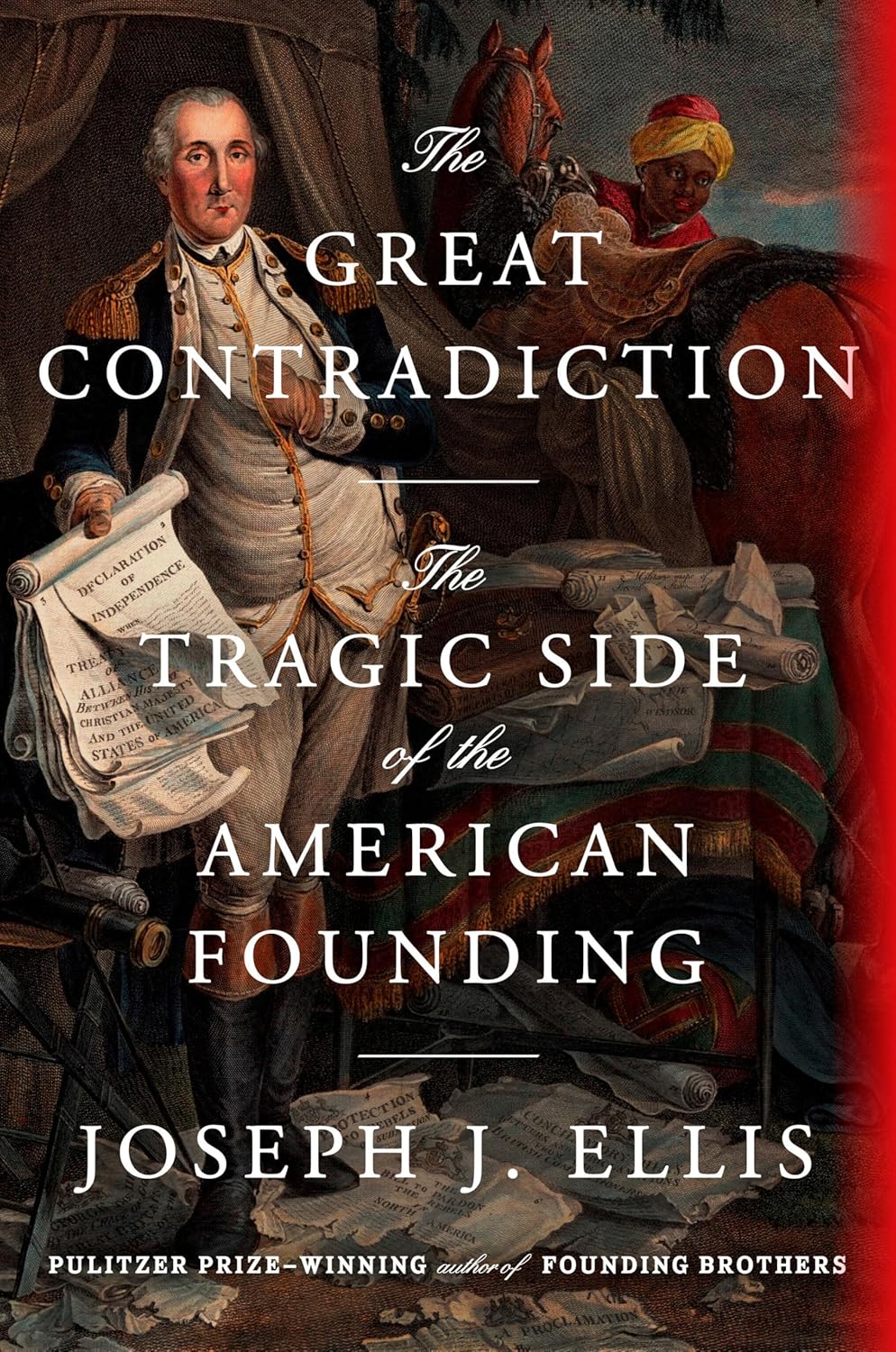
The Great Contradiction: The Tragic Side of the American Founding
- By Joseph J. Ellis
- Knopf
- 240 pp.
- Reviewed by David O. Stewart
- December 8, 2025
Liberty and justice were never for all.
Joseph J. Ellis may rightly be called the doyen of writers on America’s Founding Era. For several decades, he has published elegantly crafted, thoughtful accounts of that pivotal time in American history. His books have won the National Book Award and the Pulitzer Prize.
Ellis has eschewed the door-stopper tomes that overwhelm their subjects through intellectual levees en masse that marshal facts and salient quotations, along with social and economic context, in pulverizing ranks that march into (and often out of) readers’ minds. Instead, Ellis’ narratives present curated examinations of central figures, an era, or a phenomenon. He takes the measure of the people and larger forces in play, teases out narrative threads, and presents them in graceful, sometimes tart prose. He knows what to leave out.
His American Sphinx captured Thomas Jefferson’s protean qualities by focusing on five key moments in the career of the great American figure most likely to contradict himself. In Founding Brothers, Ellis presented a group portrait of the Founders that simultaneously rendered them familiar, human, and sometimes extraordinary.
The author’s new book focuses on two “tragic contradictions”: the Founding Fathers’ failure to adopt measures to eliminate slavery in the new nation or to grant security for America’s native tribes. He could hardly have avoided those topics in previous books but chooses to place them at the center of The Great Contradiction.
Given the course of public discussion in recent years, I wondered if the book would mark a concession to contemporary denunciations of Revolution Era leaders who piously proclaimed that “all men are created equal,” yet allowed the hideous mistreatment of the people of color who shared North America with them.
Au contraire, mon ami.
Ellis replies to that critique in the voice of an historian, emphasizing in his book’s subtitle the “tragic” aspect of these undoubted human failures. He portrays those capitulations to injustice as involving choices that were indeed tragic but also explicable and not necessarily detestable.
In his telling, the key moments in the survival of American slavery came at the Constitutional Convention in the summer of 1787, and then in the first session under the new U.S. Constitution. On both occasions, representatives of the Deep South fulminated that slave labor was indispensable to their way of life and promised to fracture the nation if antislavery measures were forced upon them. In Ellis’ view, although Northern states did gradually outlaw slavery within their own borders, national antislavery measures would have scuttled the young nation, leaving the majority of enslaved people still in bondage in Southern states.
The Founders’ choice to duck the issue and hope for better policies in wiser, cooler future days was by no means heroic, but Ellis questions whether it was too high a price to pay for preserving the first nation founded on principles of liberty and self-government. The price inflicted by that choice was terrible: the bondage of millions for three more generations, and the later Civil War that killed 700,000+ people, crippling and maiming many more.
But was that price not too high? And how much of that bloody future could people of the late 1780s foresee when they made their decisions?
The brutal treatment of native tribes, for Ellis, was determined during the first term of President George Washington. Prompted by his secretary of war, Henry Knox, Washington embraced a policy of preserving tribal enclaves throughout America’s western lands. Native communities, the administration hoped, would thrive in enclaves that would predictably shrink as tribes transitioned from hunting to agricultural pursuits.
Washington and Knox attempted to launch this policy through a treaty with the Creek Nation, which sprawled across parts of four current Southeastern states. That treaty, for Ellis, was a worthy effort that would have preserved extensive Creek lands but was undermined by the demographic realities of the times. White settlers desperately hungered for tribal lands and felt empowered to occupy them, while the infant government utterly lacked the financial resources, military might, or political capital to protect the Creeks.
The treaty swiftly became a dead letter. Instead of thriving tribal homelands, the future brought the forced removal of Eastern tribes across the Mississippi River, along with decades of conflict between them and white settlers. Nevertheless, Ellis credits Washington and Knox with admirable intentions.
He concludes the book with examinations of Washington and Jefferson, the great slave-owning Virginia leaders. Representing the largest American state with the largest slave population, both men recognized that slavery was a crime, but neither insisted on a national policy of emancipating the enslaved.
Ellis despairs that Washington never lost the attitude of a slaveowner, demanding that the people he held in bondage must perform their duties conscientiously, even enthusiastically, though those duties were imposed by force and violence. Yet he freed more than a hundred enslaved people in his will, which specified that they must remain in Virginia, thereby modeling the multiracial society that the United States would have to become, and has never perfectly realized.
Jefferson, in contrast, imagined and prescribed broad emancipation programs which never were adopted, but he always insisted that free people of African descent would have to be removed from the nation. For him, there was no place in America for freed Africans. Acknowledging the limits in both men’s thinking, Ellis prefers Washington’s national vision.
The Great Contradiction cogently performs an essential function of history writing — the careful examination of important actions, and failures to act, whose repercussions have reverberated for centuries. Ellis pushes readers to think beyond simple good-and-evil interpretations of history to consider the actual choices before the key actors and the consequences reasonably foreseeable for each action or inaction. The book deserves the widest possible audience.
As no review is complete without a cavil, however, I note the misfortune that Ellis describes as a “coup” the reinvention of the American government through the Constitution of 1787 and its ratification by all 13 states. Current events should make us sensitive to the meanings of “coup,” which is ordinarily defined as a sudden, often violent change in rule. Think Julius Caesar, Oliver Cromwell, and Napoleon. The adoption of the Constitution was neither sudden nor violent.
The creation of the new constitutional government consumed most of four years — from 1787 through 1790. The process began when the then-existing Congress endorsed the calling of a convention in Philadelphia to improve the federal government’s structure; 12 state legislatures then voted to send delegations. Over four months of debate and consideration, 55 delegates produced a new government charter.
After the proposed Constitution was released publicly, newspapers and pamphlets vigorously debated it. All 13 states convened ratifying conventions that were attended by more than 1,600 representatives chosen by direct vote of the people. Responding to criticisms of the text, the First Congress adopted 10 amendments, now called our Bill of Rights. The writing and adoption of the Constitution was no coup; the process that produced it was a lawyer’s wet dream of careful, deliberative action.
David O. Stewart is the author of four books on America’s Founding Era, most recently George Washington: The Political Rise of America’s Founding Father.
.png)