The Great When: A Long London Novel
- By Alan Moore
- Bloomsbury Publishing
- 336 pp.
- Reviewed by Chris Rutledge
- October 21, 2024
This inaugural offering in a new series conjures a sinister parallel England.
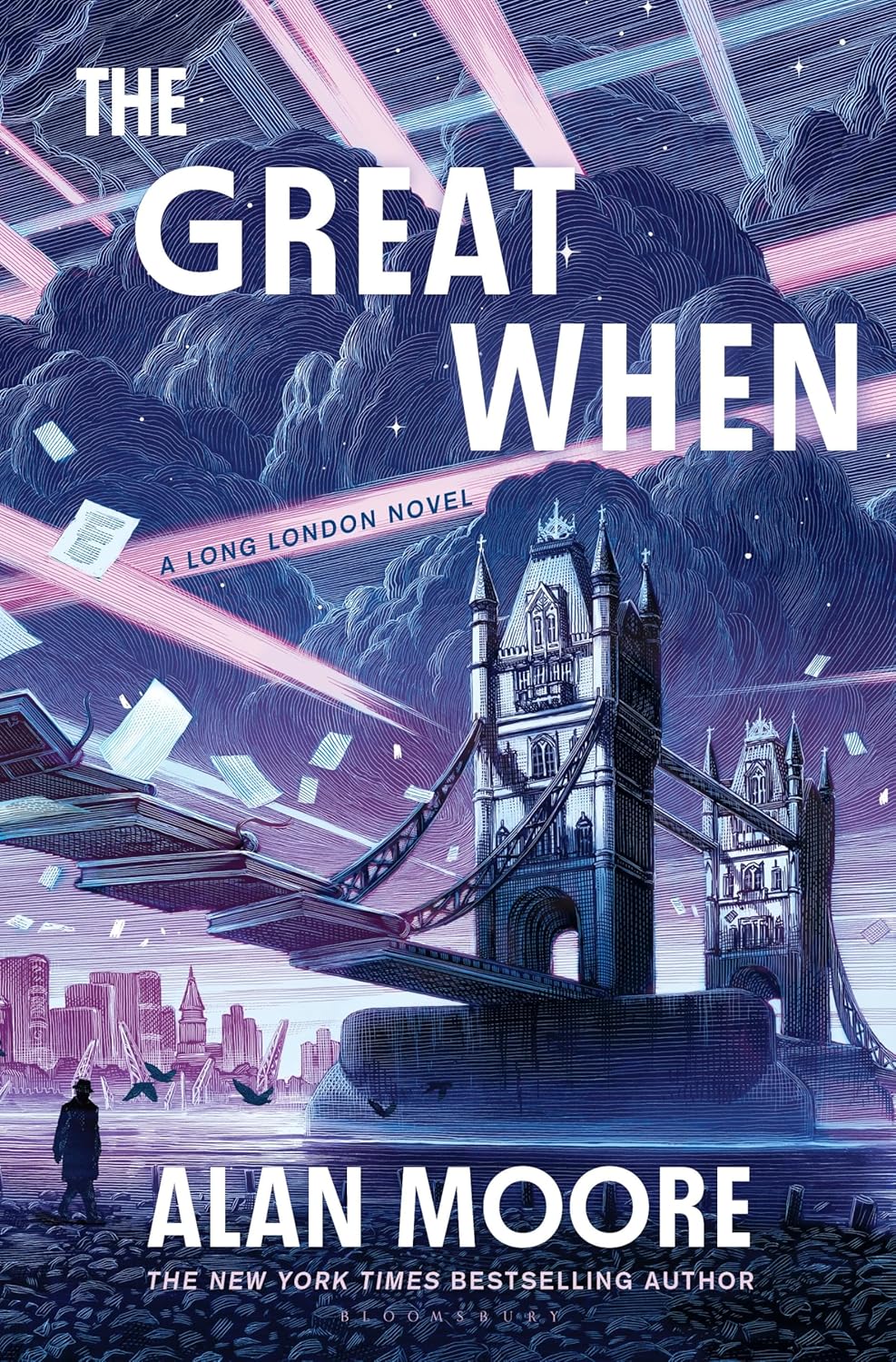
The Great When is the first installment in a new series by fantasy author Alan Moore, who’s best known for such groundbreaking graphic novels as Watchmen. In The Great When, we’re thrust into an alternate post-World War II London where the platonic ideals of our universe still exist, but they’re represented by monsters and other horrifying creatures who must occasionally cross into our realm to protect their own. This makes the novel very much a Moore book.
The MacGuffin here is a tome called A London Walk, allegedly penned by one Reverend Thomas Hampole. It seems straightforward enough, except for the fact that the book doesn’t exist. It’s a made-up work referenced in a volume of short stories by another author, Arthur Machen, a collection of whose writings our protagonist, 18-year-old Dennis Knuckleyard, is sent to purchase on behalf of his boss, a bookseller.
While this setup could lead to a garden-variety mystery, Moore has something much more sinister in mind. Other Hampole books have materialized in the real London before, you see, leading to terrible consequences. Dennis learns of one that was found by a man named Teddy Wilson, who, “when they found him…was inside out…everything…was contained in what was left of his own alimentary canal.” Dennis quickly realizes the inhabitants of the other London don’t want word getting out about their world.
This parallel realm, this “superior London,” is home to an “Arcana” of characters and traits we also experience here. As intrepid young Dennis describes it, “They’re, like, templates, essences or something, for the things in this place.” They certainly don’t look like us, though. Rather, Moore gives us such beings as murderous giantesses and crab-like ghouls who tear interlopers apart. Comprehending these beings pushes the limits of our imagination.
This other London functions as something of an underworld, one overseen by the literal preserved heads of such deceased notables as Oliver Cromwell. Our London, too, has an underworld. In it, local crime boss Jack Spot seeks to make contact with his fantastical counterpart on the other side, Harry Lud, described by Dennis as “the archetype of crime.” The real quest in The Great When is Dennis’ effort to unite the two wiseguys. If he fails, it could lead to him suffering somehow more dire consequences than those experienced by the disemboweled Teddy Wilson.
The long shadow of the Second World War pervades the narrative, weighing heavily on the residents of both Londons, including Dennis. “Both he and London shared the same predicament,” writes Moore, “the paralysis and life arrest of shell shock.” This lingering trauma drives people to act out of self-preservation, leading to the unsettling feeling that you can never really be sure who is a friend and who is an enemy. The reader would do well to watch carefully as Dennis interacts with those of his “friends” whose motives may be less than pure.
Unfortunately, two issues mar this otherwise interesting book. First, Moore frequently slips into purple prose that leaves the reader’s eyes rolling. Apparently designed to bedazzle, passages like this one, intended to sound poetic, devolve into doggerel:
“Weathered barriers, psoriatic with ripped posters, are a silent war memorial to fallen gigs…An inner scrabbling is commenced, casting around the flat in memory…”
The second issue — which could be explained away as being appropriate to 1949 England, but which nonetheless rankles in 2024 — is Moore’s language concerning race. A secondary character named Monolulu, for example, is depicted most generously as an “Abyssinian” and less so as a “darkie.” This is a fantasy world, yes, but real-world readers may have trouble suspending their modern sensibilities enough to let it pass unnoticed.
Still, if you’re a fan of elaborate worldbuilding and ambitious, multi-volume tales, The Great When offers a solid introduction to what promises to be a sweeping new series. More fair-weather devotees of the genre, however, might find themselves a bit less intrigued.
Chris Rutledge is a husband, father, writer, nonprofit professional, and community member living in Silver Spring, MD. Besides the Independent, his work has appeared in Kirkus Reviews, American Book Review, and countless intemperate Facebook posts, which will surely get him into trouble one day.