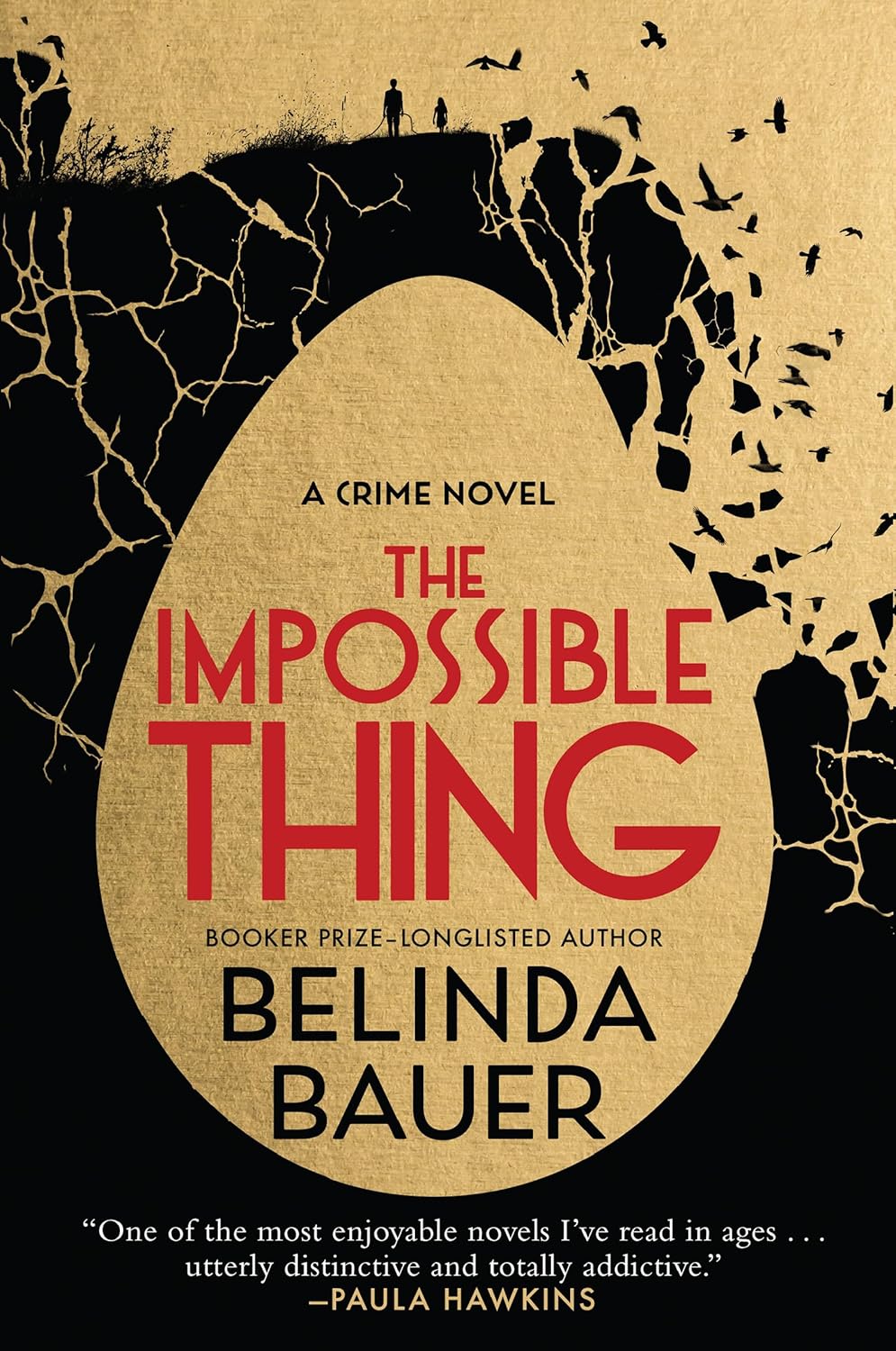
The Impossible Thing: A Crime Novel
- By Belinda Bauer
- Atlantic Monthly Press
- 336 pp.
- Reviewed by Mariko Hewer
- May 2, 2025
This oological thriller keeps readers at an unfortunate emotional remove.
It’s not uncommon for thrillers to focus more heavily on plot advancement than character development, often to their detriment. Unfortunately, Belinda Bauer’s The Impossible Thing is no exception. The novel is so fixated on driving events forward that the characters feel flat and unrelatable, leading to confusion about motivations and an uneven logic to the sequence of happenings.
The narrative takes place in two chronologies: the 1920s-1940s and the present day. Because only certain chapters are labeled, however, the reader may find herself briefly disoriented upon moving back and forth in time.
The story attempts to follow a cache of rare red guillemot eggs harvested from a cliff near Metland Farm in Yorkshire, England, in the early 20th century. The eggs — said to number 30 in total, collected across decades by young Celie Sheppard, who lives on the farm — have vanished through the cracks of history and are rumored to be priceless, partly because of their uniqueness.
Once they’re acquired, in fact, their appeal tends to plummet. After the initial find in the 1920s, a collector internally laments:
“Once he had seen the egg then he could find fault with it, pour scorn upon it; be openly and loudly glad that he had not been overcharged for it. But until it had been seen, the Metland Egg was unimpeachable.”
Decades later, in the present day, a young man dubbed Weird Nick stumbles across an unusual oological find in his attic:
“[T]he egg was red. A rich, bloody red around its blunt end fading to plain pink near its point. It looked like a painting of an egg done by a child, for sticking on an Easter fridge.”
When the egg is stolen by two men in balaclavas, Weird Nick and his friend Patrick Fort set out to reclaim it, delving deep into the shadowy world of illegal egg smuggling and putting themselves at significant risk — often, it seems, without fully understanding the stakes.
Occasional perspective shifts in the chapters told from Patrick’s point of view lead to confusion. At one point, Weird Nick, whose inner workings are almost never illuminated, “shuddered at the thought that he could still recall every detail of [an] insane transaction.” As the rest of the chapter is seen through Patrick’s eyes, the insight is especially jarring.
Additionally, various characters’ thought processes feel oblique. Upon finding a balaclava in the car of Finn Garrett, a Royal Society for the Protection of Birds member, Patrick immediately assumes he must’ve been the one to rob Weird Nick. As balaclavas are common cold-weather headwear, this is an odd conclusion.
Similarly, when Weird Nick tells Patrick that his assailants asked only about a single egg, Patrick takes this to mean the thieves already have the other 29 because “collectors are completists” and would follow the “No egg left behind” maxim. But a century-old collection could’ve easily been broken up over time, requiring a robber to locate and pick them off one by one.
Bauer does a relatively satisfying job tying the past and present narratives together by the end, but readers may still be left puzzled by some characters’ behavior. When egg-collecting Celie falls in love with Robert the farmhand, for instance, we witness barely any affection between them; she’s frustrated that he’s not around when she moves to a new house and “turn[s] her face from him as if he were a beggar on the street” when she returns to visit the farm. Yet shortly thereafter, they’re engaged. “Robert had spent months — years! — practising his proposal but, when the moment came, he did not need to say a thing.”
Perhaps he didn’t need to, but a peek into the couple’s emotional life would’ve given readers more of a stake in their eventual fate. As it stands, The Impossible Thing offers readers a glimpse into a little-known underworld but leaves them feeling disconnected from the overall human (and avian) stakes.
Mariko Hewer is a freelance editor and writer as well as a nursery-school teacher. She is passionate about good books, good food, and good company. Find her occasional insights of varying quality on X at @hapahaiku.

.png)