The Living and the Rest
- By José Eduardo Agualusa; translated by Daniel Hahn
- Archipelago
- 240 pp.
- Reviewed by Patricia Schultheis
- June 24, 2025
Writers at a retreat in Mozambique grapple with inner (and outer) demons.
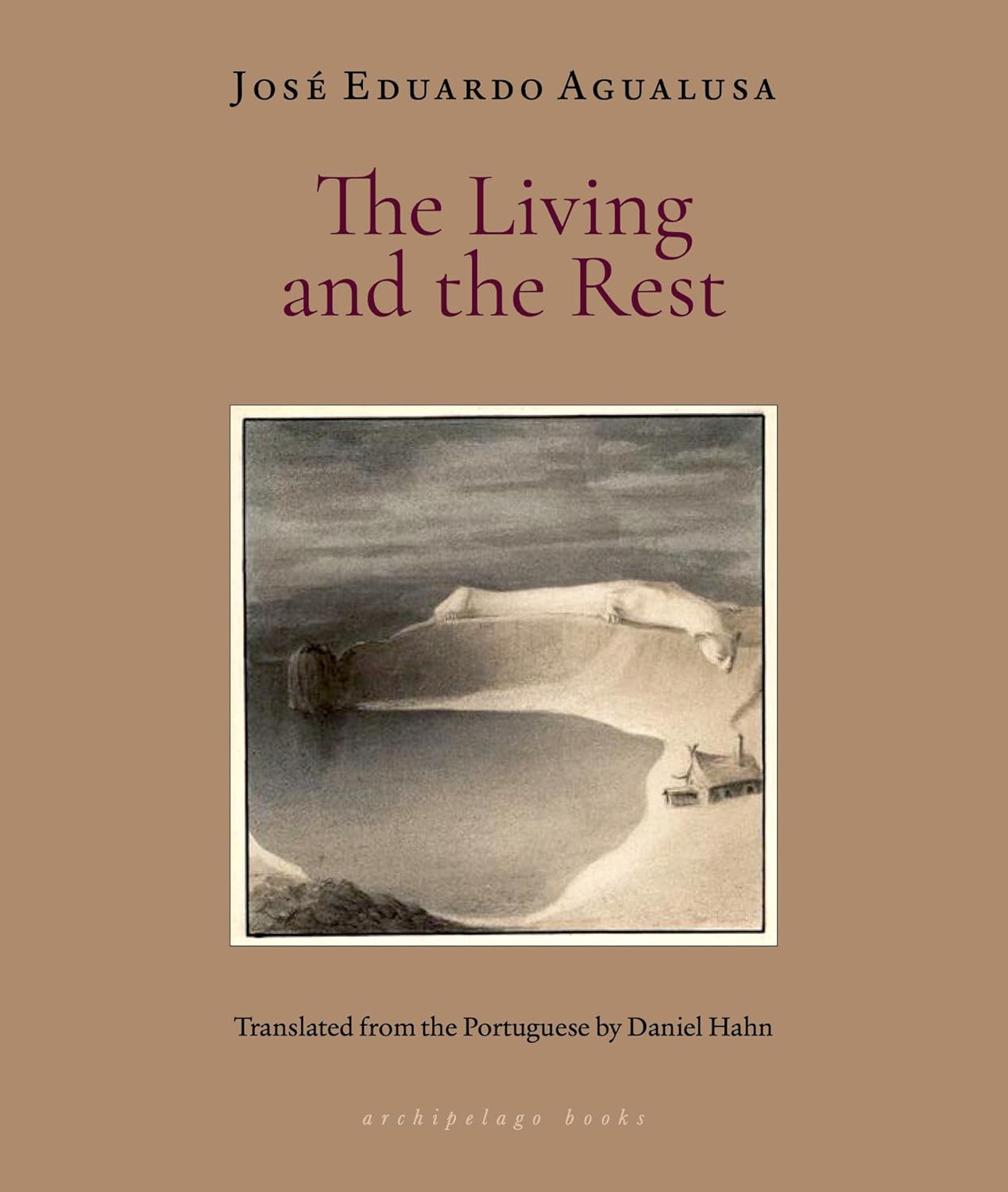
José Eduardo Agualusa’s The Living and the Rest is a daring exploration of national identity, fiction, time, and the porousness of reality itself told through a shimmering scrim of magical realism. Placed on the island of Mozambique during a conference of so-called “African” writers, Agualusa’s robust characters flirt with each other, lie to their agents about the progress of their latest novels, and camouflage their true selves behind fabricated public personas, all while remaining blissfully unaware that fate is shifting the magma of existence beneath their feet.
In short, Agualusa’s wholly human characters are oblivious to the fact that they’re pawns on a double-sided chessboard. On one side, their surface narratives unfold. On the other, unseen forces that they sense but can’t quite grasp are shaping their destinies.
The book’s design gives the first clue as to what Agualusa’s deft novel is truly about. Like the Bible’s seven days of Creation, The Living and the Rest is divided into seven chapters, each representing one day and each preceded by a distinctive epigraph. The first is from Portuguese poet Ana Mafalda Leite’s “The Creation Story”:
“In the beginning there was chuata (god) and the motionless earth
one day a huge lightning-flash drew in the skies
the rain
which brought man to the earth and all the animals.”
By dawn of the second day, the island is trapped in the eye of a fierce storm and cut off from the mainland, as well as from the internet, phone service, and even electricity. That morning, Daniel Benchimol, the writer who arranged the conference, awakens with a realization:
“Now, yes, they really are on an island surrounded by water on all sides, including above and below, and also by silence and solitude.”
The meter of the phrase “silence and solitude” echoes the pulse of the book’s enigmatic title. Exactly who are “the Rest”? Agualusa gives us a hint in chapter four, which begins with the epigraph, “Reality is an accidental by-product of fiction.” By this point, the writers’ creations, the creatures of their imaginations, are crossing over from the mainland in the guise of actual corporeal beings, while the writers’ own identities are dissolving into hysteria. The situation calls into question what and who is real. The lusty Angolan poet Ofélia Eastermann finds the position so destabilizing that she declares:
“We’re dead, all totally dead, but the island isn’t paradise, or hell, it’s purgatory. We’ll never get out of this place till we’ve reconciled with one another, especially with our ghosts.”
Chapter four also marks a turning point. After that, a blocked novelist is struck by a bolt of insight, a village elder tells a story about men who gathered at daybreak “whenever there was a full moon to affix the sky to the firmament,” and two conference-goers become lovers.
Agualusa’s choice to center his narrative on an island where, perforce, people are both isolated and dependent is brilliant. Isolation forces his characters either to look outward toward the cloud-shrouded horizon or inward at their own shortcomings as humans and their responsibilities as writers. Who but writers, after all, can create portals to other worlds? Probe the boundaries between reality and fiction? Or expose the stories people tell themselves about themselves? Who but writers can erase time so that someone in the 21st century can open a book and escape into the 19th or beyond?
The one character who remains practical and focused amidst the deteriorating situation is Daniel’s very, very pregnant wife, Moira. When a rumored nuclear attack panics the visiting writers further, it’s she who strides into the room, rings a small copper bell she’s pulled from her handbag, and shouts:
“For fuck’s sake, shut up!…We’re the ones who construct the worlds. It’s us! The worlds germinate in our heads, and grow till they don’t fit anymore, and then they burst loose…That’s reality, it’s what happens to fiction when we believe in it.”
If anyone understands reality, it’s Moira. After all, she’s creating actual life and knows in her bones how creating mere stories pales in comparison.
Agualusa is an Angolan who lives in Mozambique, which, until 1975, was a colony of Portugal. He writes in Portuguese (Daniel Hahn, his translator, is to be congratulated), and his use of magical realism calls to mind Blindness by Nobel Laureate José Saramago, another author who wrote in Portuguese. Magical realism isn’t for everyone all the time — a steady diet of it would be like listening to Fado 24 hours a day — but it does present writers and readers the opportunity to explore those stories unfolding beneath their busy lives, the ones they could hear if only they’d stop and listen.
Patricia Schultheis is the author of 40 published short stories, including the award-winning collection St. Bart’s Way. She is also the author of Baltimore’s Lexington Market, published in 2007, and A Balanced Life, published in 2018. She has received awards from the Fitzgerald Writers’ Conference, Memoirs Ink, the National League of American Pen Women San Francisco Branch (2010, 2020, 2021), Winning Writers, and Washington Writers’ Publishing House. A widow, she lives in Baltimore.