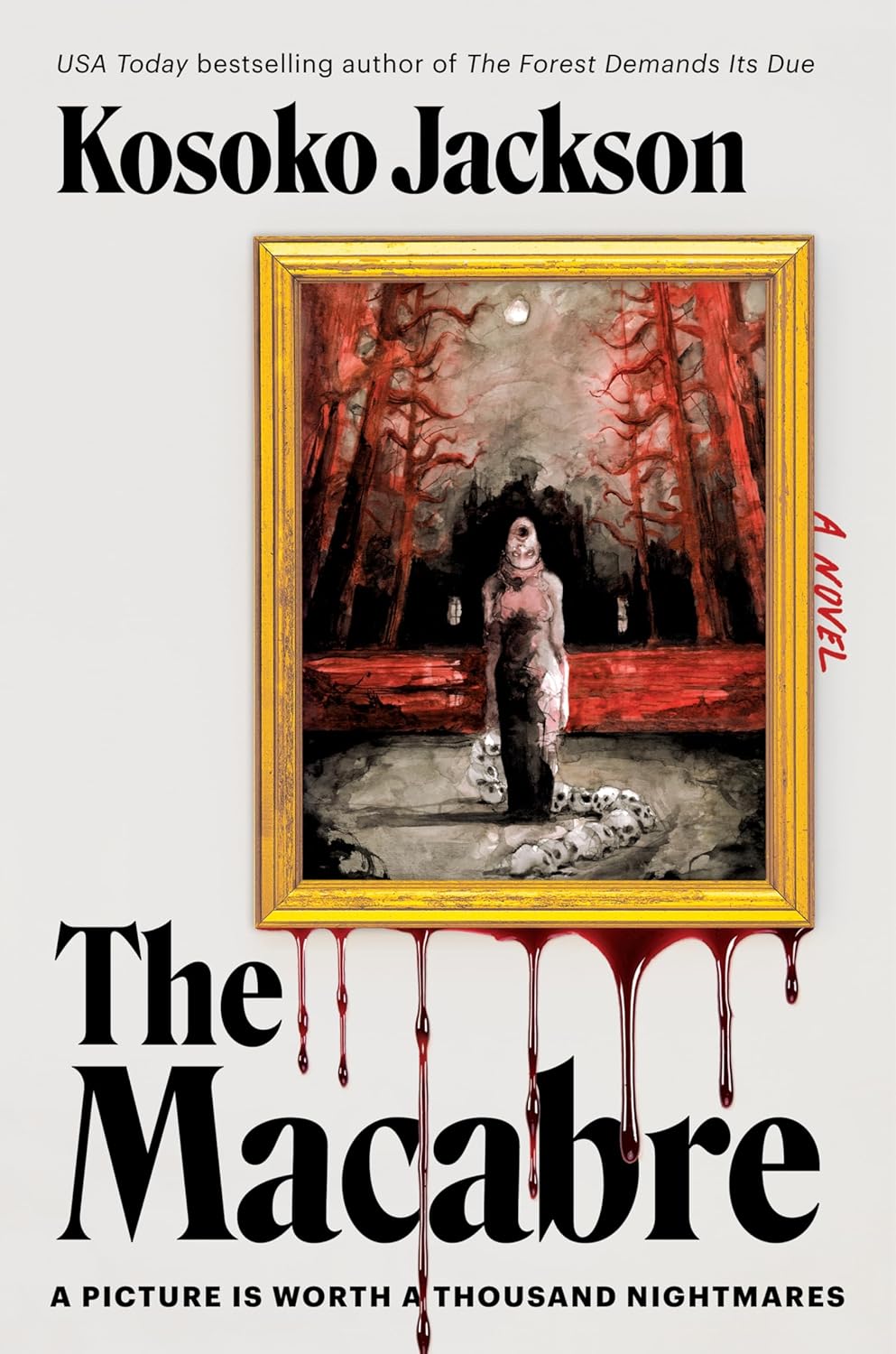
The Macabre: A Novel
- By Kosoko Jackson
- Harper Voyager
- 400 pp.
- Reviewed by Philip Zozzaro
- September 11, 2025
A struggling painter must track down and destroy deadly works of art.
Lewis Dixon, mourning the loss of his mother, is guilt-ridden over not seeing her before she passed. Then, a chance encounter with a woman named Cassandra leaves him reeling when the unfamiliar lady hints at having deep knowledge of Lewis and his mom. Before he can process how she knows them, his mind resets, and Cassandra reverts to the benevolent stranger sitting beside him. For Lewis, this is only the beginning of the strangeness that will mark his life over the coming weeks.
Lewis is a painter striving to make a name for himself in the art world. Unexpectedly, he receives an invitation to London, where he’ll showcase his signature piece at the British Museum. He suffers from impostor syndrome, though, a feeling that’s magnified after an intense grilling from the museum’s curator, Noah Rao. Lewis’ unease only grows as he’s introduced to the museum’s director, Evangeline Thompson, who proceeds to talk to him about the subject of magic. He’s further thrown for a loop when she reveals an almost exact replica of his work already hanging in the museum.
The shock hasn’t even begun to wear off when Evangeline asks him to analyze the painting. Lewis’ examination proves erudite, but when he leans closer to the piece and touches it, he briefly disappears into it. While inside, he meets the vengeful Edgar Dumont, the creator of the duplicate painting. Upon exiting the artwork, Lewis learns from Evangeline that Dumont is a “node,” a magician whose power is deployed via his art. His works, collectively known as “The Macabre,” are capable of causing untold death and destruction. Lewis is asked to travel the globe — and back in time — to help locate and destroy the remaining pieces in Dumont’s collection.
Evangeline promises him a future of celebrity if he’s successful in his mission. While Lewis would rather use whatever magical forces are afoot to bring his mother back, he’s told it’s impossible. Soon, he partners with Noah to find the cursed paintings and liberate those who’ve fallen under their spell. As Lewis tracks down Dumont’s works, he discovers that their destruction often brings pain and other consequences for himself and others.
While Lewis and Noah — who begin to develop feelings for each other — pursue the dismantling of Dumont’s grisly portfolio, the mysterious Cassandra is busy searching for the most powerful piece in the Macabre. She’ll let nothing stand in her way and has no qualms about leaving a pile of bodies in her wake. Lewis is on a collision course with Cassandra and doesn’t realize what’s in store for him: She’s heavily involved in witchcraft and may know more about Dumont than anyone else. He’ll need to be sharp to outwit such a formidable adversary; the future of humankind hinges on him getting to the paintings first.
The Macabre is a profoundly gripping horror novel that manages to hit notes of intense surrealism. Lewis Dixon is a lost soul at the book’s inception; his work has become his life, to the detriment of any close relationships. Author Kosoko Jackson expertly conveys Lewis’ forlorn nature, his longing for connection, and, as the story progresses, his evolution from suffering artist to reluctant hero. While occasionally reckless, he’s willing to sacrifice himself to save others.
Jackson also poignantly illustrates how the beauty of art can camouflage the most painful of emotions, and how the compulsion to possess works of art — without fully understanding them — can be ruinous. His use of art as a plot device is brilliantly conceived and evokes Oscar Wilde’s The Picture of Dorian Gray and Stephen King’s Rose Madder. The well-crafted narrative offers more than a few surprises alongside the mind-bending horror, making The Macabre a superior story deserving of a wide audience.
Philip Zozzaro, a married father of three, enjoys reading as much as possible, particularly history, biographies, mysteries, and horror. His reviews have appeared in the San Francisco Book Review, Booklist, the U.S. Book Review, and elsewhere.