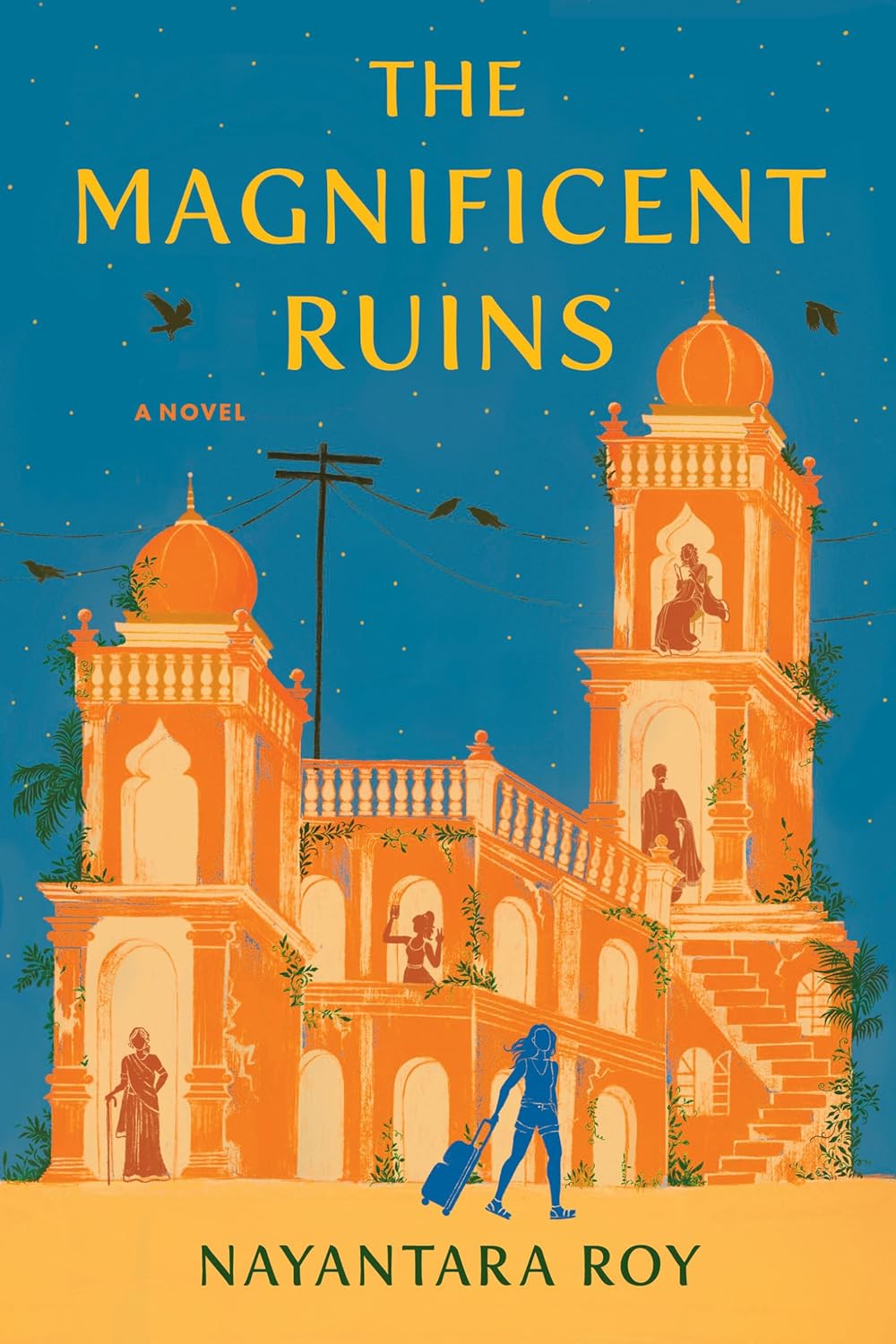
The Magnificent Ruins: A Novel
- By Nayantara Roy
- Algonquin Books
- 448 pp.
- Reviewed by Anne Eliot Feldman
- November 20, 2024
An Americanized daughter returns to her dysfunctional family in Kolkata.
“As a family, we were long practiced in the art of secrets, trading one deception for another through generations,” writes Nayantara Roy in the prologue to her debut novel, The Magnificent Ruins. “But that night on the terrace…I wondered if there would be no hiding this time. A secret is a terrible thing. Unless there was honor in keeping it.”
It’s August 2015, and 29-year-old editor Lila De is up for promotion at a respected New York publishing house when she learns her grandfather Tejen Lahiri has died. In a shocking twist to all involved, he has willed his estate — a six-story mansion in a posh Kolkata neighborhood — to his granddaughter, bypassing his two brothers and his only daughter, Maya, Lila’s mother.
Lila wrangles eight weeks of leave and gets herself to India for the funeral, but the next steps — including tending to the decaying manse and the relationships she abandoned 13 years ago when she moved to live with her father in the U.S. — confound her. She hasn’t spoken to her mother in a year. Her grandmother, aunts, uncles, and cousins decry her newfound power; all 12 have occupied the mansion for their entire lives, and its trust fund has spared most of them from needing to work.
Will Lila sell the house? Will she assume the money is now hers? Her widowed grandmother Geeta may be most afraid. “That her husband would will the house to me,” thinks Lila, “was a reckoning that threatened the ground beneath her feet.” When Lila suggests that the maid’s child be given freshly prepared food — rather than back-of-the-fridge leftovers — for lunch, Geeta pushes back:
“Lila, really…You’ve been here a day. Could you just let us live the way we know how?”
The magnificent ruin of her ancestral estate stirs Lila’s emotions most readily. Her first day in Kolkata, as she walks through her childhood neighborhood of banyan trees, rickshaws, and “weatherbeaten but regal” green, blue, and pink townhouses, she reflects:
“[T]he Lahiri house…took my breath away. Weathered by rain and neglect, covered in ivy, brick exposed (purposeful in Brooklyn, decay here), the wide balconies unlit, as if housing darkness inside. And yet, even ruined, it was still magnificent, like a once-wealthy aristocrat, struggling to stay upright, stay relevant, even in poverty.”
That struggle for dignity epitomizes how her relatives live. Lila gains perspective from her cousin Biddy as they plan Biddy’s upcoming wedding. A podcaster who speaks with candor, Biddy is to Lila “like a celebratory string of lights, adding cheer to any room.” Yet the pall of family baggage has spared no one; Lila sees herself reflected in how even Biddy “had become an expert at concentrating, distilling, bottling thought and heat and fury and joy, such that we were generations of Lahiri women, perfumed with the barest trace of what we truly felt.”
As Lila untangles her feelings, her messy romantic life — including an affair with her now-married first boyfriend and the unplanned arrival in India of her star client, who wants more than a “sporadic lover” relationship — becomes difficult to contain, intensifying her shame. Family attacks intensify, too. And while cosmetic changes to the decaying house come easily, the terrace tragedy referenced in the prologue exposes long-held secrets. Can healing ever begin?
The Magnificent Ruins is beautifully written. Lila and Maya’s mother-daughter dynamic — revealing a mutual desire to be close and the impossibility of doing so — elicits the book’s most poignant passages. Roy, an award-winning short-story writer, playwright, and TV executive, fleshes out the narrative (and the origin of the Lahiris’ troubles) with vivid depictions of Bengali history and life in Kolkata, including the intrigue surrounding an approaching election that threatens the status quo.
Lila narrates the book save for one chapter — rich in social context — that unfolds through the eyes of a rookie police officer. When he interviews the maid in the aftermath of the horrific accident, she laughs at how Lila’s great-grandfather built the terrace “to be able to see the whole city and feel like he owned it…Rich people love to feel like they own things.”
Ownership is never Lila’s goal, of course, but acceptance is. “There was nothing to be done about the past…except to…drink it in,” she thinks, “to know that it was dead but we were not.” Knowledge is power, after all, and when her family’s secrets are finally unveiled, we see an empowered Lila emerge, ready for her future.
Formerly employed by the Library of Congress and the defense industry, Anne Eliot Feldman is currently at work on a writing project of her own.