The Martians: The True Story of an Alien Craze that Captured Turn-of-the-Century America
- By David Baron
- Liveright
- 336 pp.
- Reviewed by Bob Duffy
- September 10, 2025
When the stargazing masses turned their attention to little green men.
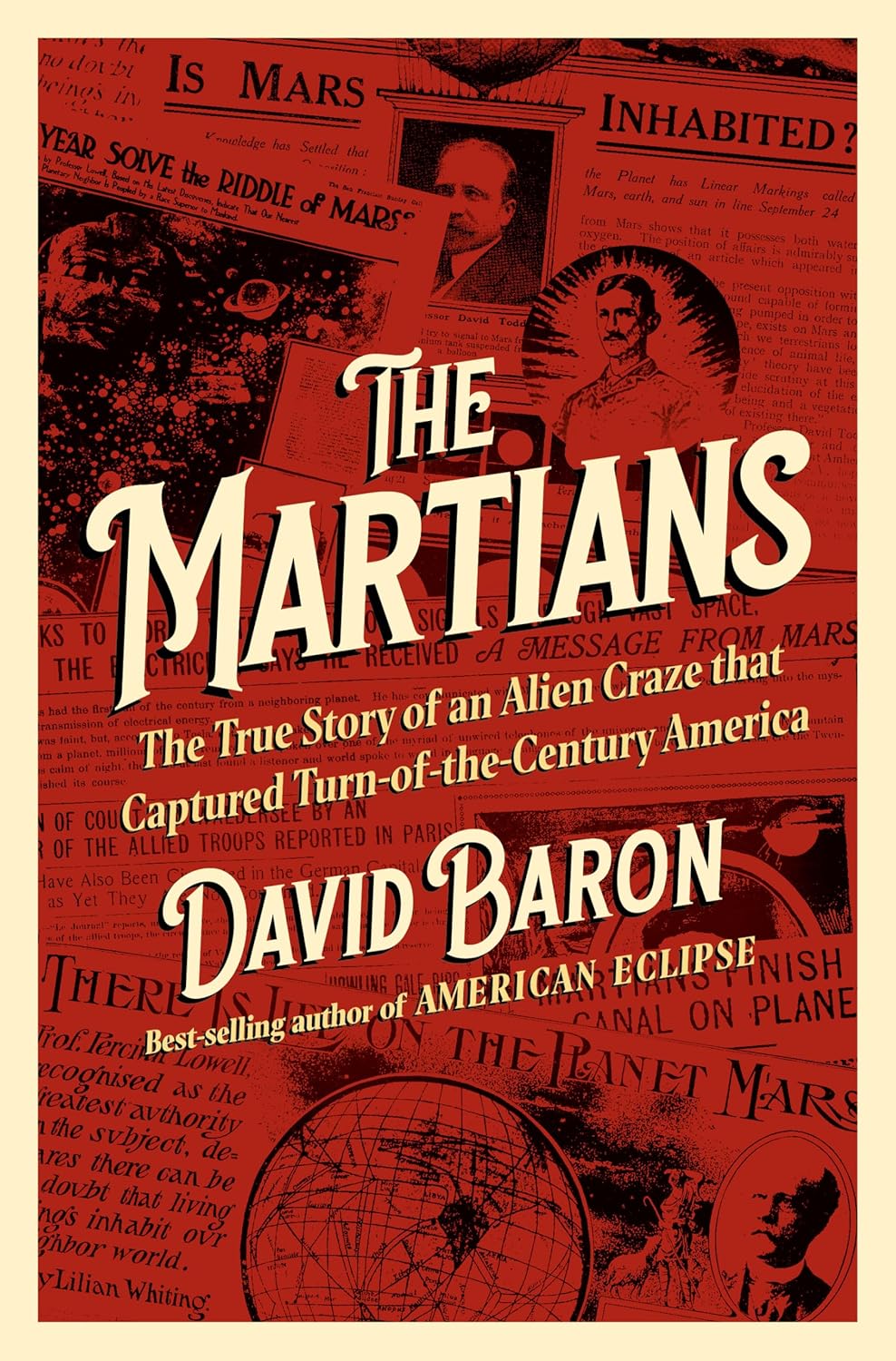
The Martians spotlights that volatile little corner of the American imagination where persistent obsessions — fueled by over-exuberant media — take hold and root. David Baron’s briskly entertaining social history homes in on the trio of decades framing the turn of the last century, chronicling the rise and fall of a stubborn belief that sociable aliens were gazing on us across the frigid darkness and longing to say, “Howdy, neighbor.”
The alien craze Baron investigates found its start in Europe, in the blurry observations of Italian astronomer Giovanni Schiaparelli, who espied plumb-line-straight channels (“canali”), many of them hundreds of kilometers long, on the surface of Mars. An English mistranslation of Schiaparelli’s descriptor as “canals” set the public imagination at a slow burn, ultimately spawning wistful visions of a pacific, civilized Martian society dependent on seasonal cultivation and irrigation.
At the apogee of the craze, around 1908, H.G. Wells — who, nearly two decades before, had described a warlike Martian race invading our home planet in giant, spider-legged globules — was now rhapsodizing in the essay “The Things that Live on Mars” about gentle, intellectual fuzzies:
“There are certain features in which they are likely to resemble us, and as likely as not they will be covered with feathers or fur. It is no less reasonable to suppose, instead of a hand, a group of tentacles or proboscis-like organs.”
For all its fascinations among the literate but often unsophisticated, the Martian fixation crashed and burned surprisingly suddenly, as the author tells, in the face of more sober scientific scrutiny supported by advances in telescopy and more favorable observatory locations and climatic conditions.
Still, the saga of its three-decade hold on the collective imagination is an intriguing one, and it’s especially vivid and colorful in Baron’s hands; his storytelling skills and astute research instincts drive the tale relentlessly. Even more adroitly, he introduces a remarkable parade of principals. Some of them are brilliant, some eccentric, and a good many are both.
Take Camille Flammarion, a French astronomer and popularizer of scientific subjects. Flammarion held a Dr. Oz-like grip on the imaginations of Francophiles who followed intellectual fashions. He enthusiastically embraced Schiaparelli’s “discovery” of putative Martian waterways, and the fever spread. It was taken up on our shores by Percival Lowell, a wealthy New England brahmin with a fortune to spend and the idle hours to pursue his infatuations.
An amateur astronomer, Lowell set up an Arizona observatory tuned almost exclusively to the Red Planet and its seasonally changing “canals.” His wealth subsidized his investigations, as well as those of a handful of earnest fellow travelers (although Lowell’s personal afflictions, including intermittent psychological eclipses, sometimes cast a shadow on team harmony). Early on, his circle of adherents included at least one journalist of note, Garrett P. Serviss, as well as — increasingly — the yellow press, including the Hearst papers, which were quick to embrace and spread the Martian obsession.
Another early disciple was Professor David Todd, head of Amherst College’s observatory, a prominent author who reported that “...Mars in ages past, has been, and may be still, peopled by intelligent beings.” Todd would travel the globe, along with his wife, Mabel Loomis Todd, in search of auspicious viewing positions for observing Mars and the visible artifacts of its civilization.
Todd’s wife’s star shone even more brightly than her husband’s: Mabel, a celebrated fashion plate and the first collator of the poems of Emily Dickinson, her deceased best friend, was soon plying the national lecture circuit, a robust network reaching thousands of mostly middle- to upper-class women. Her main topic: “The Latest News from Mars.” (If you’re interested in a mildly scandalous tidbit concerning the Todds’ unconventional marriage and Dickinson’s bereaved brother, pick up this book. Otherwise, the foregoing hint, obvious enough, will have to suffice.)
The Martians is studded with delightful in-text illustrations, as well as allusions to prominent proponents of the craze: Alexander Graham Bell, Nikola Tesla, Guglielmo Marconi, J.P. Morgan, Thomas Edison, and Oscar Wilde. Not to mention a stupendous set of endnotes and a thorough index.
Of course, the widespread fixation on Mars quickly crumbled in the clarity of finer optics and sounder science. But still, before you plunge into retrospective ridicule, consider a few popular delusions of more recent vintage: that ancient astronauts built the pyramids, that professional wrestling is real, that vaccines cause autism, and so on. Those gung-ho Victorians weren’t alone in their loony-tunes preoccupations.
Bob Duffy, a retired academic and advertising executive/brand consultant, reviews frequently for the Independent.