The Mesopotamian Riddle: An Archaeologist, a Soldier, a Clergyman, and the Race to Decipher the World’s Oldest Writing
- By Joshua Hammer
- Simon & Schuster
- 400 pp.
- Reviewed by Darrell Delamaide
- April 24, 2025
An overabundance of detail hobbles what could’ve been an absorbing saga.
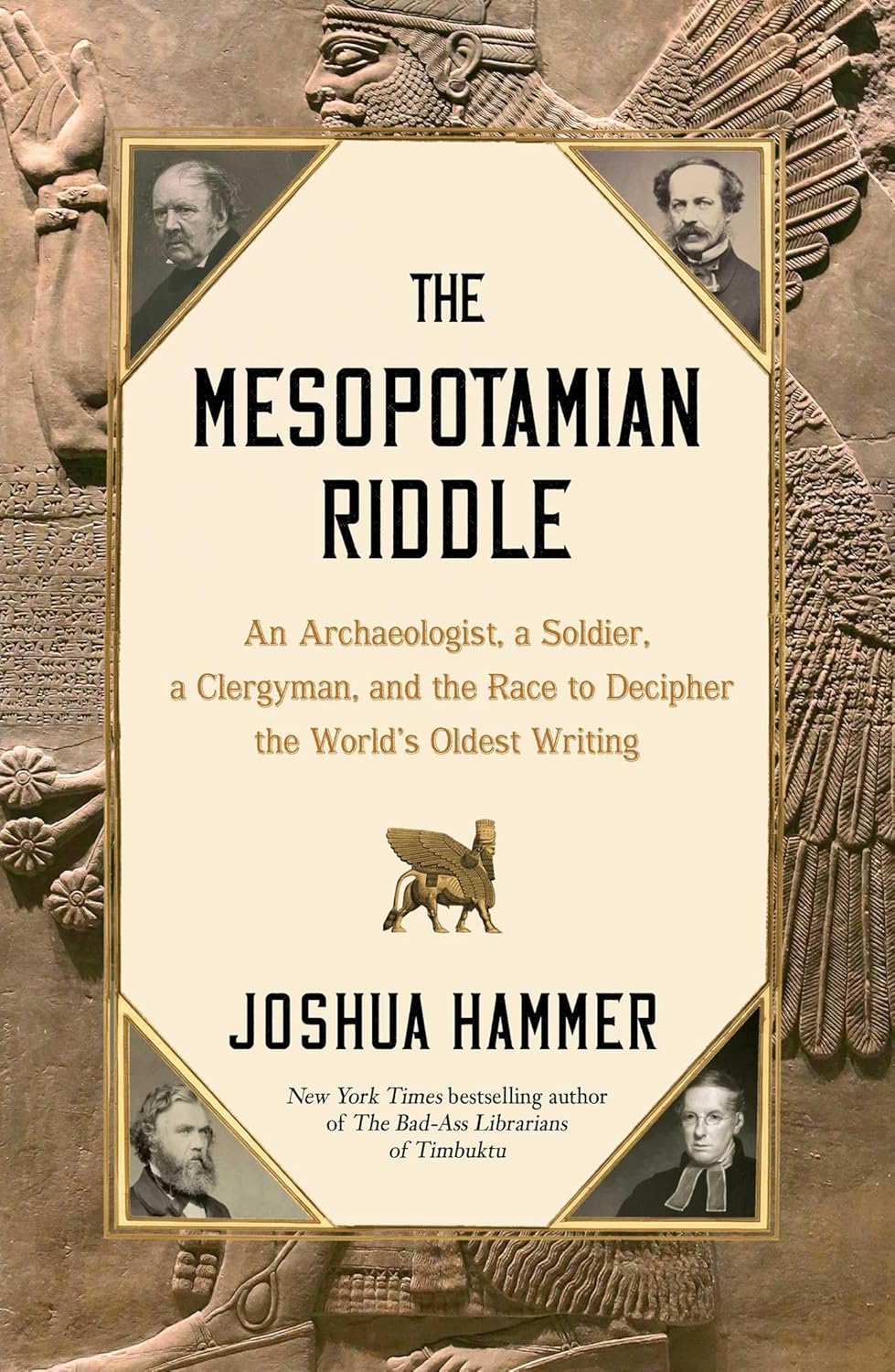
In the 19th century, a handful of men worked both together and in competition to decipher the inscrutable markings on archaeologists’ recent finds: cuneiform. Writer Joshua Hammer chronicles their efforts in his latest book, The Mesopotamian Riddle, which culminates in an 1857 translation contest hosted by the Royal Asiatic Society in London.
The opening is resounding, with its description of the first excavation of the tablets:
“The mound stood on a bluff high above a bend in the river. Excavation teams had peeled off densely packed layers of wind-borne sand, exposing an ancient field of stonework and mud-brick masonry. Fragments of human-headed lions and bulls and smashed bas-reliefs lay strewn across the ruins, evidence that the city had come to some apocalyptic end.”
Hammer quotes a description of cuneiform as “what you might get if a flock of birds with obsessive-compulsive disorder took a walk across wet clay.” It didn’t help that the writing was used in several languages, often meaning different things in each.
However, the book quickly bogs down in a plethora of detail, not so much about ancient writing as about a group of Victorian amateurs eager for the fame of being the first to decipher this newly discovered script. There is a somewhat tiresome description of the intrigue that marked the interaction of those amateurs. It’s interesting to personalize the quest to solve the Mesopotamian riddle, but you’d probably have to be intensely fascinated by linguistics and/or Near Eastern history to enjoy this story.
Sadly, The Mesopotamian Riddle is not nearly as good as an earlier book from Hammer, 2016’s The Bad-Ass Librarians of Timbuktu: And Their Race to Save the World’s Most Precious Manuscripts. While the newer offering boasts the same amount of assiduous research and is similarly well written, the quest to decipher cuneiform isn’t as inherently compelling as a saga about preserving documents in a complex geopolitical environment in a place many people consider mythical.
(Readers should note that Joshua Hammer is not to be confused with Josh Hammer, though both have written for Newsweek. Joshua lives in Berlin and seems happy to explore arcane topics, while Josh is a right-wing columnist in the United States. Four years after Bad-Ass Librarians, Joshua published The Falcon Thief: A True Tale of Adventure, Treachery and the Hunt for the Perfect Bird, about a smuggler who specialized in stealing raptor eggs for wealthy Middle Eastern clients.)
The conclusion of the contest put on by the Royal Asiatic Society makes for satisfying reading. “With the emergence of the four similar translations, it became instantly clear that the secrets of the ancient world would be secret no longer,” Hammer writes. He notes approvingly that the success of the contest inspired others “to join this grand quest to understand humanity’s past.”
The unveiled translations include an account of a deluge from the Old Babylonian period, probably centuries before the chronicle of Noah in Genesis linked the story to the Bible. The same George Smith who made the discovery also connected the legends to The Epic of Gilgamesh, “now regarded as the world’s oldest narrative and its themes of courage, the lust for adventure, the brevity of life, and the joy of companionship have defined the human experience” over a span of 5,000 years.
Sadly, these highlights get lost in the crushing detail of the book. There is a limit to what exhaustive research and excellent writing can achieve.
Darrell Delamaide, a writer and journalist in Washington, DC, covers global politics for an international publisher.