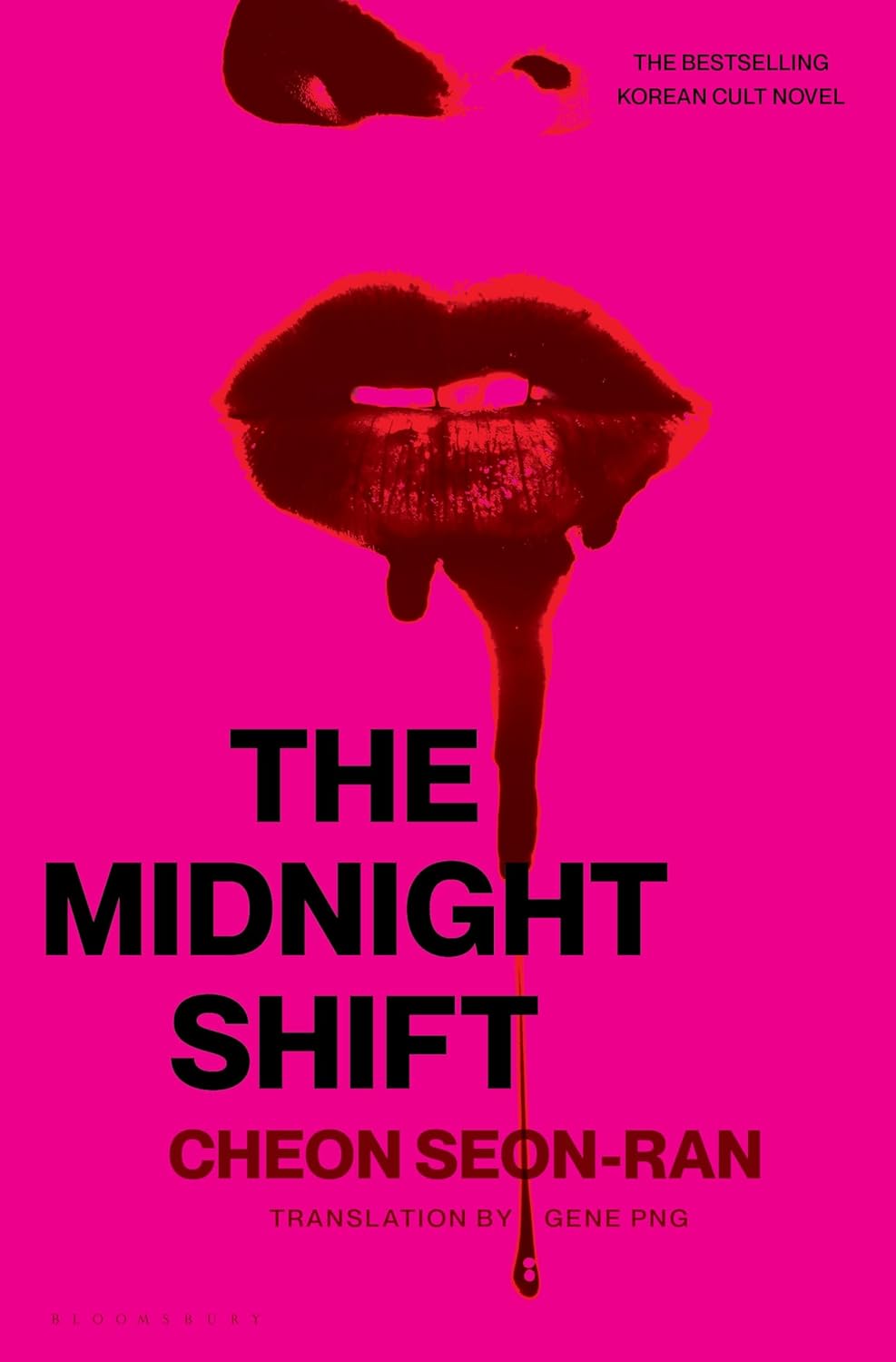
The Midnight Shift
- By Cheon Seon-Ran; translated by Gene Png
- Bloomsbury Publishing
- 304 pp.
- Reviewed by Alice Stephens
- September 18, 2025
Who — or what — is killing patients at an Incheon hospital?
Vampires never get old, either literally or literarily (which I suppose is the same thing, as they only exist in stories). They are a powerful storytelling device, human-presenting but not human, feeding off goodness and innocence in exchange for eternal life, the hidden “other” that is latent within us all. Because they were once human, they are capable of emotion and can even fall in love. Slaves to their insatiable need for blood, vampires find it difficult to build healthy relationships since everyone who is friend material is also dinner fare.
But who needs friends when you’re immortal?
The vampires in Cheon Seon-Ran’s The Midnight Shift choose their victims precisely for their lack of community, seeking out “the scent of lonely blood” coming from those who have nobody to care if they live or die, or who wish for death due to age, addiction, or unbearable solitude. And in contemporary Incheon, South Korea’s third most-populous city, who’d believe that the deaths of dementia patients were caused by these mythical monsters?
Investigating the death of a fourth elderly patient at the Cheolma Rehabilitation Hospital in a month, Suyeon, an Incheon detective, meets a mysterious woman, Violette, who’s lurking around the crime scene. While the patients left suicide notes, Violette encourages Suyeon’s doubts about the odds of four people from the same hospital leaping to their deaths within weeks of each other. Pointing out that there was very little blood at any of the death scenes, Violette says she knows the culprit but doubts Suyeon will believe her. Suyeon insists she tell her anyway:
“After a long pause, [Violette] obliged. ‘OK. A vampire did it.’
“Suyeon was forced to eat her own words.
“This was bullshit…And it angered her. To think that she’d given this woman her time.”
But when a fifth victim is found a week later, Suyeon listens to Violette, whose story is revealed in flashbacks to 1983, when she’s 16. Adopted to France, she has “a name that didn’t match her Korean features.” Though her parents are doting, her “only friends were the books in her room.” In order to get out of the house, she goes to the one cinema in town to read on a bench across from the bathrooms. There, she meets Lily, a pale girl who goes barefoot even in the snow.
Back in the contemporary timeline, a night nurse at the hospital named Nanju has turned to selling drugs to pay off her parents’ crushing debts. Her loneliness and desperation attract a vampire named Ulan, with whom she has a passionate affair that ends when he takes her hated father’s life but doesn’t drink his blood, and she realizes that “he was just a fucking bat who killed for sport.” Though no longer in love with him, Nanju is now complicit in her father’s killing. With no way out, she’s caught in the same existential dilemma she has wrought upon the addicts to whom she supplies drugs.
Loneliness and alienation are epidemic in South Korea, which has one of the highest suicide rates in the world. Cheon’s vampires prize the “taste of lonely blood,” so it’s no wonder the undead Ulan, a foreigner who’d “never learned to remove his shoes inside the house,” has made the country his hunting grounds.
Along with loneliness, the three main characters also wrestle with a beast that resides within. As a teenager, Suyeon searched for a suicide partner to die with. A drug-dealing nurse trapped in a relationship with a murderous vampire, Nanju feels “as if there was a monster living in the pit of her stomach, consuming everything.” Raised in racial isolation, Violette sees a monster when she looks in the mirror. When her father’s best friend is brutally killed, his neck mauled, her father says hard times make monsters out of people. Vampires are part human; humans are part monster.
To relieve their suffering, the women all seek to save or be saved. Nanju is looking for someone to rescue her from Ulan’s grip. Saved from ending her own life, Suyeon joins the police to rid the world of injustice. And Violette, “saved” by her adoptive parents, offers herself up to spare the vampire she loves, then dedicates herself to saving the world from other vampires.
Translated with verve by Gene Png, the novel’s prose sometimes stumbles with awkward phrasings, perhaps due to an overly faithful rendition of the original. The occasional authorial judgments — “Lily agreed. But it was a promise that would have better not been made” — lift the reader out of the close-third-person flow of the narrative. These minor bumps are easily overlooked, however, due to the fast-paced sweep of the plot and its fresh twist on the vampire story.
By incorporating loneliness and transracial adoption, Cheon elevates her entry into the genre to a potent vehicle for social commentary, much as the recent movie “Sinners” did in calling out white people’s appropriation of Black culture. While some details don’t ring true about the transracial-adoption experience (Violette’s parents are the most enlightened adoptive parents I’ve come across in either fiction or real life, with her mother knowing to make seaweed soup for Violette’s birthday, and her parents feeling guilt that, as a child, she was unable to consent to her own adoption), there is much the author gets right. Violette’s description of a vampire could also apply to adoptive parents:
“A vampire can find a way to bury into their victims’ hearts, feed them faith and love, all while consuming them up bit by bit.”
In this age of tech bros and carnivorous capitalism, the vampire should be poised for a comeback. With The Midnight Shift, Cheon Seon-Ran brings new blood to a centuries-old tale. Let the feeding frenzy begin.
Alice Stephens is the author of the novel Famous Adopted People.