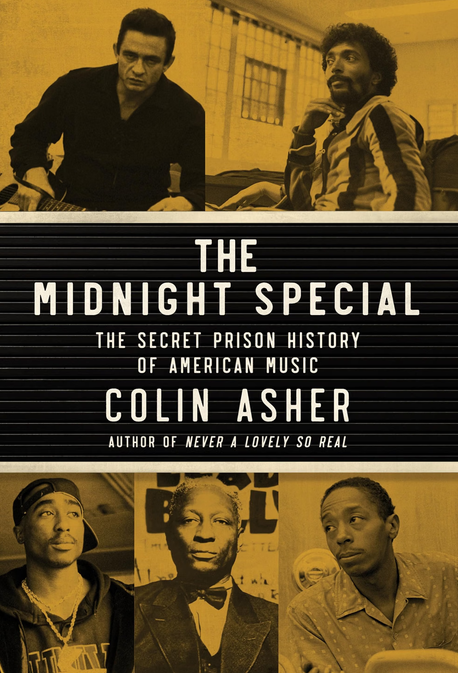
The Midnight Special: The Secret Prison History of American Music
- By Colin Asher
- W.W. Norton & Company
- 336 pp.
- Reviewed by Charles Caramello
- September 17, 2026
A virtuoso account of jailhouse artistry and the pernicious racism behind it.
Imprisonment has proven a durable trope across the history of American music. Consider, for example, the jaunty “In the Jailhouse Now,” written in 1915 and recorded by Jimmie Rodgers in 1928; the seminal “Midnight Special,” written and performed in the 1920s by Huddie Ledbetter and since interpreted by countless blues artists; the raucous “Jailhouse Rock,” recorded by Elvis Presley in 1957; or the discordant “Hurricane,” written and recorded by Bob Dylan in 1975. And don’t forget Sam Cooke’s catchy 1960 chart-buster “(Working on a) Chain Gang” and Big Mama Thornton’s searing “Ball and Chain,” which, in 1967, launched Janis Joplin’s career.
Colin Asher says of his engaging study, The Midnight Special, that “trying to write a definitive history of American prison music would be quixotic. This book isn’t that. Instead, it focuses on five albums and the lives of the musicians who made them, each of which has something distinct to say about the ways that policing, and incarceration, have shaped our musical culture — affecting our perception of an artist’s work, choosing who is able to perform, record, and tour, and influencing the development of musical style.”
Though clearer on what the book isn’t than on what it is, Asher’s précis captures its capaciousness and peripatetic focus.
Basing The Midnight Special on “the fact that genius exists within society, not in isolation,” the author focuses on the lives and times of his subjects more than on their works. That is, he wants to plumb the circumstances — the where, when, why, and how — of the music’s production and reception, so he turns his insightful readings of albums toward that end. Those circumstances, of course, primarily concern “crime” and punishment — the latter being incarceration, the former often the consequence of racism, poverty, and/or addiction combined with systemic injustice. That indelible music emerged from them is the miracle.
Asher advances his argument through profiles of an eclectic group of exemplary artists and signature albums: Ledbetter (aka “Lead Belly”) and “The Midnight Special and Other Southern Prison Songs” (1940), Asher’s ur-text; Elmo Hope and his bebop “Sounds from Rikers Island” (1963); Johnny Cash and the live recording “At San Quentin” (1969); Ike White and the shape-shifting “Changin’ Times” (1976), “written and recorded entirely inside California prisons”; and, finally, Tupac Shakur and his “bleak and brilliant” bestselling hip-hop album “Me Against the World” (1995).
The five artists came from backgrounds as diverse as Ledbetter’s dirt-poor sharecropper family, struggling simply to survive, and Shakur’s well-educated militant family, fighting to remake society. They shared the experience, however, of incarceration, albeit varied in type, duration, and degree of brutality — experiences informed by the history and politics of race in America. Four of the artists are Black, and Cash, though white, also lived on the margins until finding acclaim. Nonetheless, the Black men were imprisoned, while the white man mainly visited prisons, a point Asher makes with conviction but without smugness.
The more important of Asher’s two lesser-known subjects, Hope was a prolific composer and recording artist, one among the many brilliant postwar jazz musicians addicted to heroin and denied a cabaret license and the means to make a living. Like Charlie Parker, Hope died prematurely of heart failure — an embodiment of the 1960 study “The Use of Drugs by Jazz Musicians,” done in by drugs and by anti-drug hysteria.
Equally fated but sentenced at age 19 to a long stretch for murder, White, in Asher’s term, “thrived” in prison, writing his celebrated album “Changin’ Times” behind bars. For years, though, he shuttled in and out of prison and was shuttled from prison to prison — a case study in career recidivism and a gifted musician who ultimately committed suicide.
As a white man who spent only a brief time in jail and who died rich and famous, Cash serves as Asher’s point of contrast, underscored by the author’s casting of Ledbetter’s “Midnight Special” as “born of experience” against Cash’s “Folsom Prison Blues,” a “fiction” by a self-styled Nashville “outlaw.” Although Asher praises Cash’s efforts in generating strong public support for prison reform, that slight followed the man in both life and death. A recent New York Times obituary for fellow “outlaw” David Allan Coe crowed, “Unlike Mr. Cash, who only sang about prisons and performed in them, Mr. Coe,” who served time in the Ohio State Penitentiary, “was the genuine article.”
Engaging as those three chapters are, Asher’s treatments of Ledbetter and Shakur bracket and most fully realize his book’s central theme of race. Ledbetter personifies the phenomenon of the obscure, Black, Southern blues artists who were discovered, recorded, and marketed by father-son team John and Alan Lomax and their imitators, who used a potent mix of admiration and exploitation. Tirelessly curating Lead Belly’s persona as “Famed Singer, Twice Pardoned Killer,” the elder Lomax did more than anyone to fix in the public imagination a pernicious association of Black music with criminality. For his part, Ledbetter “endured,” his dignity evident and his music timeless.
“The ‘rapper with a rap sheet,’ the press called [Shakur],” Asher writes, “1994’s version of ‘murderous minstrel.’” Shakur’s mother held leadership roles in the Black Panther Party and the Black Liberation Army, and Shakur’s genius lay in transmuting hip-hop from “party music” into “a vehicle for the ideas his mother’s generation of radicals had advocated,” efforts that led to his being cast as a criminal — a role, in Asher’s mind, that Shakur had no choice but to adopt in order to co-opt. Prosecutors, in any case, used Shakur’s music as evidence during the infamous 1995 “rap murder trial” of artist Snoop Dogg, who was acquitted. Soon after, Shakur was murdered. (Ironically, a jury finally convicted his killer — 30 years after the fact — as I write this review.)
In the hands of an author as enthusiastic about his subject as Asher, this blend of gripping life stories, foreign (for most readers) social conditions, and brilliant art provides a heady read. Well-informed and well-written, The Midnight Special is a sprawling work packed with fascinating information, provocative insights, and shrewd analysis. It can seem uneven at times, but just where, I suspect, will depend more on the musical passions that the reader brings to the book than on any qualities inherent in it.
Charles Caramello is a professor emeritus of English at the University of Maryland and John H. Daniels Fellow at the National Sporting Library and Museum in Middleburg, VA.