The Mind Reels: A Novel
- By Fredrik deBoer
- Coffee House Press
- 168 pp.
- Reviewed by Samantha Neugebauer
- November 4, 2025
A disappointing, two-dimensional exploration of mental illness.
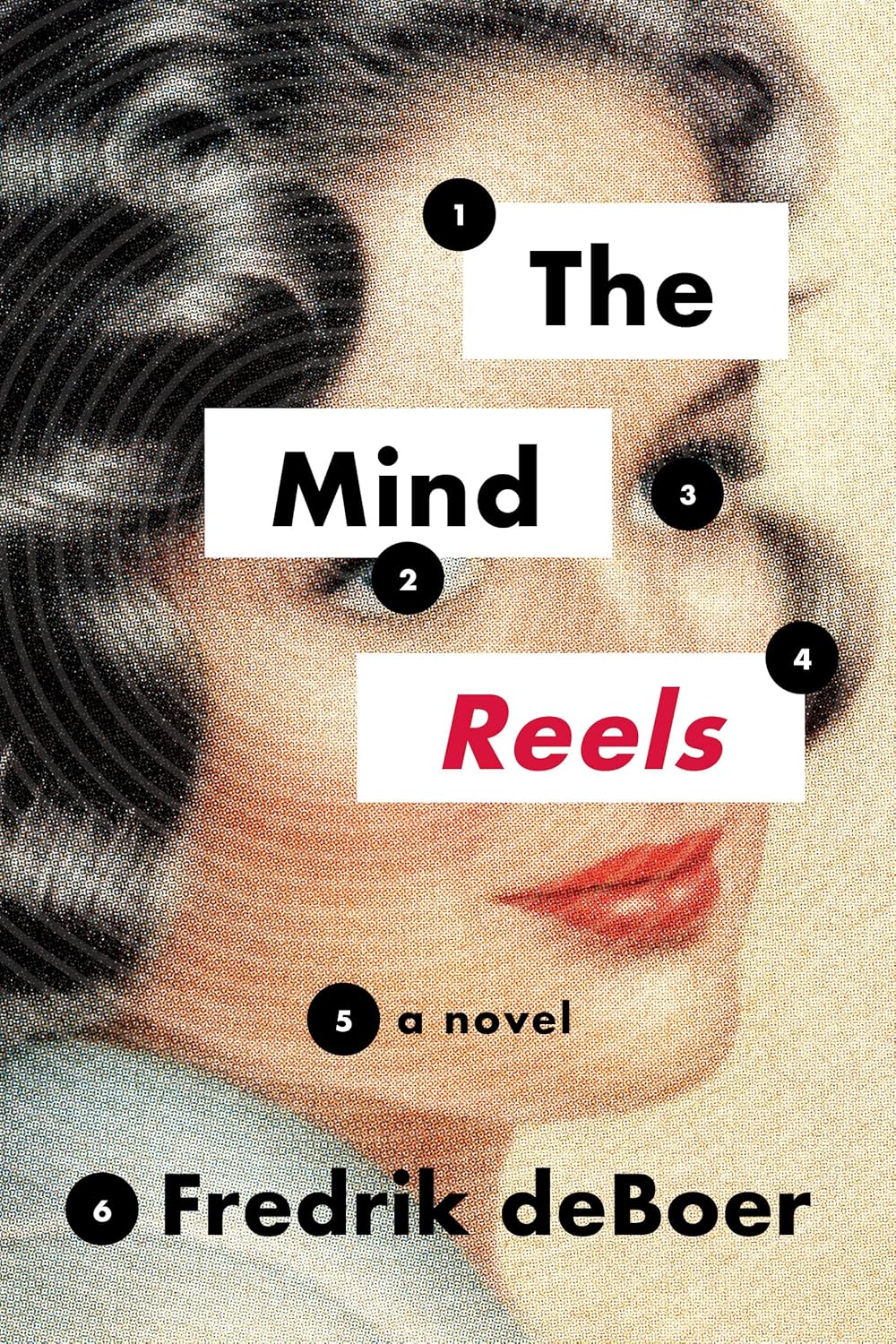
The project of Fredrik deBoer’s debut novel, The Mind Reels, is an admirable one: Strip the mental-illness narrative of its drama and the mentally ill protagonist of her giftedness in order to highlight the disease’s cyclical mundanity and tedium.
In this way, the book’s spirit has something in common with Michael Deagler’s solid 2024 novel, Early Sobrieties, in which the author forgoes exposing his protagonist’s chaotic addiction years to instead tell the story of his first staid year in recovery. But whereas Deagler then shifts his narrative energy and intrigue both outward (hijinks in Philadelphia and quirky secondary characters) and inward (droll and occasionally devastating interior monologue), deBoer remains doggedly committed to his original aim, often at the cost of what separates the best fiction from nonfiction: fully realized characters, felt tragedy, setting, and enchantment. In general, throughout his novel, deBoer’s instincts are more paradigmatic than narrative.
Nevertheless, The Mind Reels’ opening is strong. From the first page, deBoer displays his gift for pacing while ensuring we understand protagonist Alice’s home life and desultory nature:
“In all things she put her head down and marched unwaveringly into the unexceptional spaces everyone had predicted she would occupy. As a senior in high school, this was enough and she was content.”
We’re given a satisfying bird’s-eye view of Alice at school, where her “fundamental friendliness” awards her a safe place in the social order. Meanwhile, her middle-class parents are convincingly drawn as well-meaning yet clueless (paralleling Deagler’s, in fact).
The novel’s most vivid storytelling appears when Alice experiences her first psychotic break. The prose in this climactic chapter channels the fever-dream writing in Down Below, Leonora Carrington’s mid-20th-century memoir about her own psychotic break. Alice becomes like a “wounded, hunted animal…[moving] in the dark spaces between buildings on campus, avoiding lights, alternating between running and staggering in rhythm with her waves of panic and fear.” Even more striking is Alice’s internal experience of grandiosity and paranoia:
“Thoughts assaulted her without pity, whispering insistently that she was a grand being of immense power…[that] she was being tracked and surveilled, her movements noted down for history.”
Unfortunately, the stretch between the book’s strong opening and Alice’s breakdown — and again before its cliffhanger ending — is bogged down by persistent telling and summarizing rather than showing, all alongside feeble character dynamics and heavy-handed dialogue. The friendship between Alice and her college roommate, for instance, is so flat and forced that it’s difficult to feel any pain or grief at its demise. The same is true for Alice’s other relationships, including her most lasting romantic connection and a cloudy childhood friendship.
Worse, though, is the story’s failure to anchor Alice and her world in a coherent, identifiable reality. Oftentimes, due to her word choices and behaviors, I found myself scratching my head, wondering whether Alice and her peers were supposed to be in 1995, 2005, or 2025. As a university lecturer, I’m surrounded by young women, yet I can’t recall the last time I heard one using the words “poseur,” “piss,” or “word processor.” At the same time, Alice’s social-media use and desire for an “email job” smack of the here and now.
For some readers, this discordance might not be an issue. However, I tend to align with William Faulkner when he said, “The aim of every artist is to arrest motion, which is life, by artificial means and hold it fixed so that a hundred years later, when a stranger looks at it, it moves again since it is life.”
This claim rings especially true in the crowded subgenre of coming-of-age fiction addressing mental health. For good reason, most of it still exists under the shadow of Sylvia Plath’s The Bell Jar, a novel that continues to resonate not only for its gorgeous prose and dark realism, but also because it successfully “arrests time.” Plath immerses you in what it feels like to be a young woman finding herself (and breaking down) in “the summer they electrocuted the Rosenbergs.” One memorable scene in The Bell Jar shows the disillusioned protagonist flinging her fancy clothes off a New York City skyscraper, dramatizing the alienating nature of 1950s consumerism. Surprisingly, given deBoer’s previous writing on class and sociopolitical issues, he seems uninterested in mining any potential connections between Alice’s mental distress and late-stage capitalism.
As a fan of deBoer’s nonfiction book The Cult of Smart and his essays on mental illness, I was disappointed to read a work of his that feels less thoughtfully crafted. At times, the narrator reveals a detectable impatience with their own story, particularly when presenting readers with a list of Alice’s prescriptions. There’s a sense that deBoer never really got to know Alice, and therefore, neither can we, making it hard to fully feel her various griefs and humiliations, including gastrointestinal ones. Instead of crying for Alice as she struggled with incontinence, I was reminded of Cholly Breedlove from Toni Morrison’s The Bluest Eye. He’s a vicious rapist and abuser, yet when he defecates in his pants after confronting his father, it’s impossible not to feel sympathy for him. That is the result of careful character development.
Vladimir Nabokov said, “There are three points of view from which a writer can be considered: he may be considered as a storyteller, as a teacher, and as an enchanter. A major writer combines these three…[but it’s] the enchanter in him that predominates and makes him a major writer.” Enchanters are challenging to find. Storytellers, too, although many have potential. In my reading, The Mind Reels is the work of a teacher — one who feels a bit exasperated, as if he’s taught this lesson too many times before.
Samantha Neugebauer is a lecturer at NYU in D.C., a senior editor for Painted Bride Quarterly, and a regular contributor to the podcast Slush Pile.