The People’s Historian: The Outsized Life of Howard Zinn
- By Dave Zirin
- Dutton
- 320 pp.
- Reviewed by Peggy Kurkowski
- September 25, 2026
Power to the people!
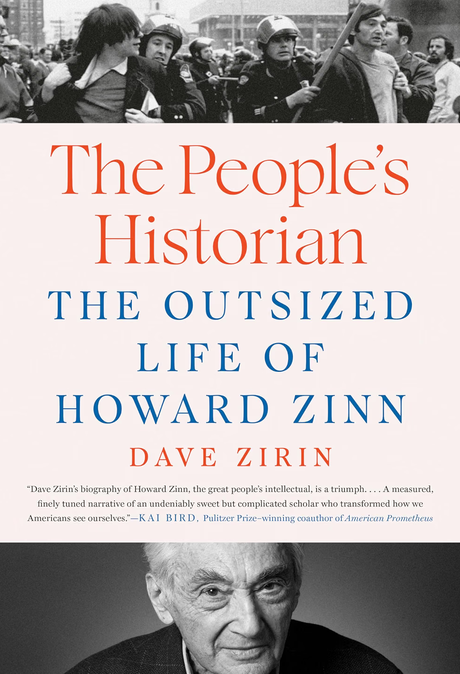
The life and impact of one of America’s most beloved — and most reviled — scholars unfolds in cinematic strokes in Dave Zirin’s The People’s Historian. Howard Zinn (1922-2010), the progressive icon, is best remembered for his radical textbook, A People’s History of the United States. But he was also a “happy warrior” who put his principles into direct social action and encouraged others to so, too. In this admiring tribute, Zirin traces the path of Zinn’s inspiring life through the key national moments and movements that helped shape both the man and America.
Though not a comprehensive biography, The People’s Historian focuses on how the son of poor Jewish immigrants cultivated early on a love of reading and an empathy for the common worker. Raised in a tenement, Zinn went to work right out of high school as an apprentice shipfitter at the Brooklyn Navy Yard, where he rapidly became a union organizer.
A primary source in Zirin’s account is Zinn himself, whose words Zirin quotes liberally (no pun intended). The narrative is often in conversation with Zinn, and the author is a keen-eyed interlocutor with a penchant for punchy prose. When it comes to Zinn’s commitment to labor issues, Zirin paints a potent visual:
“…rather than climbing the ladder of American prosperity, he decried a ladder that demanded stepping on the hands of others also trying to ascend.”
Perhaps not common knowledge, Zinn enlisted in 1944 and flew on several World War II missions as a bombardier. In the military, he witnessed both racism and the atrocity of impersonal killing — because he was part of the latter. The French village of Royan supposedly contained a “smattering of Third Reich dead enders,” which precipitated the American bombing raid that “rained death” on 3,000 civilians and what turned out to be only 23 German soldiers. Zinn’s role in the slaughter would vex him for the rest of his life and make him feel “he was a party to a historic crime.”
Zinn’s journey into the movements of Civil Rights, Vietnam protest, and Democratic Socialism was not a solitary one. Zirin pays egalitarian attention to Zinn’s wife, Roslyn (Roz to those who knew her). Married for 63 years until her death in 2008, the couple was dedicated to each other, but even more so to the causes they believed in. Zirin devotes an entire chapter to Roz and describes her as a “deeply political person who infused her politics with an empathy that only true believers in mass social change can understand.” Along with her progressive activism and role in raising their two children, Roz was the impetus behind Zinn’s decision to pen his popular history (which she also edited).
The academic fisticuffs, firings, protest marches, and birth of A People’s History form an engaging, accessible narrative, even if Zirin tends to some repetition and editorializing. He knows how to tell stirring stories from Zinn’s life, with perhaps one of the more powerful being Zinn’s seven years spent teaching at Spelman College, an all-female Black institution in Atlanta:
“He could lecture in the classroom about Black history — at a school with no Black history classes as of 1956 — and then prove his sincerity to his students and the administration by going into the streets and picketing, committing acts of civil disobedience, and getting arrested.”
When his focus on taking direct action conflicted with administrators’ philosophies on a professor’s duties, Zinn was fired by Spelman, which prompted one of his students to write a letter of protest. Her name? Alice Walker. Zirin quotes from Walker’s letter and explores the admiring relationship she shared with “Howie and Roz.” He seasons The People’s Historian with numerous such stories that personalize Zinn, as well as with his own praise for the man he calls “an unafraid, joyful champion of the unheard.”
Surprisingly, the chapter on A People’s History and its epic afterlife isn’t as in-depth as one might expect, but Zirin nonetheless captures its high points and includes Trump-era reactions to it. Zirin considers the book, which he calls a “counternarrative to the entirety of US history,” the distillation of everything Zinn wrote, learned, and lectured on. It was also a popularizer of the phrase “standpoint theory,” the idea, he explains, that what people know and see, and how they understand reality, “stems from our social position.” And he humorously addresses the criticism Zinn’s masterpiece received from academia for its unorthodox style (i.e., people actually enjoyed reading it).
The People’s Historian is an absorbing, detailed, and warm remembrance of a controversial scholar who believed in “the potential for ordinary people to do extraordinary things.”
Peggy Kurkowski is a professional copywriter for a higher-education IT nonprofit association by day and major history nerd at night. She writes for multiple book-review publications, including Publishers Weekly, Library Journal, BookBrowse Review, Historical Novels Review, Foreword, Shelf Awareness, and the Independent. She hosts her own YouTube channel, “The History Shelf,” where she features and reviews history books (new and old), as well as a variety of fiction. She lives in Colorado with her partner and four adorable, ridiculous dogs.
.png)