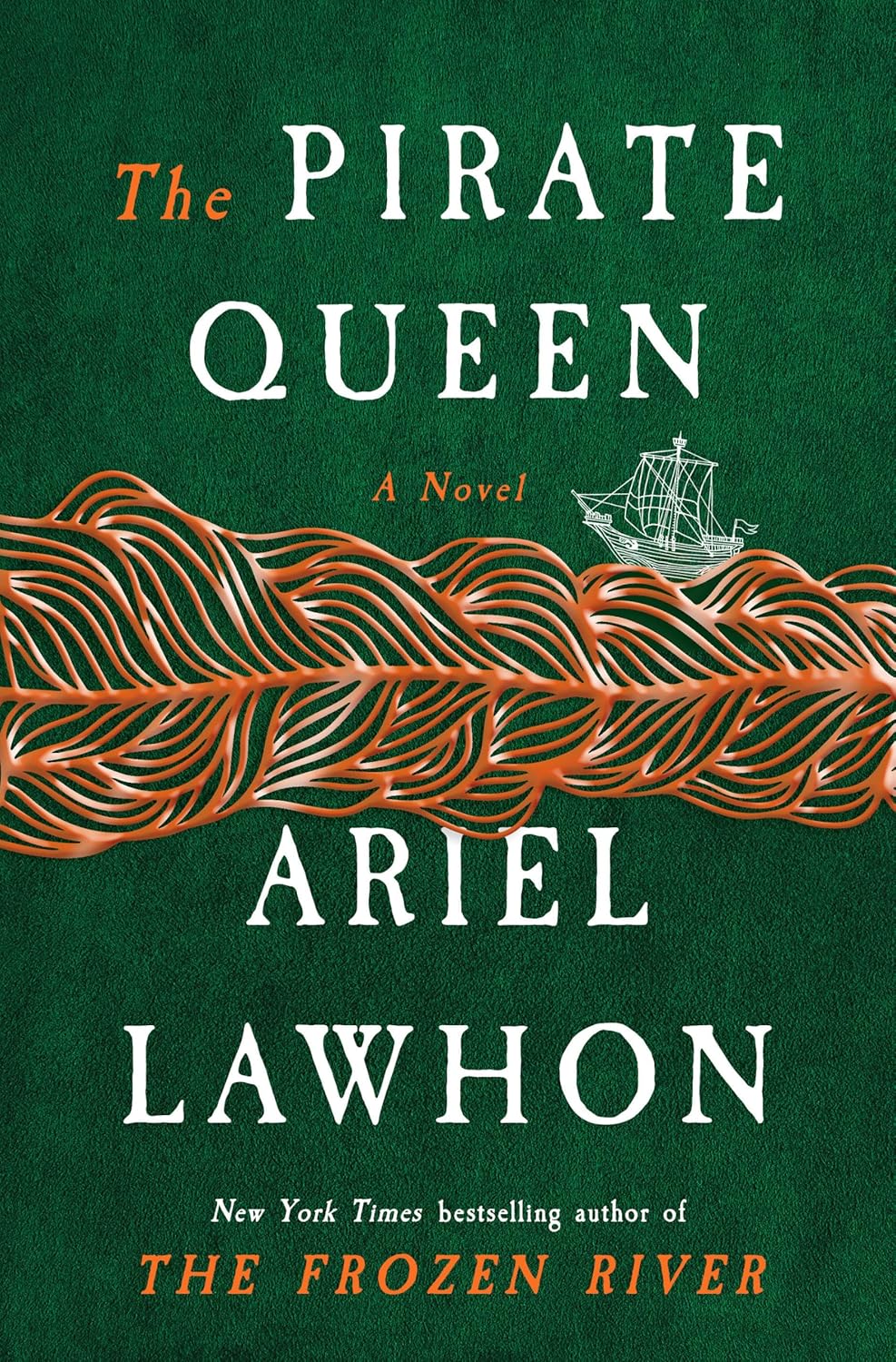
The Pirate Queen: A Novel
- By Ariel Lawhon
- Doubleday
- 528 pp.
- Reviewed by Jennifer Bort Yacovissi
- September 14, 2026
A rollicking tale of the strongest of strong women.
Grace O’Malley — Gráinne Ni Mháille in Gaelic — was born in Ireland in 1530, the younger child and only daughter of The O’Malley, The being the honorific attached to Chief of the Name, the acknowledged head of each clan. Her father is Eóin, her mother is Maeve, and her older half-brother is Donal, born of Eóin’s early romp with a girl from the village.
Donal’s out-of-wedlock birth does not hinder him from being his father’s presumptive heir as chieftain. One problem, though, is that Eóin is a captain with a fleet of ships — the O’Malley clan motto is “Powerful by Land and Sea” — and Donal does not like boats or the open water. Grace, on the other hand, revels in both, demanding at age 5 to accompany her father and his crew on trading voyages, a request he flatly refuses. Girls don’t sail.
Author Ariel Lawhon lays out this exposition quickly and neatly in the first few pages of The Pirate Queen, a captivating fictional account of this outsized and ever-surprising historical figure. Filling her tale with adventure, bloodshed, and much political intrigue, suffusing it with the sights, sounds, smells, and customs of 1500s Ireland and England, Lawhon draws from both the Irish folklore that surrounds Grace and the archival documents, primarily from the English point of view, that expound upon the pirate queen’s long and notorious career.
As Lawhon says in her author’s notes (which she emphatically warns us not to read before we have finished the whole novel, so I promise I won’t spoil anything):
“The Queen’s deputies, Governors, and sheriffs kept up a steady stream of enraged correspondence for roughly forty years, griping about Grace’s exploits along the coasts of Ireland, her efforts at open rebellion, and her shrewd political maneuverings.”
Fans of Lawhon know that she rarely tells a story in straight chronological order, to greater or lesser effect (I didn’t especially like the constant backing up in time in I Was Anastasia). Here, she uses an intriguing device based on the Celtic concept of a woman’s life stages: maiden, mother, matriarch. Chapters march forward in sets of these three stages, with helpful dates and notations of how old Grace is at each point. The chapters are accompanied by a quote from an apropos historical document.
I was skeptical of this approach, worried that it was gratuitous, but it turns out that it works exceptionally well, driving the action and building layers of suspense more effectively than if the tale had been told straight through. Reading it again in chronological order — as Lawhon herself suggests readers may want to try — markedly changes its feel and impact, illustrating that the author knew what she was about. She delivers a page-turner.
It won’t betray anything to say that Eóin eventually relents, realizing that Grace has a natural feel for the sea, the weather, and the ships, and that she is both clever and hardworking — even that she seems to have inherited an O’Malley gift of the Sense, which connects her to the sea god Manannán. But Eóin isn’t happy about any of it. “He needs her to be a noblewoman,” writes Lawhon. “He needs her to stay ashore and build his family name, to give him grandchildren. What he doesn’t need is for her to take after him.” Still, he begins to allow Grace to come on his trading trips to Galway. And whereas Maeve resents Donal, he and Grace develop a tight and enduring bond.
This litany of what Eóin needs from his daughter shapes a large part of her young life, overriding any desires of her own. As every girl born into nobility eventually discovers, she is merely a strategic asset, “a brood mare with nice manners,” as Grace spits at her father. She and Donal are fostered out for their formal education and finishing to the complicated clan interrelations of The McWilliam, where the younger son, Richard, teaches her the intricacies of knife fighting and so wins her heart. Too bad, though: She’s married off to a different man, whom she despises, and is sent off, forced to find her own way as Bean an Tí, the Lady of the House. Along the way, she has three children and gains the loyalty of much of the household.
Grace is 35 the first time she leads men in battle, but from there on, she is unstoppable. It may be surprising how much of the story takes place on land rather than at sea, but all that political maneuvering, including her historically documented parley with Queen Elizabeth I, really did happen on terra firma. Besides, there are only so many times Grace needs to prove to us that she can lead ships into a fight, or men on a battlefield, and win. She is powerful by land and by sea, and we are with her all the way.
Jennifer Bort Yacovissi’s novel, Up the Hill to Home, tells the story of four generations of a family in Washington, DC, from the Civil War to the Great Depression. She reviews regularly for the Independent and serves on its board of directors as president. Follow Jenny on Bluesky at @jbywrites.bsky.social.