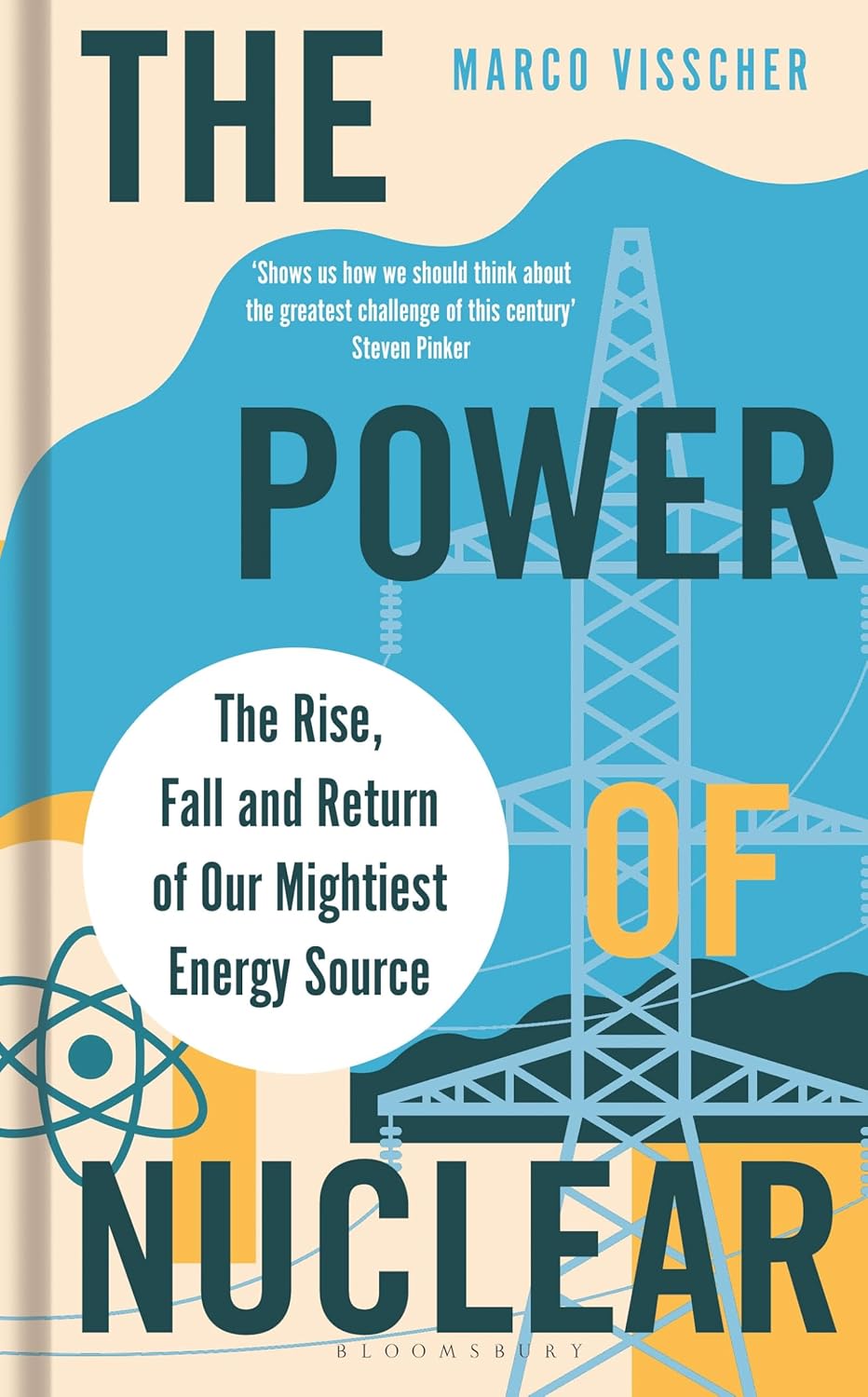
The Power of Nuclear: The Rise, Fall and Return of Our Mightiest Energy Source
- By Marco Visscher
- Bloomsbury Sigma
- 320 pp.
- Reviewed by Jay Hancock
- January 14, 2025
Leave the bombs in the past and look to the future.
Three nuclear reactors at the Fukushima Daiichi plant melted down and exploded after a tsunami in 2011. Radiation spread hundreds of miles, dosing plant and rescue workers with tens or hundreds of times safe levels. Japanese authorities evacuated 150,000 people, many for years or forever.
Experts predicted radiation mortality and cancer epidemics. “Potential Nuclear Disaster” declared the New York Times. A “poison cloud” threatened Tokyo, a British tabloid reported. If only anybody had listened to them, environmentalists wrote in op-eds, this never would’ve happened.
But the number of radiation deaths from Fukushima, reports Marco Visscher in The Power of Nuclear, turned out to be zero. There have been no cancer outbreaks, no increases in birth defects or overall deaths. Ironically, thousands of people, including frail nursing-home and hospital patients, did die as a result of the evacuations.
Meanwhile, coal, oil, and gas burning put another 30 billion tons of carbon dioxide in the air last year. Atmospheric carbon dioxide, universally acknowledged as a greenhouse gas, has risen 40 percent since 1900. Earth temperatures have increased more than two degrees Fahrenheit. The year 2024 is now the hottest on record.
Visscher, a Dutch journalist, once opposed nuclear energy. “Now is the time to bring the nuclear industry down, before it can ruin the twenty-first century,” he wrote in 2000. Decades later, he has published here a careful and brilliant analysis portraying nuclear electricity as an indispensable part of quitting carbon energy.
“Original and gripping,” say the book’s blurbs. “A timely intervention.” “Clear explanation.”
All true. The Power of Nuclear, published in Europe in 2022, should amplify the message that solar and wind energy alone are not enough to end carbon pollution. The work is also a model of critical thinking in a world fogged by memes, egos, and intellectual garbage. Visscher considered the arguments, assembled the facts, double-checked them, weighed them, and changed his position, angering allies along the way.
Who else do you know, in public life or private, who has done that lately?
Starting with the discovery of protons and neutrons at the center of gold atoms in 1911, the book tells the panoramic story of nuclear research, nuclear war, nuclear power, nuclear horror, and nuclear hope — all in 266 pages, not counting back matter, a tidy packet that necessarily deprives the tale of range and grandeur. Those seeking the full Promethean and Faustian drama should go to Richard Rhodes’ The Making of the Atomic Bomb, accurately described by Visscher as “the longest page-turner” most of us are likely to read.
The first rule of fair debate is to take possible objections to your argument and consider them “in their most plausible and persuasive form,” as John Stuart Mill said a long time ago. Good luck finding examples of that in modern discourse. Yet Visscher carefully and forcefully presents the anti-nuke position and then dismantles it. As an apostate, he knows all the talking points, many of them scarily compelling.
To wit: The industry has a long record of broken promises about safety. Plant operators are naturally secretive, and it doesn’t matter if they’re the Soviet government or Metropolitan Edison. Radiation damage to living creatures is unseen and unfelt until long after exposure. Reactor waste stays radioactive for thousands of years.
But the world is a stew of needs, threats, and policy tradeoffs. The tradeoff here is to embrace and manage the risks of nuclear energy (with know-how accumulated over 70 years) in return for limiting global warming (maybe the biggest threat of all) while lifting a billion people out of poverty via low-carbon energy.
One Visscher theme is the contrast between the intense fear and regulation around nuclear energy and society’s looser approach to much more dangerous energy sources. Air pollution from indoor cooking in the developing world and coal-fired electric plants, for instance, kills many more people than nuclear energy.
“A coal mine collapses. A gas pipeline bursts. An oil train derails. A dam breaks,” he writes. “These things happen and people die, but no one demands that an entire industry be shut down.”
On the other hand, nobody blew up Hiroshima with an oil train. Atomic energy will never escape its association with hellish weapons, which probably has more than a little to do with the exaggeration and sensationalism of nuclear accidents. The taboo and fear keeping humans from using nuclear bombs since World War II have also hampered civilian atomic-energy use.
But over and over, Visscher shows that even respected news organizations and documentary-film studios get nuclear-power accidents very wrong. One misinformation prize goes to a Dutch TV newsroom that blamed the Japanese tsunami on the Fukushima meltdown. In fact, it was vice versa.
Even at Chernobyl, site of the world’s worst nuclear-plant disaster, the number of immediate and long-term deaths — a few dozen, according to the United Nations Scientific Committee on the Effects of Atomic Radiation — turned out to be much lower than that estimated by journalists and even public-health authorities. Radiation may be much less harmful than we fear, Visscher says.
In any event, wind and solar energy are insufficient to unplug the planet from the hydrocarbon furnace. They don’t make kilowatts when the sun sets or the breezes cease. Adequate battery-storage capacity to solve this shortcoming is decades away.
Every argument against nuclear power, says Visscher, still an environmentalist, is an argument for keeping ExxonMobil and Saudi Aramco in business for a very long time.
Jay Hancock was the chief economics correspondent for the Baltimore Sun. His free Substack newsletter is here.