The Price of Power: How Mitch McConnell Mastered the Senate, Changed America, and Lost His Party
- By Michael Tackett
- Simon & Schuster
- 416 pp.
- Reviewed by Ira Shapiro
- November 19, 2024
The Kentucky senator long intended to bend Congress to his will.
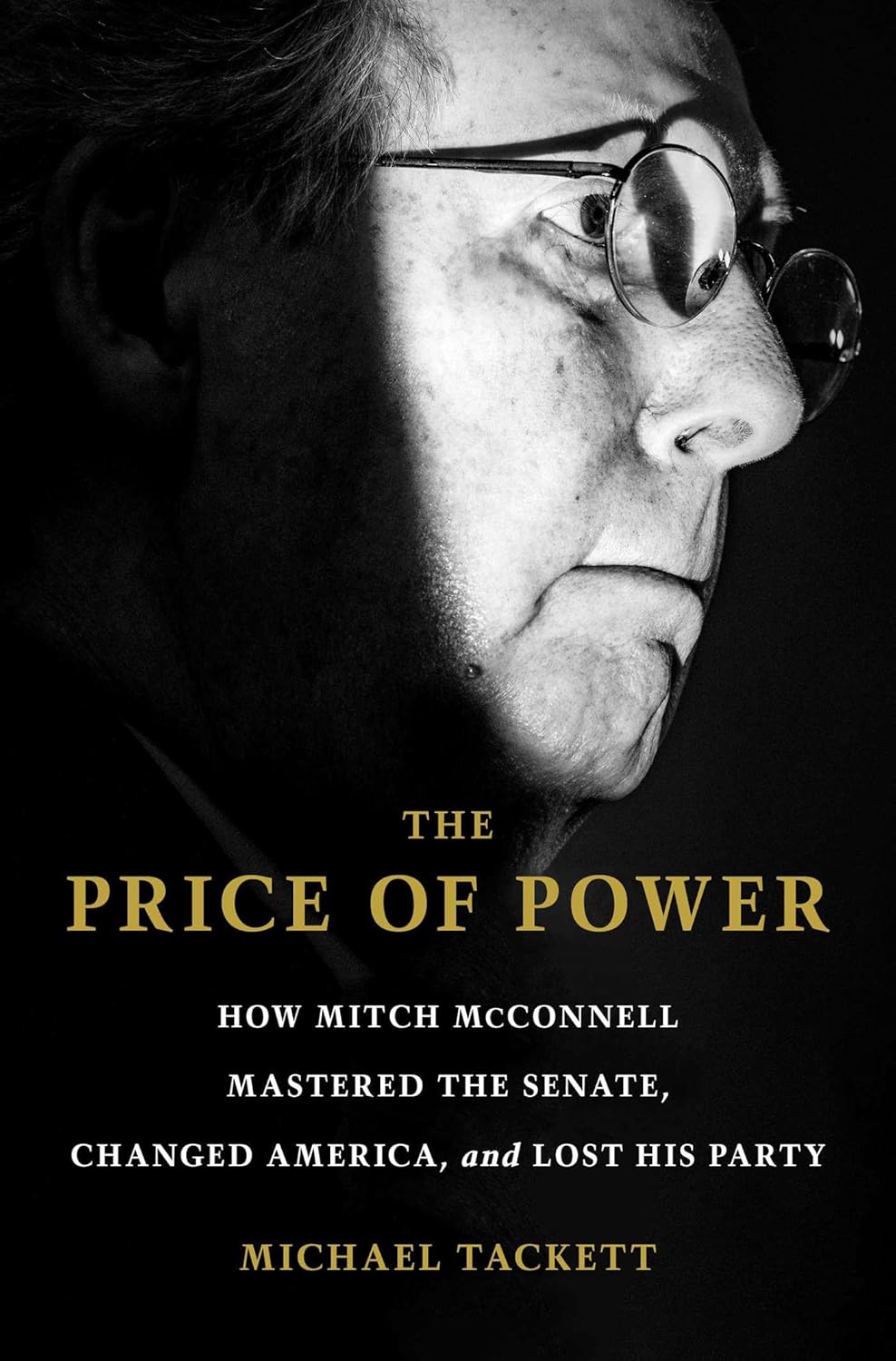
In 2021, Senator Mitch McConnell learned that Michael Tackett, a respected veteran journalist and author, was planning to write his biography. McConnell, notoriously guarded, encouraged his staff and other close associates to speak with Tackett. He also gave Tackett access to his papers, including sensitive oral histories, and sat with him for 50 hours of interviews. McConnell’s decision to cooperate benefited both the author and him. Tackett’s The Price of Power is, thus far, the most comprehensive and fair-minded account of McConnell’s life and career.
Tackett attributes McConnell’s fierce determination to overcoming childhood polio with strength and stoicism and to the unflagging love and support of his parents. His chronicle shows that McConnell became enthralled with politics early, running for office in high school. Recognizing that he had no real appeal, McConnell cultivated the popular classmates who did. He won his election to be student-government president and set his long-term goal of becoming one of Kentucky’s U.S. senators. Like many aspiring politicians before or since, McConnell shuttled between his home state and Washington, DC, where he worked as a Senate staffer and a Justice Department official in the Ford administration.
Despite gaining valuable experience and building important relationships, McConnell, still in his early 30s, regretted a “lost decade” since he had not yet run for higher office. Returning to Louisville, he seized the opportunity to run for chief judge of Jefferson County, essentially chief executive of Kentucky’s largest county. Bringing youth, energy, and the promise of change to an intense campaign, McConnell won an upset victory in a Democratic county. Having achieved an elected position, he immediately set his sights on the real prize: running for the U.S. Senate in 1984 against Walter “Dee” Huddleston, the genial and popular Democrat strongly favored to win a third term.
“As Mitch McConnell embarked on his decades long plan to run for the Senate,” Tackett recounts, “there was near universal agreement on one thing: he had no chance.” In a July poll taken months before the election, McConnell trailed Huddleston 67-23. But then McConnell met Roger Ailes, the high-powered media consultant who first became famous by helping Richard Nixon come back to win the presidency in 1968.
McConnell suggested it might be good to run some positive ads.
Ailes: “Do you want to look nice, or do you want to take out your opponent and win this thing?”
McConnell: “I want to do what it takes. I want to win this thing.”
Finding that Huddleston had missed some votes while giving speeches for honoraria, Ailes concocted one of the memorable ads in the history of American politics: a pack of bloodhounds sniffing around a resort swimming pool looking for the absent senator. The ads were an instant hit, the race started to turn, and McConnell, on Ailes’ advice, hammered Huddleston relentlessly. On election night, McConnell won by 5,000 votes, a 0.3 percent margin. On that slim margin, one of the most extraordinary political careers in American history was launched.
Arriving in the Senate, McConnell immediately staked out his ultimate goal: becoming Senate majority leader. He easily won re-election, but it took 22 years before he became Republican leader, and another eight before he was named majority leader. McConnell titled his 2016 memoir The Long Game, and Tackett offers vivid examples of how McConnell managed to combine intense ambition with great patience; his love of politics and his commitment to winning are all-consuming.
Tackett deftly shows that McConnell’s rise to power was closely tied to his understanding of the role of money in politics. He earned the admiration and eventual support of his Republican colleagues by waging a years-long fight against the late John McCain, who wanted to limit political spending. McConnell lost battles along the way but ultimately won decisively when the Supreme Court, in the 2010 Citizens United case, held that money equals speech and therefore cannot be limited. From then on, McConnell became the most effective Republican fundraiser and strategist of his or any other era: a vertically integrated political machine.
For example, in 2016, McConnell orchestrated the victory of Todd Young over Evan Bayh, the popular former Indiana governor who was seeking to return to the Senate, which he’d retired from. As Tackett astutely explains:
“It was a vivid demonstration of how McConnell amassed, then wielded his power, creating a campaign apparatus to help Republican candidates and to build loyalty to himself as the party leader. The conservatives on the Supreme Court, in their Citizens United decision, had created a financial pipeline that McConnell built into a vast political ecosystem. It played to all of McConnell’s strengths: the politics, shorn of the weedy details of policy. He helped pick candidates, he helped fund their campaigns, he delivered strategic advice, his Super PAC ran millions of dollars in advertisements, and their success was McConnell’s success. It was mutually reinforcing.”
Because Tackett’s book covers McConnell’s whole life, the narrative moves quickly through the senator’s role in the tumultuous events of the Trump era, including the second impeachment trial, during which McConnell memorably condemned Trump’s incitement of the January 6th attack on the U.S. Capitol but nonetheless voted to acquit him (when conviction would’ve disqualified Trump from seeking the presidency ever again). This reader hoped for more insight into McConnell’s thinking about those volatile times, especially given the extensive interviews the author conducted. But perhaps it can be summarized simply in the words of Mona Charen in the Bulwark:
“Ultimately, McConnell’s partisanship overwhelmed his patriotism.”
Even McConnell’s most severe critics — I am one — must respect his brilliance as a political strategist and tactician. He has outworked, out-thought, and outlasted virtually everyone else. His scorecard shows countless victories and few defeats. The Price of Power arrives at a moment when McConnell is celebrating yet two more victories: the Republicans’ retaking of the U.S. Senate earlier this month, and the naming of John Thune, McConnell’s deputy, as majority leader over Rick Scott, whom McConnell detests.
In February 2024, McConnell observed, “History will settle every account.” His record tenure as Senate leader coincides precisely with that chamber’s descent into bitter partisan division and its worst failures. Given his profound impact on all three branches of government, McConnell will get that page in the history books he worked so hard to earn. Ultimately, what it says is likely to depend on the results of his most consequential actions: Donald Trump’s second term as president and the installation of a radical Supreme Court.
Ira Shapiro, a former U.S. Senate staffer and Clinton administration trade ambassador, is the author of three books about the Senate, the most recent of which is The Betrayal: How Mitch McConnell and the Senate Republicans Abandoned America.