The Price of Victory: A Naval History of Britain: 1815-1945
- By N.A.M. Rodger
- W.W. Norton & Company
- 976 pp.
- Reviewed by Steven Groff
- May 30, 2025
This conclusion to a trilogy is richly detailed, if light on drama.
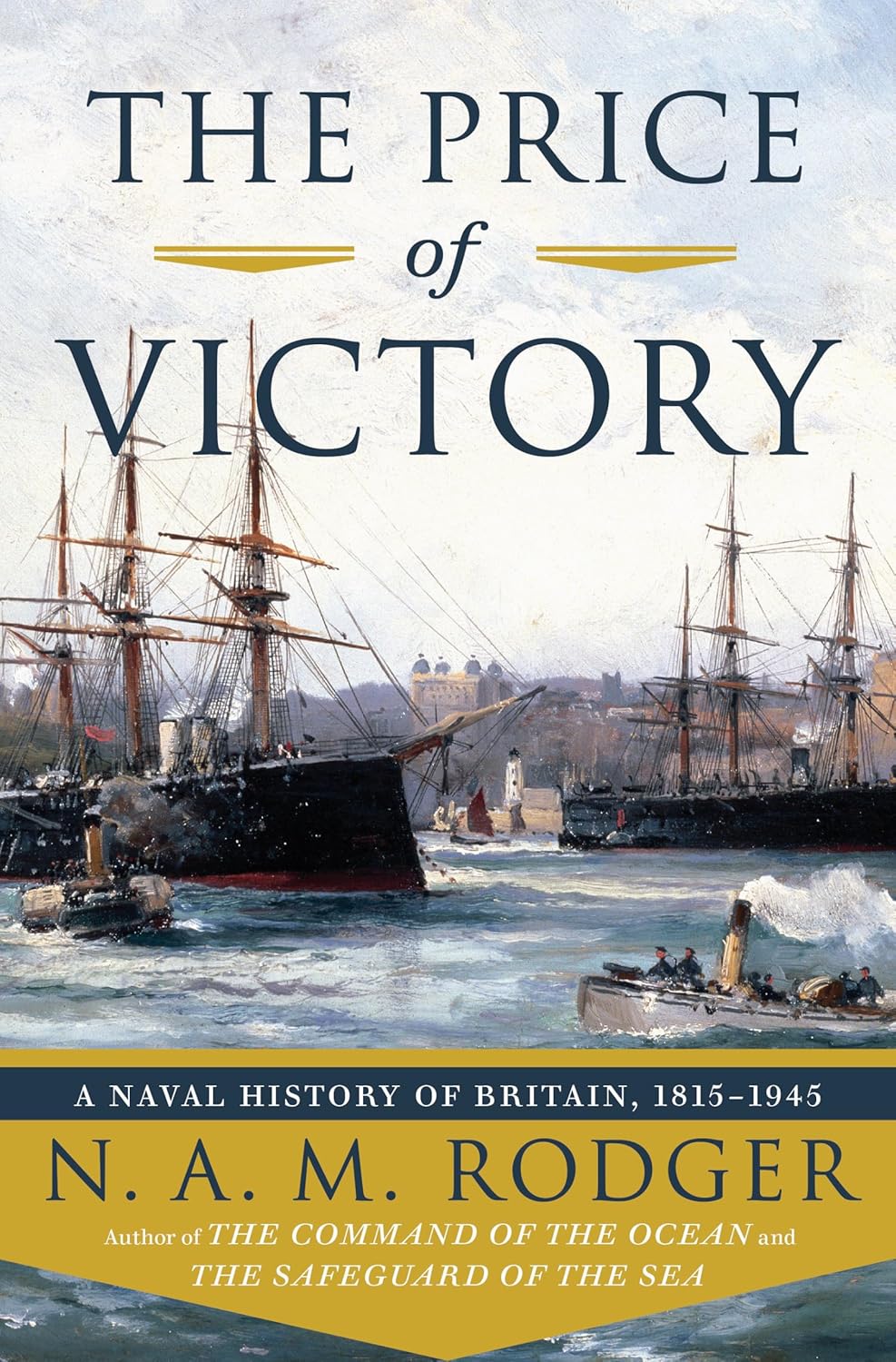
The Price of Victory is the final installment in N.A.M. Rodger’s trilogy covering the history of the British Navy from the 7th century through World War II. This volume starts in 1815, as the Royal Navy has become the preeminent world power and commands the seas, and wraps up with a brief overview of the sailing force from 1945 through to today.
If you desire a tale of battles and related tactics and strategy, this is not the book for you. Rather, its aim is to illuminate the political, economic, societal, and international thinking and events that drove the evolution of the British Navy. Why did Great Britain need such a large navy? How did it afford to recruit, train, and sustain so many sailors for so many decades? And how did Britain lead the development and implementation of groundbreaking technologies like the modern battleship, submarines, and aircraft carriers? Rodger details all of this while at the same time contrasting how rival navies from France, Germany, Russia, Japan, and especially the United States evolved during the same period.
The book’s title derives from the reality that the British Empire paid for its free and open trade across its vast expanse, as well as for stability in continental Europe and around the world. The Royal Navy, along with a large merchant fleet, was the main instrument for maintaining — and quelling challenges to — that stability. In 1815, supremacy over the seas was vital, but functioning as a superpower came at great expense. Rodger details how the cost was not just financial; the navy was pulled in different directions by political actions, economic realities, and available manpower that had to be trained, fed, and billeted globally. He writes:
“In the era of the world wars of the twentieth century, that supremacy was challenged by new enemies and weapons which were in the end defeated, but at a high price that weakened the national economy thereafter.”
I was surprised by much of this book. For example, until WWII, the Royal Navy struggled immensely to train officers, particularly technical specialists. The predominant thinking throughout the middle and late 1800s was to distrust experts and rely instead on “gentlemen” and “good breeding” to ensure the best decisions on strategy, tactics, and ship design. Experts were considered too biased to make critical decisions, even at a time when mechanical advances and foreign competition were driving the fleet toward ever more complex technology. The idea of formal officer training — analogous to the kind offered at the U.S. Naval Academy — didn’t finally become the norm in the United Kingdom until World War II.
For military-history geeks like me, this volume provides deep insight into the myriad factors required to develop and sustain a fighting force capable of waging and winning seagoing battles across the globe. The fact that comprehensive, effective, and repeatable training strategies took decades to develop is mind-boggling, as is the realization that actual joint-service coordination and effective central management of the Royal Navy — taken for granted today — was largely nonexistent during the majority of the period covered. Some readers will be amazed, too, by the navy’s ability to dominate and vanquish its enemies throughout the 19th century given the internal chaos and dysfunction back in London.
And yet. As mentioned, if you picked up The Price of Victory hoping for tales of epic clashes like 1916’s Battle of Jutland or 1941’s sinking of the Bismarck, you’ll likely be disappointed. The wartime sections delve more into strategy than actual battles, although readers should appreciate Rodger’s chronicling of the Royal Navy’s feats during WWII, which are often overshadowed by America’s storied achievements in the Pacific Theater. Also, while the book unfolds chronologically, a chapter may cover several decades, and the author often jumps around within those decades. Keeping the timeline straight can be difficult. (There are several factual errors, too, such as when he states the USS Monitor sank two Union ships in 1862; it was the CSS Virginia, formerly the USS Merrimack, that destroyed the vessels.)
Rodger delves a bit into the personal motivations and convictions that influenced events on the seas, most poignantly during the WWII period. While extensively researched, his conclusions that those with professional rivalries or personal scores to settle would knowingly work against the common war effort — at the cost of untold lives and materiel — left me unconvinced. I also feel he significantly downplayed the impact of signals intelligence (and the sharing of it among the Allies), which has been well documented elsewhere. Overall, this able, fact-filled volume will appeal to serious students of Britain’s military exploits on the waves. Casual readers may struggle to keep their heads above water.
Steven Groff is a retired intelligence officer, docent at the National Cryptologic Museum, enthusiastic student of American and British history, and self-described history geek.