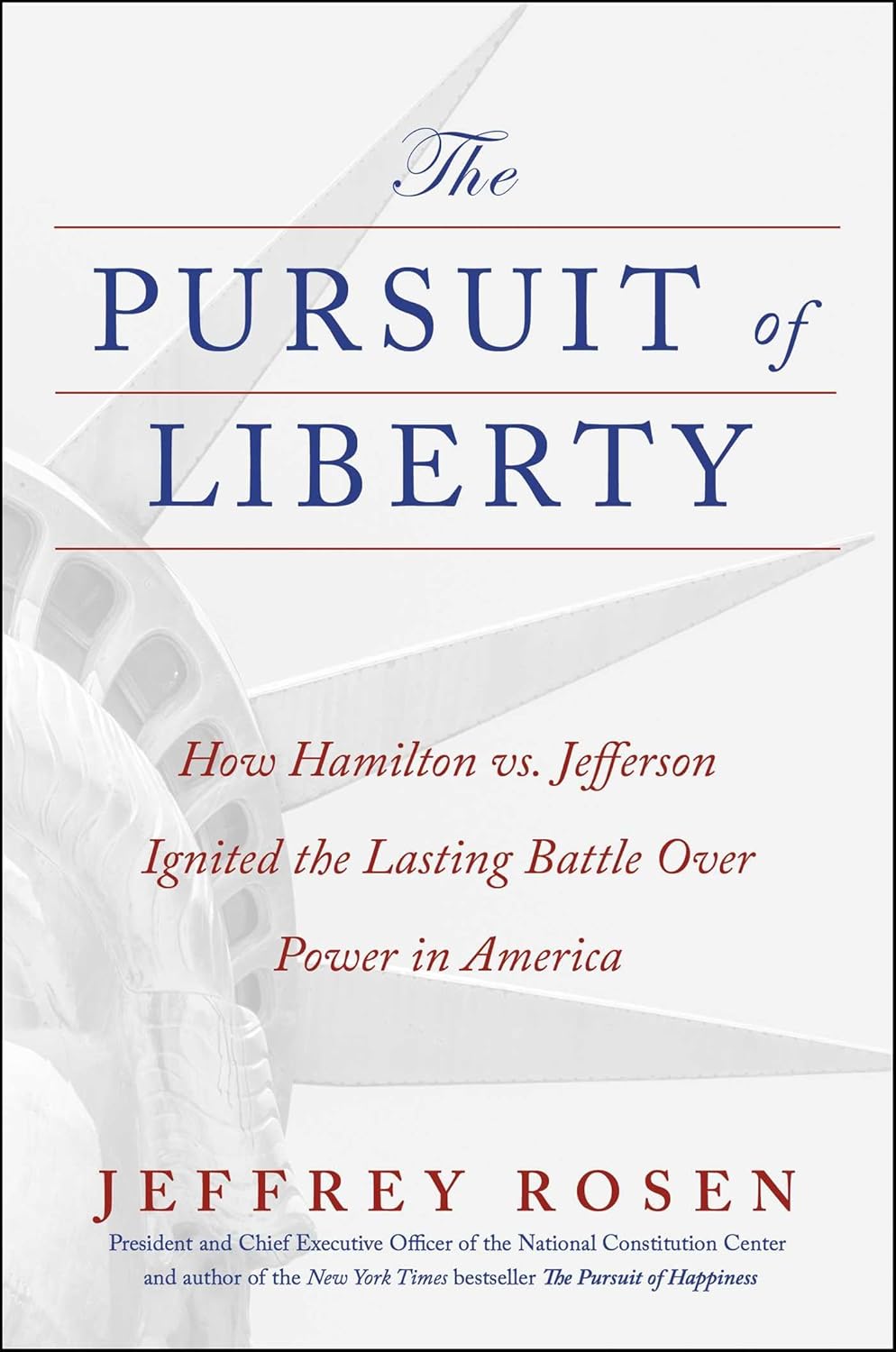
The Pursuit of Liberty: How Hamilton vs. Jefferson Ignited the Lasting Battle Over Power in America
- By Jeffrey Rosen
- Simon & Schuster
- 448 pp.
- Reviewed by Jennifer Bort Yacovissi
- December 23, 2025
Proving once again what a miracle it is we’ve made it this far.
When you speak to your great-grandchildren about the current splintering of our 250-year-old republic — and you will — be sure to let them know the seeds of our destruction were sown in April 1791 at a dinner party.
And that, kids, is why we don’t entertain.
According to Jeffrey Rosen in his latest look at the Founding Fathers, The Pursuit of Liberty, it was several comments made by Treasury Secretary Alexander Hamilton over the course of the evening which may or may not have been misinterpreted by Secretary of State Thomas Jefferson that served as the inciting event. Hamilton’s statements confirmed Jefferson’s long-held suspicions that Hamilton was a monarchist.
While Hamilton didn’t believe in hereditary leadership, he did, in fact, support the concept of a president who was elected for life in the belief that preventing the tyranny of the mob required a strong, stable leader. Given that Jefferson initially felt presidents should be elected every year because the tyranny of the sovereign was the greater threat to the state, it was hard to see the possibility of a middle ground. (James Madison typically offered that middle ground, albeit more quietly than those incendiary opposites.)
As Rosen says, “It’s true that both Hamilton and Jefferson thought the text of the Constitution should be interpreted in light of the spirit in which it was adopted, but they fundamentally disagreed about what that spirit was: for Hamilton, federal power should be construed liberally; for Jefferson, strictly.”
They fought over the meaning of the Necessary and Proper clause (was that absolutely necessary [T.J.] or more like useful/helpful [A.H.]?), whether the Constitution afforded the executive implied powers (Hamilton: You bet! Jefferson: Never!), and whether the Constitution was ratified by the states (Jefferson, states’ rights) or if The People — therefore the nation — did (Hamilton, federalism).
I found myself wondering: Would they have pulled so hard in opposite directions if each hadn’t seen the other as obdurate? Did they reinforce in each other the commitment to extreme positions? (I also imagined the eye-rolling frustration of George Washington as each man ran to him to tattle on or complain about the other; they were both unhelpfully thin-skinned.) The number of times just in the first 20 or 30 years that one side or the other threatened to take their ball and go home — to secede from or nullify the union — underscores how deeply into our foundations these divisions run.
The Pursuit of Liberty is written for the interested layperson, and engagingly so. It’s filled with reminders and perhaps revelations of how these two interpretations of the American idea have fought with each other — to and beyond the brink — over 250 years, risen into and fallen out of favor, been repeatedly codified and overturned, been deployed in both good and nakedly bad faith, and, eventually, “like two drunken men,” per Abraham Lincoln, had crossed sides and exchanged principles so often that it’s sometimes hard to track back to the original position.
Asked to give a thumbnail description of our two major political parties — if we consider the time before that infamous ride down the golden escalator in 2015 — most reasonably informed people would probably offer that Republicans represent the monied interests and want a small, non-intrusive federal government, while Democrats support a stronger federal government that can help the little guy get a fair shake. In this way, each party is generally assessed to be half Jeffersonian and half Hamiltonian. Who would’ve guessed that the hero of our favorite hip-hop musical cared more about property rights than civil rights and was forever urging that the military be called in to beat down the latest citizen uprising?
Still, like Rosen (I intuit), I found myself coming down on the side of Hamilton more often, at least as the republic was just getting its legs under it. The newly birthed country needed a strong executive to get it into the habit of thinking of itself as a union, given that for so long, it had been the several states, each protective of its own privilege. For many, Hamilton’s deep understanding and championing of the need for a federal financial system is the national bedrock that allowed America to endure and to thrive.
In contrast, the strictly constrained concepts of government that Jefferson put forward often seemed impracticable and prone to chaos, especially as the nation grew larger and more populous. How exactly would it have worked if each branch of government had been allowed to interpret the Constitution as it saw fit and to act accordingly? (Arguably, we’re experiencing that right now, as the executive seems free to ignore the judiciary’s rulings however it likes.)
His romantic mythology of incorruptible yeoman farmers as the ultimate steadying hand on the ship of state, along with his philosophy that “I like a little rebellion now and then,” don’t hold up as a long-term governing strategy. (Chief Justice John Roberts notes that Jefferson had a “somewhat precious attachment to ideas for the sake of ideas,” in a way that was perhaps less “invested in the success of the American experiment.” I feel the need to ask, “Exactly how invested are you, C.J. Roberts?”)
Given that the Supreme Court gets to pick winners and losers in these arguments, and that the author is a longstanding scholar of the Court, it’s only fitting that Rosen deeply probes its various justices, cases, and decisions over the years. Again, it seems clear that the nation was lucky early on to have the long tenure of Chief Justice John Marshall, a Hamiltonian Federalist, so the union’s roots could take hold and flourish, before we got his successor, states’-rights-champion Roger B. Taney (of Dred Scott infamy).
Rosen walks us through all the significant constitutional fights, through Bush v. Gore, and delivers us into the world we’re experiencing today. He notes, “[Trump’s] election would soon give conservatives a Jeffersonian majority on the Supreme Court,” and yet that court has conferred upon him Hamiltonian monarchical powers, allowing him to indulge in, among other things, “Hamilton’s unfortunate habit of trying to use the law to retaliate against his political enemies.”
In this executive’s apparent capture of all three branches of government — “what distinguishes an ordinary populist demagogue from a would-be dictator is a successful assault on the separation of powers,” Rosen notes — it is hard to imagine that any of the founders, including Hamilton, would find cause for celebration.
The genius of Rosen’s book is to make the reader interrogate where she lands in this long-running debate. For each of us, what is the American idea? (This reader has plenty of thoughts.) Rosen, noting that Jefferson placed a bust of Hamilton across from his own at Monticello, leaves us with his assessment:
“The success of the American experiment doesn’t require agreement between Hamiltonians and Jeffersonians about how to balance liberty and power; it requires a good faith commitment to participate in the inevitable tug-of-war between them…The founding of America on the principles of liberty, equality, and government by consent is one of the most inspiring events in world history.”
The emphasis on the author’s “good faith” is my own. It is the piece that I worry we may have irrevocably lost.
Jennifer Bort Yacovissi’s novel, Up the Hill to Home, tells the story of four generations of a family in Washington, DC, from the Civil War to the Great Depression. She reviews regularly for the Independent and serves on its board of directors as president. Follow Jenny on Bluesky at @jbywrites.bsky.social.