The Rarest Fruit: A Novel
- By Gaëlle Bélem; translated by Hildegarde Serle
- Europa Editions
- 192 pp.
- Reviewed by Alyson Foster
- July 25, 2025
An enslaved boy’s cuisine-altering innovation is credited to his white “father.”
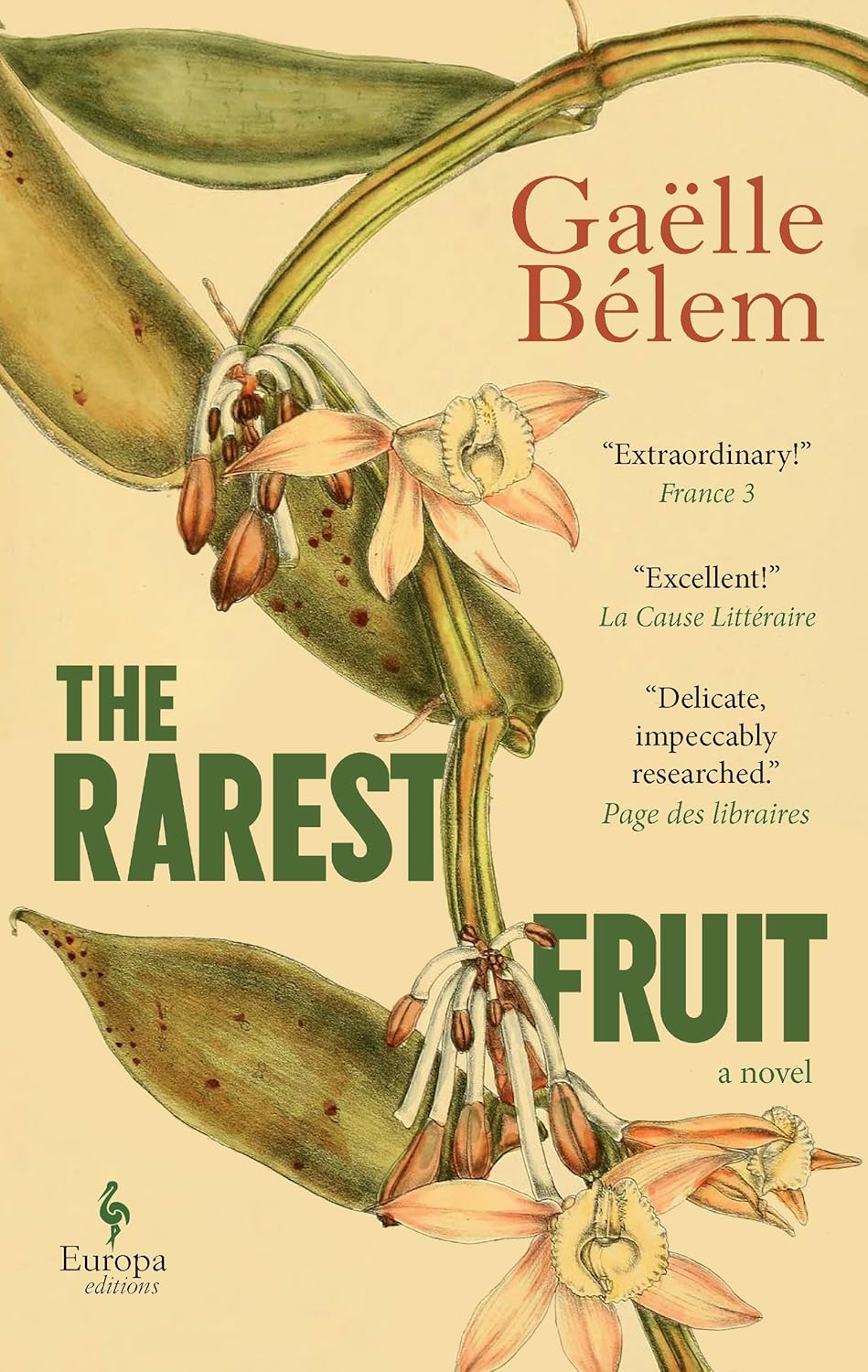
The Reunionese writer Gaëlle Bélem is drawn to tragic and darkly humorous stories of colonialism and its consequences. It’s a proclivity that makes her well suited to tell the story in her second novel, which centers around the strange-but-true history of vanilla and its introduction to the West, one full of ironic plot twists that she relates briskly to readers.
Among the facts we learn in The Rarest Fruit: that the aromatic flavor was introduced to explorer Hernán Cortés by the Aztecs, whose civilization he would famously destroy. And that when cuttings of the vanilla planifolia orchid were brought back to Spain in 1529, European horticulturalists were unable to figure out how to get it to produce the beans they assumed would make them a fortune. And also that the plant then proceeded to languish in royal gardens for nearly three centuries until a gardener shipped it to the French colony of Bourbon (now Réunion), where an illiterate slave named Edmond Albius — a 12-year-old Creole boy — developed the method for hand pollination still used in its cultivation today.
Edmond’s discovery had widespread economic and culinary impacts, but it’s his relationship with Ferréol Bellier-Beaumont, the white botanist who raised him, that lies at the heart of The Rarest Fruit, which opens with a different kind of conquest — an emotional rather than military one. Edmond, an orphaned infant, has just been placed in the arms of Ferréol, who is “smitten” with the beautiful baby at first sight. The tender encounter and Ferréol’s impulsive decision to adopt the enslaved child seem to promise a kind of mutual salvation: Edmond will rescue Ferréol from the grief that has consumed him in the wake of his wife’s death, and Ferréol, in turn, will offer protection to Edmond on an island where “tenderness is almost alien.”
Or — as Bélem’s shrewd narrator warns — perhaps not:
“It’s predicted to end badly, like all stories of adoption, that schizophrenia is brewing.”
Ferréol may be Edmond’s father, his ti père, but he is also his owner. He dotes on his adopted son, teaching him the Latin names of flowers but not how to read the books in his library. He spares Edmond from toiling in the sugarcane fields, assigning him instead to the garden, but indignantly dismisses the boy’s aspirations of becoming a botanist. Edmond runs wild through a childhood paradise — Bélem vividly conjures the lush beauty of Réunion’s landscape — but it’s a corrupted Eden populated by fellow slaves, a “bunch of living skeletons” who coldly eye the coddled favorite, awaiting his inevitable downfall.
That downfall comes with Edmond’s great triumph. When he manages to pollinate the vanilla orchid in the garden (Ferréol procured it but failed in his yearslong efforts to make it bear fruit), his father’s response is first to disbelieve him and then to take credit for his protégé’s success. “La vanille, c’est moi,” he declares, as the teenage Edmond travels the island, training farmers in his new technique. The colony’s vanilla production takes off.
A less-nuanced writer might be tempted to reduce Ferréol to a villainous caricature, a tidy symbol of the evils of colonial exploitation. But Bélem resists that simplification, offering something more unsettling about the overt and subtle ways that power imbalances can warp relationships and selfishness can undermine loyalty. In the wake of Ferréol’s betrayal, Edmond’s enslavement becomes increasingly intolerable. The rift widens, and yet Ferréol refuses to let Edmond go, even as he gradually emancipates his other slaves:
“Perhaps old Ferréol, fifty-seven and childless, curses and laments the departure of a son who grew away from him. Perhaps Edmond no longer calls that love, but rather possession.”
At 19, Edmond finally leaves his father’s plantation (slavery was formally abolished on the island in 1848), stumbling out into a country whose fortunes he has helped transform. But life outside the garden presents its own disillusionments and hardships. Edmond is accused of theft by his new employer and sentenced to five years of hard labor in a penitentiary where the convicts “double up laughing” when he tells them of his horticultural feats.
After Edmond and a repentant Ferréol are finally reunited, Ferréol attempts, belatedly, to give Edmond the credit he has been denied. (“La vanille, c’est lui!” he proclaims.) Will the sincerity of these efforts by the now-feeble father salvage their relationship? Or will it be that Edmond finally relinquishes his dreams of recognition and comes to terms with the country he calls home — a new Réunion that is not so different from the old one?
That’s for readers to discover. Human bonds can be repaired, after all, but the wrongs of history may be impossible to rectify. They leave in their wake the ghosts of those like Edmond, “who make us wonder whether they are resting in peace.”
Alyson Foster is an editor and the author of the novel God Is an Astronaut and the short-story collection Heart Attack Watch.