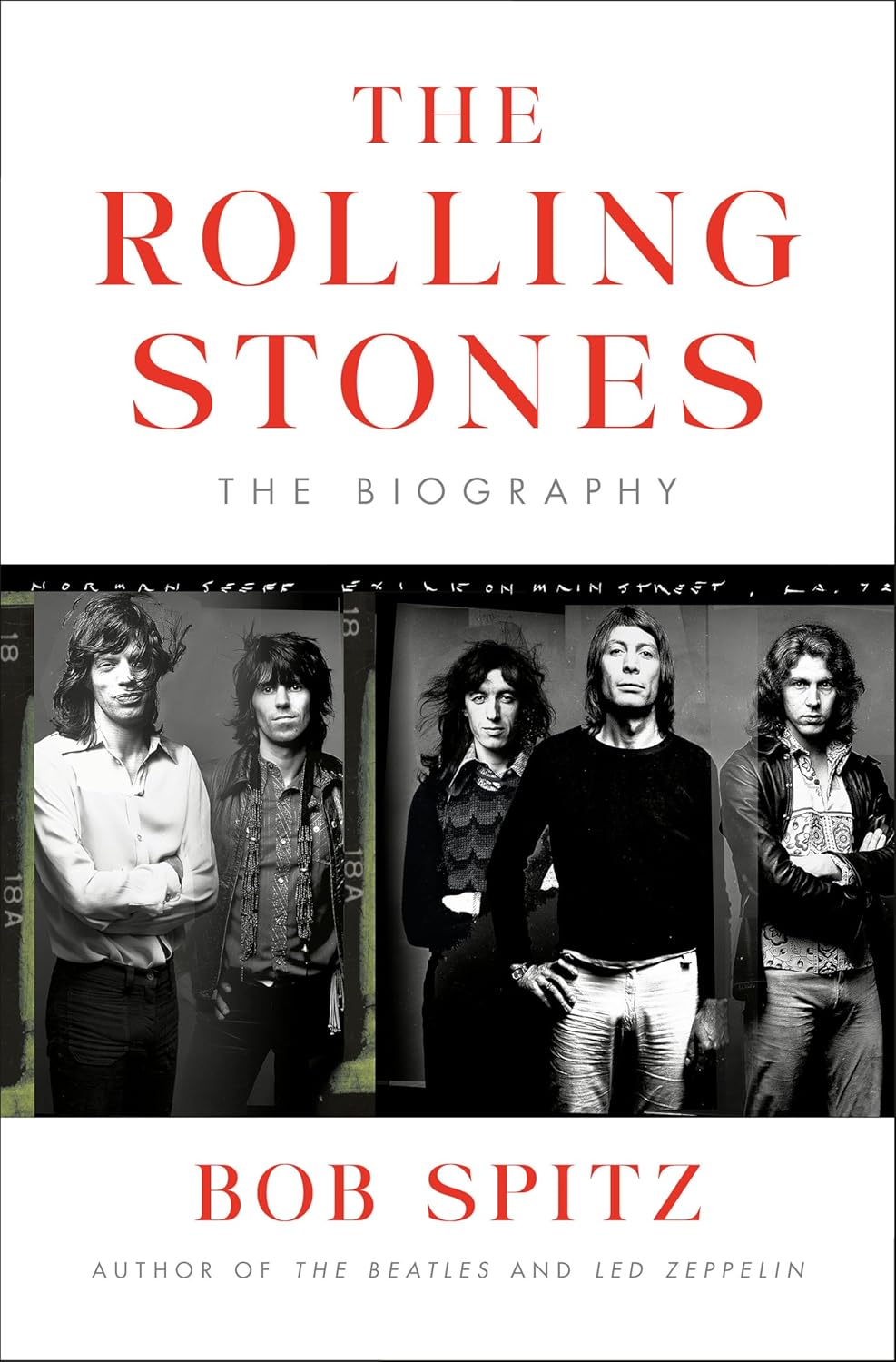
The Rolling Stones: The Biography
- By Bob Spitz
- Penguin Press
- 704 pp.
- Reviewed by Daniel de Visé
- May 13, 2026
An outstanding chronicle of Mick and the boys.
You could argue that the Beatles had two distinct acts. In act one, the band played rock ‘n’ roll to screaming fans on ceaseless tours, with John Lennon as bandleader. In act two, the touring stopped, the songs got deeper, and Paul McCartney gradually supplanted Lennon. At the end of the 1960s, the play was over.
The Rolling Stones, by my count, had at least six acts.
In act one, Britain’s best electric blues band found its footing, led by the blonde-haired musical polymath Brian Jones. In act two, the Stones learned to write pop songs, and their authors took center stage: singer Michael “Mick” Jagger and Chuck Berry-obsessed second guitarist Keith Richards. Act three: An identity crisis led the Stones from pop to psychedelia and then back to American roots music, leaving Jones behind. Act four: The Stones hired a proper lead guitarist, Mick Taylor, and proceeded through a string of albums that latter-day fans would consider their best. Act five: Richards sank into heroin addiction, setting off an artistic decline. The proper lead guitarist quit, replaced by a lesser guitarist, Ron Wood, who was a better fit. And act six: After a stirring late-1970s comeback, the Stones settled into a contented dotage, releasing unremarkable albums and staging massively remunerative tours.
Bob Spitz’s The Rolling Stones: The Biography is the first book I’ve read that covers the whole play. Spitz clearly loves the Stones, as I do. I’ve read a few of the classic Stones texts, including Richards’ literary Life and Stanley Booth’s peerless The True Adventures of the Rolling Stones.
Spitz’s book told me nothing dramatically new about the band. But it was a satisfying read, filling in dozens of little holes in my knowledge base and leaving me with that rewarding feeling of knowing the whole story at last.
Spitz is a fearless biographer who has previously tackled the aforementioned Beatles, Dylan, and Led Zeppelin. I say “fearless” because it’s daring to attempt a biography of such well-chronicled subjects, and also because Spitz, who is American, has the chutzpah to write about British bands.
He may have gotten some of the context wrong about the origin stories of the Stones, but I wouldn’t know. And he interviewed none of the core surviving members for this book, as far as I could tell. But let me say this: I’ve read plenty of biographies of British bands by British authors, and they never, ever take the time to explain the curious workings of the British educational system and other odd British-isms. Spitz does. Thank you.
The friendship between Jagger and Richards sits at the center of Spitz’s project: Two boys who forged a friendship on a railway platform, a creative partnership that would spawn the world’s greatest rock ‘n’ roll band.
Wait, were the Stones the world’s greatest rock ‘n’ roll band? Spitz opines, in his acknowledgements, that their contest with the Beatles was a “dead heat.” That’s charitable. I think the Stones were always a distant second in overall artistry and impact, from the day they formed until the day the Beatles broke up, and I think they knew it. One withering glare from acid-tongued Lennon would put Mick and Keith in their place.
The Stones were probably the most important live rock act in the late 1960s, though, after the Beatles stopped touring. And maybe they were the greatest rock band in the world for a brief moment, in the early ‘70s, an era capped by the legendary ’72 tour. (Zeppelin fans would likely disagree.)
The “two boys” motif reminds me of John & Paul: A Love Story in Songs, the recent offering by Ian Leslie that explores the deep and fractious bond between Lennon and McCartney. That book, by the way, is a great work of pure music journalism: Like Spitz, Leslie had no access to his principal characters (one of whom, of course, is dead).
Richards eviscerates Jagger in Life, leaving the impression that the two boys had barely tolerated each other for decades. Spitz, naturally, delivers a more objective read on their relationship. Jagger and Richards created the Stones as an artistic force, collaborating on most of their greatest songs, written and recorded between roughly 1965 and 1972.
(I was surprised at how many songs Jagger penned largely on his own, including “Brown Sugar,” “Sympathy for the Devil,” and “You Can’t Always Get What You Want.” I’d thought Keef was the musical one.)
The Glimmer Twins endured as a true artistic partnership for about as long as Paul and John lasted. Drugs, I think, drove both duos apart. And drugs, I think, explain why Lennon contributed more sporadically to the Beatles songbook after the mid-1960s and why Richards wrote his greatest songs in the first decade of his tenure in the Stones.
There’s a lot to process in Spitz’s 600-page book. Here are a few tidbits I’ve shared with my Stones-obsessed friends:
- I love his observation that Richards, around the time of “Satisfaction,” started building songs around memorable guitar riffs, and that nearly every subsequent Stones song of note featured one.
- I’d never thought of Jones as the most talented musician in the Stones, as Spitz asserts. I’d dismissed him as a useless appendage, the guy who would show up at the studio, play a few notes on a sitar, and nod off.
- If Richards was the band’s creative spark, he was also its angel of death. His hard-living habits passed to literally dozens of wives, girlfriends, bandmates, roadies, producers, and hangers-on, leaving a veritable Moonlight Mile behind him littered with junkies and wasted souls.
- Women fared poorly in the Stones’ entourage. Mick, Keith, and the others treated girlfriends and groupies about as you’d expect from their lyrics. (For a refresher, listen to the album Aftermath.)
I would respectfully disagree with Spitz on a few critical points, however. I think he unfairly dismisses 1967’s Between the Buttons, the second Stones album filled with entirely original songs. The U.K. version is admittedly weaker, but the U.S. release gave us “Let’s Spend the Night Together,” “Ruby Tuesday,” and a batch of demonic folk classics.
And I don’t get why Spitz mostly ignores the last halfway-great Stones album, Tattoo You (which includes “Start Me Up,” “Hang Fire,” and “Waiting on a Friend”), and devotes long passages to Undercover and Dirty Work, albums no one will ever play again.
But those are quibbles. The Rolling Stones is a thorough, well-researched, and writerly biography. I breezed through it.
Daniel de Visé is the author, most recently, of The Blues Brothers: An Epic Friendship, the Rise of Improv, and the Making of an American Film Classic.