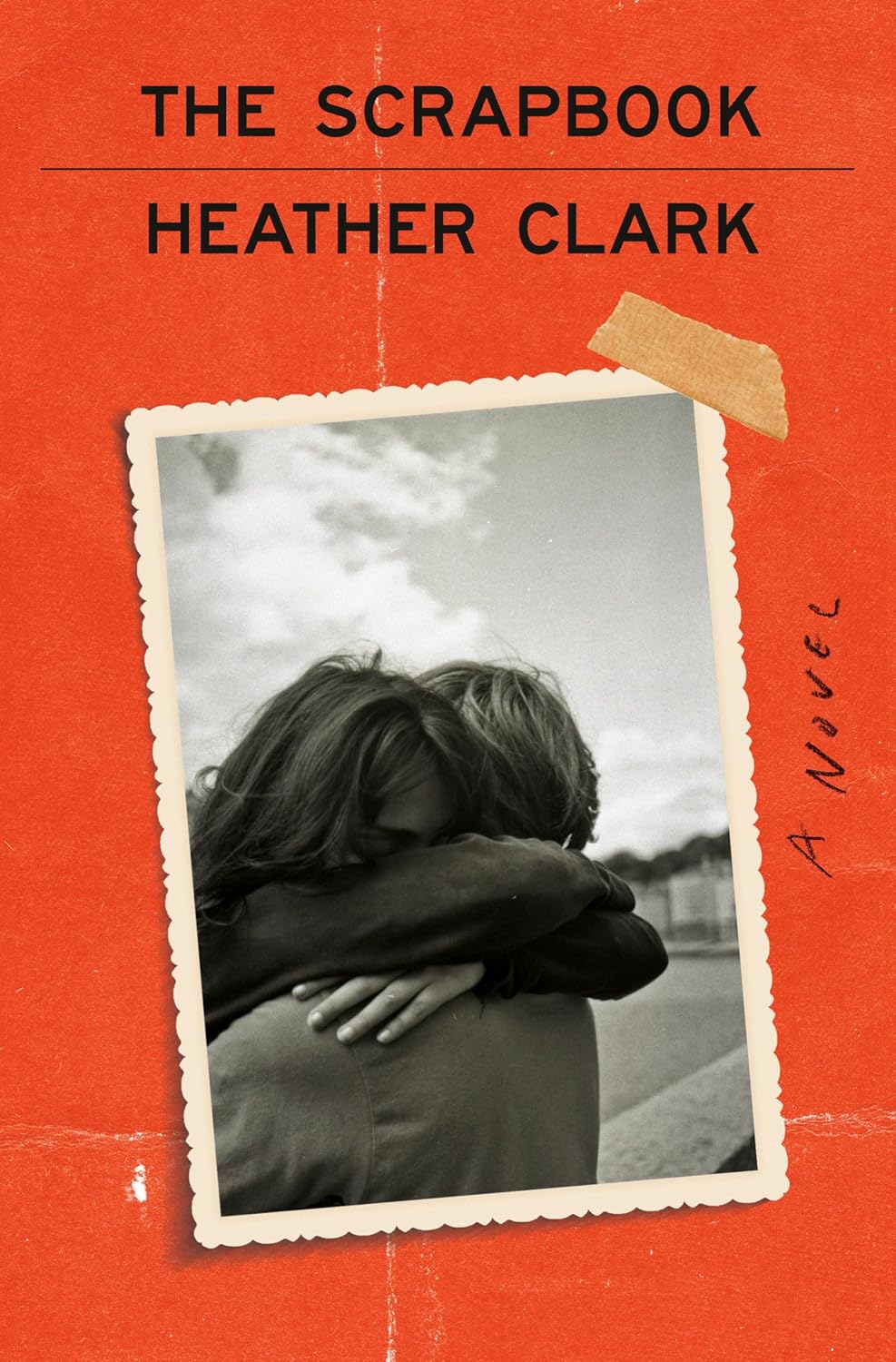
The Scrapbook: A Novel
- By Heather Clark
- Pantheon
- 256 pp.
- Reviewed by Anne Eliot Feldman
- December 30, 2025
Young lovers in the 1990s grapple with their grandparents’ actions in WWII.
“I crossed borders for him. To Germany. I knew nothing of the country...He was everything to me then. Everything.”
The evocative first paragraph of Heather Clark’s stunning debut novel, The Scrapbook, encapsulates the poignant love story between the proud granddaughter of an American G.I. who witnessed the liberation of Dachau and the inscrutable grandson of two Wehrmacht soldiers. Their year-long relationship plays out amidst intense conversations that reflect the intergenerational trauma inflicted by World War II upon both its winners and its losers.
The novel commences in May 1996, when Anna and Christoph meet at a Harvard University party and spend a week together. Anna is a top student and an avid rower. The copper-haired Christoph was once an exchange student at a Boston prep school and is back in town meeting friends. He puts a dent in her study plans and leaves the day finals begin (but she still aces them).
With the prize money she wins for her thesis on Yeats, Anna buys a ticket to Germany to see Christoph that summer. She spends a few days with him — against the urgings of her Jewish roommates, one of whom lost most of her family in Treblinka, and the other whose grandfather survived Buchenwald — and their bond deepens.
In sparse prose reminiscent of Hemingway, Clark shows us the affair through Anna’s eyes. The couple’s physical attraction and desire to connect compete with their mutual compulsion to process and understand a war in which their grandfathers fought on opposite sides. Their conversation often feels at once intimate and adversarial (note that Clark eschews quotation marks to delineate dialogue):
You probably thought he was a Nazi, Christoph said, setting down his glass. My grandfather.
No, I said. But of course I did.
He fought in the German resistance.
I didn’t know there was a German resistance.
Of course there was a German resistance. Christoph shrugged and drank his beer.
So your father was a hero? I said.
No, I didn’t say that.
Anna struggles more than the elusive Christoph with the vicissitudes of a long-distance romance in which his level of commitment is rarely evident. Yet despite being most comfortable in libraries and boathouses, the awkward twentysomething shows flashes of inordinate self-awareness in reflecting on her new love:
“Mossy ground, looking into a high canopy. Christoph’s hand on my heart. I already knew I would remember this day for the rest of my life. How many of us mistake oblivion for transcendence?”
The novel shines with the couple’s provocative talks. Together, they consider the German concept of Historikerstreit, that history is relative, equating the unnecessary Allied bombings of Germany to the Nazi horrors at Auschwitz. Christoph endorses Hannah Arendt’s “banality of evil” concept, arguing that anyone is capable of wickedness and we delude ourselves in thinking otherwise.
Against this come the thoughts of Jürgen Habermas, a German philosopher who believed the Nazi genocide was sui generis and represented a moral and social catastrophe requiring Germans’ deep reckoning with their history. Christoph categorically rejects Habermas’ view that “our history must remain painful” and points out the hypocrisy: Americans rarely discuss Hiroshima but expect Germans to never forget the atrocities they committed.
Three third-person-POV chapters from the grandfathers — Christoph’s Wilhelm in April 1945, Anna’s Jack in May 1945, and a shocking finale from Christoph’s Opa Hans in spring 1943 — give the story a wonderful sense of completion you didn’t realize you were missing until it shows up in front of you. These chapters’ gritty specifics expand Anna and Christoph’s conversations beyond mere intellectual pursuits by invoking WWII’s real-life events and their heart-wrenching consequences.
Perhaps the biggest gift The Scrapbook offers, however, derives from its title, a nod to the faded album Anna’s grandfather left behind. Its vivid testimony — in the form of red armbands, black swastikas, green badges decorated with grey eagles, and photos of Dachau’s cadaver-stuffed cattle cars — speaks louder than words. Clark’s own grandfather, who served in the 86th Infantry Division and to whom she dedicates the novel, left a wartime scrapbook with those same photos. Years later, they remain haunting. Silently, they demand not only that we bear sober witness to the evils of war, but also that we consider whether such evils can ever be righted.
With a B.A. from Colgate University, an M.A. from Georgetown University, both in Russian area studies, and a UCLA certificate in fiction writing, Anne Eliot Feldman has worked in the Library of Congress and the defense industry. She’s currently at work on a writing project of her own.