The Shanghai Agents: The Soviet Plot to Start a Revolution in Interwar China
- By Heather Salter
- Cambridge University Press
- 364 pp.
- Reviewed by William Rice
- September 24, 2026
An ambitious but unsatisfying saga of 1930s subterfuge.
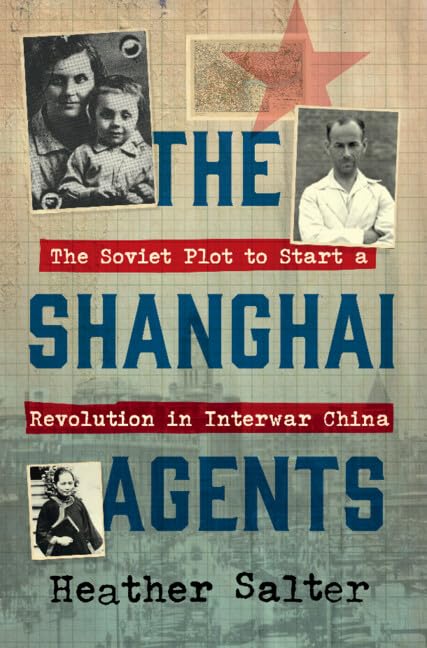
Heather Salter’s The Shanghai Agents: The Soviet Plot to Start a Revolution in Interwar China is a carefully researched and adequately written book about the chaotic trial of married spies in early 1930s China. The premise of the book — that there was an ongoing, global battle over communism waged between the more famous post-World War I Red Scare and post-World War II Cold War — is enlightening. But shortcomings in the storytelling soften the impact of this espionage tale.
Part of the problem is that there is really no one to root for in the story. The author clearly wants us to sympathize with the Soviet-agent couple nabbed by the Western powers and turned over to Chiang Kai-Shek’s brutal nationalist government for trial. She ably relates their careers in service to the Soviet Union, especially impressed by what the wife was able to accomplish as a woman. But given that they were promoting the interests of a totalitarian government that would kill millions of its own people, it’s hard to cheer.
At the same time, international communism had imbedded itself in the admirable movement to end Western colonialism, so those fighting to preserve that system are hardly heroes either. Much better protagonists would be the liberals and democratic socialists resisting both reactionary colonialists and dictatorial communists, but this isn’t their tale.
Another reason it’s difficult to root for the couple at the center of the saga is that, as befits spies, their existence is ephemeral. It was their job not to be known. We don’t even know what to call them: Because they used multiple aliases in their work and then assumed several different identities as an evasive strategy during their arrest and trial, their names fluctuate throughout the book.
One character who does deserve our sympathy is the couple’s young son, who wound up temporarily orphaned by his parents’ ultimate imprisonment. It was this child who, nearly 60 years later, at the end of the Cold War and with Soviet archives opened, was able to piece together his family’s story.
The diligent, disciplined efforts of communism’s true believers to spread the gospel around the world explains its success in the middle of the last century and why the ideology’s foes reacted with such panic. It doesn’t excuse the demagogues ranging from Joe McCarthy to Adolf Hitler who exploited the communist threat for their own evil ends, but it does show that threat was real.
The international campaign organized to free the couple feels very modern. Celebrities, including Albert Einstein, were recruited to sign open letters of protest and rallies were held. The coordinator of all this activity, a German who was somehow simultaneously press baron and enthusiastic communist, deployed all his media outlets and savvy to agitate for the couple’s release.
Some important characters put in appearances. Zhou Enlai, Mao Zedong’s right-hand man, who would become premier of the People’s Republic of China for nearly 30 years, was apparently feeling discouraged in the 1930s when the Chinese communist revolution was at its nadir. But the spy network of which our couple was an integral part convinced him to stay in the fight. And the Vietnamese revolutionary leader later known as Ho Chi Minh traveled in the same espionage orbit as the two protagonists.
The prose, while generally clear and well-organized, is infested with cliches: Within just a few pages, we’re informed that, during an emergency, “there was no time to lose”; a seriously ill character was “at death’s door”; and a dedicated one was “in for the long haul.” There’s also a tendency to state the obvious, such as that spies inhabited “clandestine lives” and went to “great pains to obscure their identities and actions.”
Perhaps because of the elusive nature of her subjects, Salter frequently indulges in the by-now-common but still presumptuous historian’s habit of claiming to know without evidence what they were feeling. She tells us the wife “watched in amazement” as her body changed during pregnancy, “could hardly wait” to go into labor, and, once her boy was born, was “astonished” by her strong maternal feelings for him. Probably good guesses but guesses nonetheless.
And it’s never a good sign when an author has to tell you that what she’s written is important. But that’s exactly what Salter does in the last few pages, declaring what we’ve just read “a remarkable story” and then explaining why.
Amidst all the overwrought intrigue, there is one darkly comical circumstance. At one point, when his parents are in jail, the son is staying with a German couple living in Shanghai. Otherwise good caretakers, the foster parents teach the child of our two committed communists to offer the Nazi salute to the picture of Hitler hung proudly in their home.
William Rice is a writer for political and policy-advocacy organizations.