The Shape of Wonder: How Scientists Think, Work, and Live
- By Alan Lightman and Martin Rees
- Pantheon
- 224 pp.
- Reviewed by Nikolas Mavreas
- October 15, 2025
An affable, overly simplistic glimpse into the minds of researchers.
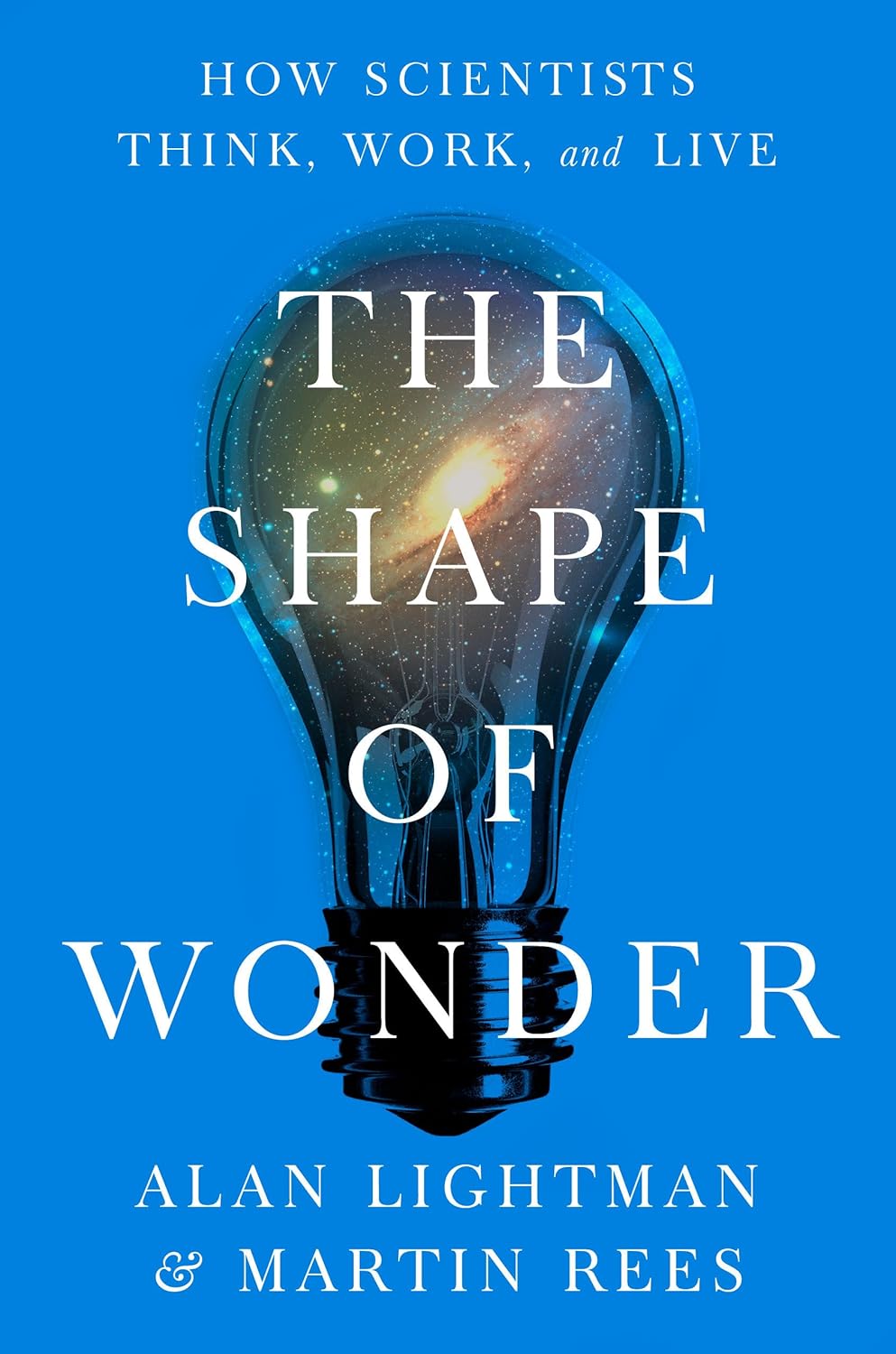
Astrophysicists Martin Rees and Alan Lightman are grey veterans of communicating science to the public as well as to those in power. Lightman is currently a member of the United Nations’ Scientific Advisory Board, while Rees’ many prominent former positions include that of Astronomer Royal to the British crown.
Seeing a public increasingly mistrustful of scientific institutions, and demagogues happily exploiting that mistrust, the authors set out to demystify science by humanizing the people who practice it. The Shape of Wonder treads what will be very familiar ground to all but the completely tenderfoot, who’ll find here an accommodating introduction to some of the ideas, the worries, and the glories of the scientific enterprise.
Albert Einstein and Marie Curie are the most famous of the two-dozen or so luminaries appearing in these pages — under 200, excluding endnotes — alongside a handful of extended profiles of ordinary scientists and the work they do. The overriding focus is on these contemporary scientists’ psychology, extending from the child-like pleasure of discovery to considerations of moral responsibility.
We visit with neuroscientist Lace Riggs, learning about her jiu jitsu classes before turning the page to see a diagram of a neuron. We read about physicist Dorota Grabowska’s growing up skiing on the same page as we see the differential equation for the ideal pendulum. Both women love what they do (“Doesn’t it blow your mind!” says Riggs) but are concerned about competition in their fields and the difficulty of getting tenure. This is a tiny glimpse into the anxiety plaguing young scientists, a cohort underrepresented in this volume, which is mostly populated with Nobel laureates.
An easygoing, journalistic approach seems to have been the authors’ preferred tactic for reaching their intended audience. But they’re not, in fact, journalists, so their prose often turns dull in passages unaided by the inherent sparkle of stars or Big Bangs. For comparison, in Origins: the Lives and Worlds of Modern Cosmologists, a book with a similar concept published in 1990, Lightman opted for more of an editor’s role, letting his subjects (one of whom was Rees) speak entirely for themselves.
The ethics of science is a major thread running through this book, becoming as thick as yarn in the last and longest chapter, which deals with the looming concerns of evolving technologies and climate change. Earlier, we’re offered a concentrated exposition of the authors’ oft-repeated view:
“The products of science, such as knowledge of the uranium atom…can be used for good or for ill. Science itself does not have values. Science does not have notions of right or wrong…Scientists are usually the first to understand the potential uses — good and bad — of what they have discovered…In such ethical and moral decisions, scientists have no more competence or authority than other citizens. But no less.”
Resting as it does on the idea that technology is somehow distinct from science, this view doesn’t hold up. Around the world, the promise of new and better technology is the main argument in favor of funding scientific research. To count, say, the invention of GPS as a plus for physics, while rejecting the atomic bomb as a minus against it, is pointless.
In one section, we come across a slight misquotation of an anecdote about Werner Heisenberg from Edward Teller’s Memoirs. The quote includes a sentence on piano-playing that is meaningless even in the original; its inclusion here feels like a careless, mechanical attempt to add color. It confirms, as does the unadventurous material and contrived style, that this is an especially artificial book fit for a single purpose. But it’s a good purpose, in any case, and even a bit of triteness can be revealing:
“[Ecologist Magdalena Lenda] is as adventurous in her personal life as she is in her professional life. She takes tango classes twice a week and, on weekends, goes with friends to milonga, a club or nice restaurant with tango dancing and music.”
The authors’ conclusion that Argentinian dance constitutes adventure is an amusingly non-elementary (if strange) insight into how scientists think. If only the book itself had been a little less elementary.
Nikolas Mavreas is a reader living in Athens. His book reviews have appeared in Open Letters Review, California Review of Books, Independent Book Review, Midwest Book Review, and Classical Music Daily.