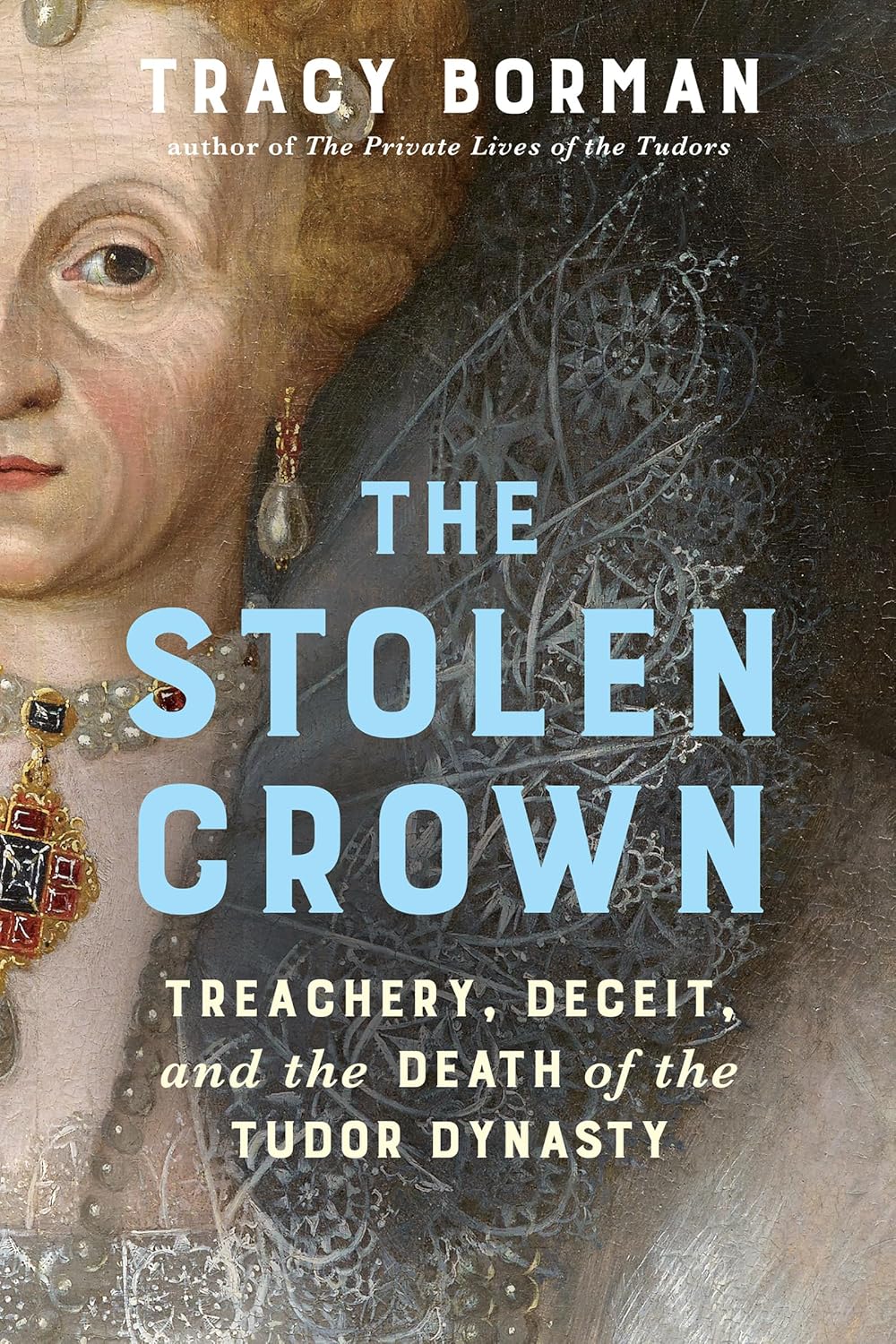
The Stolen Crown: Treachery, Deceit, and the Death of the Tudor Dynasty
- By Tracy Borman
- Atlantic Monthly Press
- 448 pp.
- Reviewed by Bob Duffy
- November 24, 2025
Did Elizabeth I, on her deathbed, truly anoint a successor?
Queen Elizabeth I was laid to rest in late April 1603. Upward of 200,000 mourners thronged London’s streets to witness the procession. More than a thousand “nobles, bishops, and courtiers” walked behind the horse-drawn coffin, which was topped by a breathtakingly lifelike effigy of the dead monarch. She had reigned for 44 years.
In her final days, reportedly, the queen had named King James VI of Scotland to succeed her, ending decades of speculation about the succession. Despite James’ incessant self-promotion as her rightful heir in years of letters to Elizabeth, the new king did not attend the funeral, which took place a month after her death. He was still wending his ceremonial way southward toward London.
In The Stolen Crown, Tracy Borman challenges the long-held chestnut that Elizabeth had explicitly endorsed James as her end approached. Borman marshals a raft of robust research in questioning the shaky oral testimony of the deathbed witnesses. Then, more importantly, she cites a recent physical examination of the manuscript that provides our oldest extant account of the scene, contending that the manuscript itself — rarely inspected today because a printed version of its text is widely available — had been deliberately corrupted, and the hand-written alterations carried through into the printed text. Under X-ray, the wording of the original — clearly altered before the manuscript went to press — appears to confirm that Elizabeth offered no nod to the Scottish ruler as her successor.
Borman suggests that Robert Cecil, a prominent advisor to Elizabeth, and later to James, had prevailed on the document’s author, William Camden, to emend his manuscript before passing it on to his compositor for printing in book form. In her view, Cecil’s aim was clear. A longtime supporter of James’ claim to the throne and a formidable power in the new Stuart regime, Cecil was bent on retroactively justifying James’ legitimacy.
While it would be an exaggeration to say that Elizabeth died at the zenith of her popularity, she was a widely beloved monarch, steering England through many challenges to her reign, some seriously threatening, others scattered and unfocused. Catholic resistance to her Protestant-leaning regime, for example, was a grumbling undercurrent, with Continental governments underwriting the infiltration of European-trained priests to covertly keep Catholic faith and ceremony alive.
Elizabeth faced down threats from the north, as well, notably the long shadow of Mary, Queen of Scots, a Catholic long held as an unwilling “guest” in an English castle. The most serious threat, however, came from the abortive invasion by the Spanish Armada under the aegis of Philip II, Elizabeth’s former brother-in-law and one-time suitor.
During the final two decades of Elizabeth’s reign, as it became increasingly apparent that the aging queen would neither marry nor conceive an heir, speculation centered on a handful of candidates to succeed her. All of them were descendants of one or the other of King Henry VIII’s two sisters. Borman, amply buttressing her take with exhaustive research, traces the lineage and activities of this cluster of putative replacements throughout the 16th century until well into Stuart times. James — who became James I upon assuming the British throne — was the ultimate winner in this royal sweepstakes.
His path to the throne was notable for more than a few striking ironies. He was the son of Mary, Queen of Scots, whose beheading for treason was ordered by Elizabeth in 1587. Mary’s guilt in the plot to depose Elizabeth was pretty much unequivocal, although Elizabeth, weak in the knees over executing an anointed sovereign, later claimed it was a mix-up. James never knew his mother, having been snatched from her by political rivals at 10 months old. Even so, on reaching the throne 16 years after his mother’s death, he was quick to rehabilitate her reputation and re-inter her adjacent to Elizabeth herself.
This is an old and timeworn tale, but under Borman’s industrious scholarship, it takes on fresh urgency, at least for students of the period. She tells it in the vivid and expressive detail it deserves, and she writes brilliantly, one of the very best of the bevy of Tudor historians who have emerged in recent years.
In short, The Stolen Crown is an engrossing and gracefully presented account worth dipping into for its insights into royal goings-on at the turn of the 17th century. For the serious reader, it’s equally worth lingering over, cover to cover.
Bob Duffy, a frequent contributor to the Independent, is a retired brand-development consultant and a former academic specializing in Tudor drama and theatrical culture.