The Theater: Courage and Survival in the Defining Atrocity of the Ukraine War
- By James Verini
- Simon & Schuster
- 208 pp.
- Reviewed by Chris Rutledge
- August 7, 2026
A searing account of the Russian attack on civilians in Mariupol.
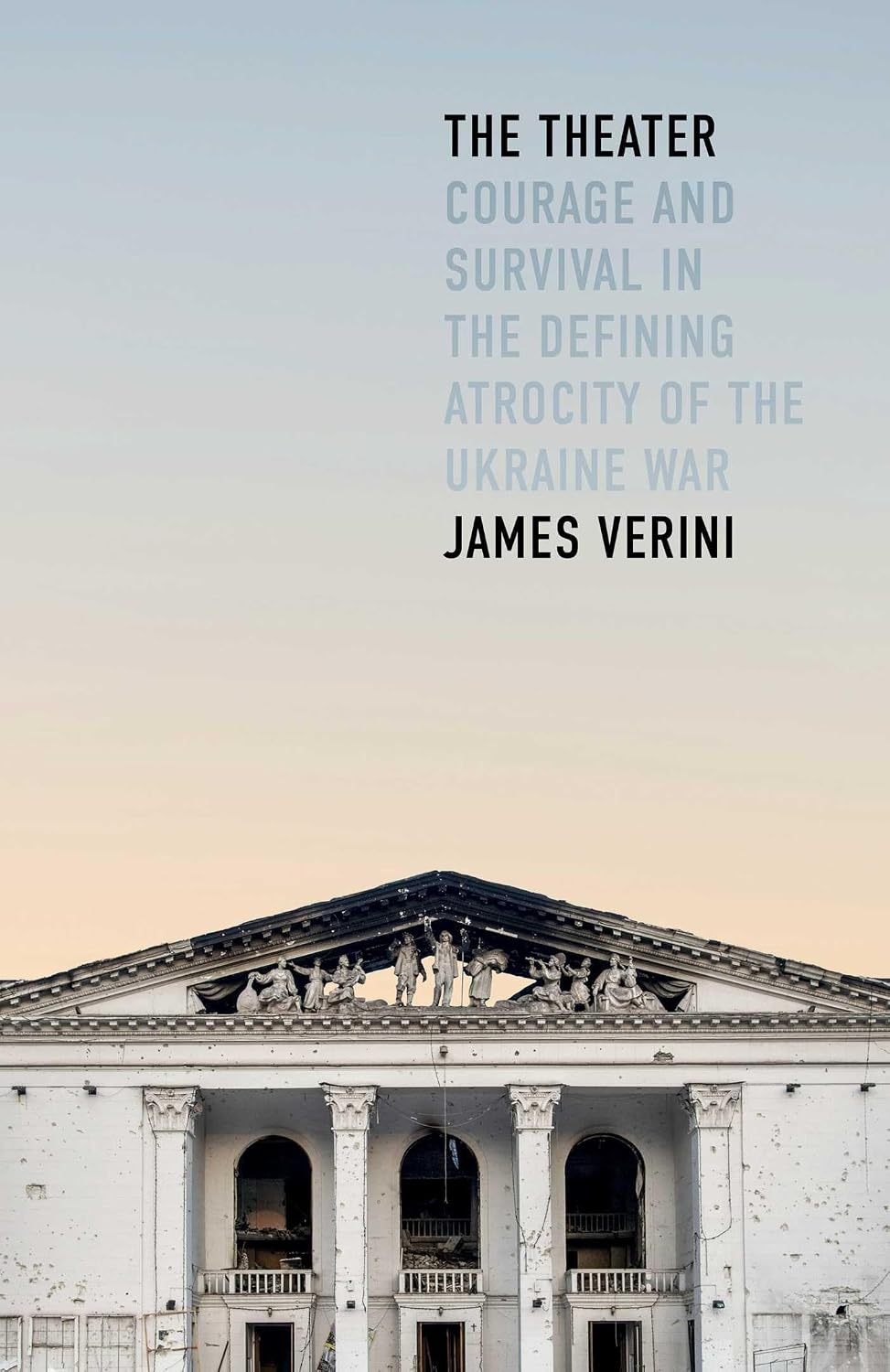
The Theater chronicles the Russian bombing of the Donetsk Academic Regional Drama Theatre in Ukraine in March 2022. At the time, it was being used as a shelter for over 1,000 victims of the Russian attack on the city of Mariupol. Author James Verini is well positioned to tell this tale: His years as a war correspondent, including stints in Afghanistan and the Democratic Republic of the Congo, exposed him to countless atrocities visited upon the innocent.
The story begins in February 2022, when Russia launched its long-threatened invasion of Ukraine. Despite its vast military strength, Russia could not conquer (and still has not conquered) the small nation. Nonetheless, the endless, hard-fought, town-by-town battles have left tens of thousands of Ukrainians dead, a significant number in Mariupol.
We are introduced — and quickly grow attached — to a number of refugees, including Evegenia and Sergiy, who performed and worked at the theater before the war unfolded; Olena, a doctor pressed into service in her new home; and Olena’s husband, Ihor. During the siege, which lasted until the city fell in May 2022, these and other Mariupoltsi sought refuge in a warren of apartment basements, government shelters, and the Regional Drama Theatre. Verini writes that it’s hard to imagine the humanity of:
“…the Russian pilot who as he dove toward the theater…must have seen…the two Russian-language signs reading…CHILDREN that had been painted…on the ground in front and back of the theater.”
Prior to the attack — which Amnesty International declared “a clear war crime” — the Russians bombed the pumping stations that provided clean water to the city and were accused of torturing captured Ukrainians in a series of basement chambers. One survivor, upon looking around after the bombing, remarked, “There was complete extermination…Stores, gone…Buildings, gone.”
Verini is also critical of Ukraine’s government, including President Volodymyr Zelenskyy, citing its naivete in thinking Russia would never actually invade. “Few thought Putin, who was known for his risk-averse pragmatism...could be reckless enough to try to conquer all Ukraine,” he writes.
Even after the war began, many believed an all-out attack would not occur in Mariupol. “We could never have thought the Russians would bomb such a big and developed city,” one refugee told the author. Driving this notion was the idea that if Putin truly felt the region was Russian in character and law, he wouldn’t destroy it. Further, not all Mariupoltsi wanted Ukrainian independence. “Much of the city’s industrial working class,” reports Verini, felt “Mariupol would be better off if it was ruled by Russia.”
This lack of consensus and skepticism that the worst could occur split loyalties and left the city unprepared for war. Shelters were created, yes, but they weren’t stocked sufficiently for a lasting siege that many assumed would not come, anyway.
The highlight of the book is the courage and compassion of those who fell under Russian attack. “Without having to be asked,” Verini says, “Mariupoltsi volunteered to help at the hospitals, and orphanages, and elder homes.” And some who could’ve fled the battered city chose instead to remain. As Evegenia said, “Someone had to stay and help these people.” Those who did gathered napkins and the theater’s makeup wipes to use as bandages; they served on toilet duty, keeping the facility’s overwhelmed plumbing going; they cooked and cleaned; and some even drew on long-dormant medical training to staff a makeshift onsite infirmary.
Which brings us to the morning of March 16th. Although attacks on civilian areas of Mariupol had been ongoing, this day stands out. In graphic detail, Verini chronicles the fallout from the unexpected aerial assault on the shelter:
“First the building rocked; then came a thunderous roar.” [One resident] “noticed that sunlight was flooding the room. She…saw not the ceiling but the sky.”
It was later reported that two 500-kilogram bombs had been dropped on the theater (which, again, was plainly marked as housing children). Hundreds were killed in the blast.
“Bloodied and dismembered people lay all around,” reports Verini. “Some lay uncovered, their lifeless eyes reflecting the blue of the sky.” Describing one victim, he writes, “Only one of his legs had a foot. He was cradling his other foot in an arm.”
In the end, Verini balances the inhumanity behind such war crimes with the humanity needed to overcome them. He leaves us with the image of an orphaned young man who has just lost everything in the theater bombing. “His mother died,” Olena tells her husband. “Now he will be our son.” May each of us muster such generosity of spirit amid unspeakable horror.
Chris Rutledge is a husband, father, writer, nonprofit professional, and community member living in Silver Spring, MD. Besides the Independent, his work has appeared in Kirkus Reviews, American Book Review, and countless intemperate Facebook posts, which will surely get him into trouble one day.