The True True Story of Raja the Gullible (and His Mother): A Novel
- By Rabih Alameddine
- Grove Press
- 336 pp.
- Reviewed by Anne Eliot Feldman
- October 14, 2025
With help from his doting mom, a gay Lebanese man comes of age.
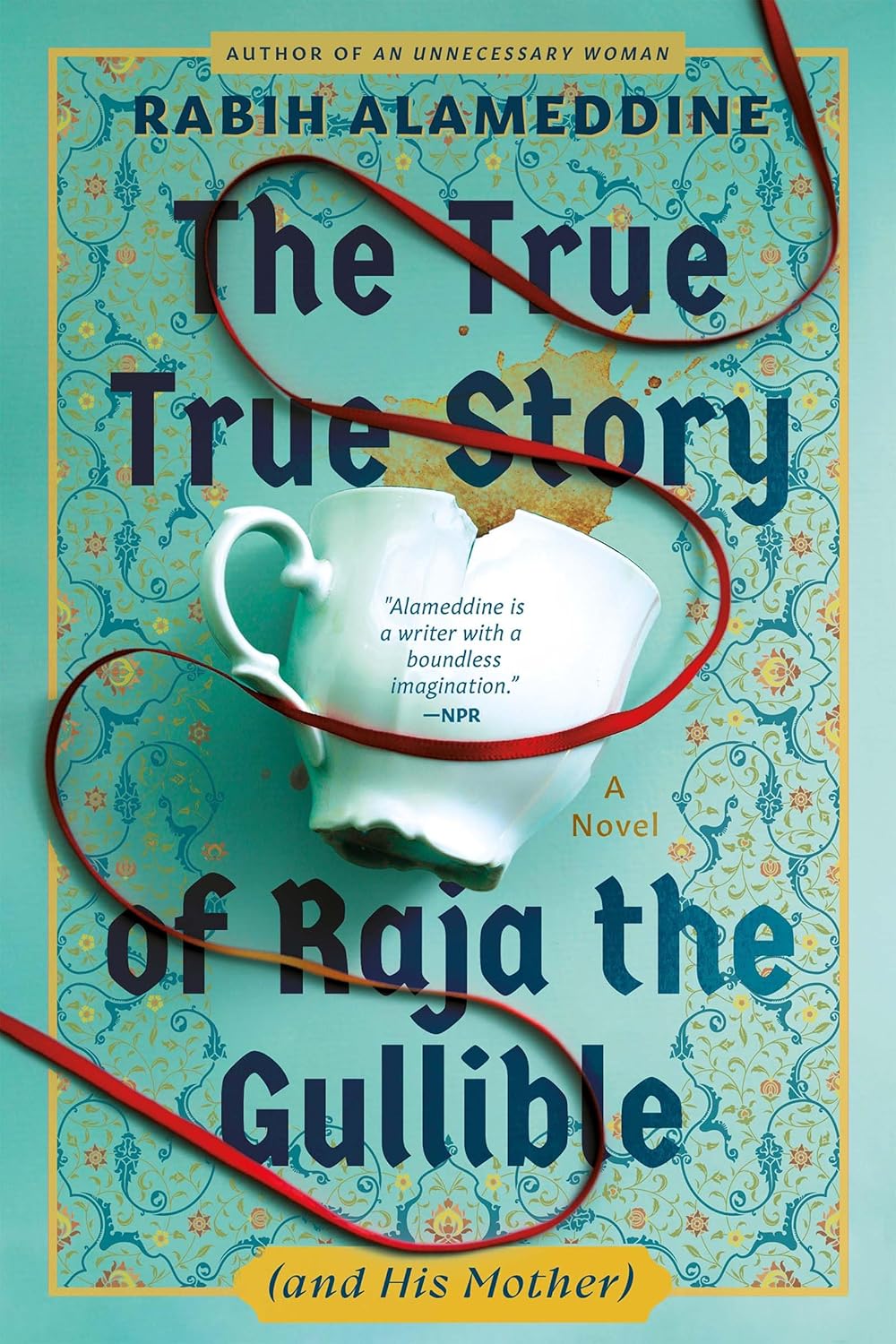
Rabih Alameddine’s The True True Story of Raja the Gullible (and His Mother), a finalist for this year’s National Book Award, is a vivid, one-of-a-kind read from a lauded author. Set in Beirut over six decades, the story juxtaposes searing moments from a gay man’s coming of age with the upheaval of a city in perpetual strife. With little left unsaid between the sharp-tongued mother and her self-aware son, humor and poignance bring their challenges — close living quarters, difficult family members, financial turmoil, and wartime trauma — into bittersweet perspective.
The novel opens with a pseudo-prologue set in 2023, when 61-year-old Raja is dyeing his mother’s hair. The octogenarian Zalfa sits before him, covered neck-to-toe in a “red-checkered, black-streaked wax tablecloth we’d been using as a hairdresser cape for a few years now, fastened with a binder clip, of course.” A beloved teacher of French philosophy at his old high school, Raja, awash in clips, has been his mother’s colorist for nearly 40 years. The two share a bedroom and a life together in a tiny Beirut apartment that also houses a 16-seat wooden table. Made by Zalfa’s grandfather a century earlier, its weatherbeaten top goes unrepaired, speaking to the inconvenient and chaotic life they lead. As Raja describes:
“To get from the living room to the kitchen I had to squeeze my butt between it and the wall, sliding crablike. But…I loved it. Our history was carved into it. That stupid table meant the world to me.”
An event in mid-2021 launches the plot. The American Excellence Foundation — a nonprofit fighting disease, poverty, hunger, and inequity — awards Raja an all-expenses-paid, three-month writing residency in Virginia. Commending his “courageous and excellent” literary sensibility, they offer him the chance to “work on whatever I was working on.” It’s a seeming stroke of good fortune, but even the naïve Raja gets suspicious. His last and only book came out 25 years prior, after all, and was written in his limited Japanese. Not a bestseller. He’s written nothing since, and has no plans to. So, why the honor? His getting to the bottom of it fuels the narrative.
The timeline of Raja’s life spans crisis upon crisis: the Six-Day War in 1967; Lebanon’s 15-year civil war that began in 1975; its 2019 banking-liquidity crisis; and the 2020 covid pandemic and a massive explosion in Beirut that same year. But Alameddine puts Raja’s personal traumas center stage, and they begin early:
“I certainly was terrified as a child, like many gay boys of my generation. Somewhere around the age of five or six, I instinctively understood that adults no longer found my effeminacy endearing…I spent most of my childhood worried I might slip, might do something that would expose my disgusting wickedness.”
Reading and rereading Dostoevsky bolsters his confidence. Then, as civil war rages, a teenage Raja follows the wrong crowd, and things go horribly awry. That he survives is due in no small part to his mother, who breaks all boundaries — interrogating her son after every crisis, later meeting his students against his will — to help him heal. She drives him crazy — “I knew no one else who could use sighs as a lethal weapon” — but he idolizes her, too. “It is said that a synaptic transmission occurs in less than one-thousandth of a second, but my mother was a hell of a lot quicker than that.”
Their interactions often go as such:
“Where are you going?” she said.
“To my room. You’re not speaking to me.”
“You can’t go to your room,” she said. “How can I not speak to you if you’re not here for me to not speak to?”
“You make no sense,” I said.
We remained next to each other, uncomfortable and irritated…My mother and I bonded in our sulk.
Raja’s journey brings him out of his “broken bird” childhood to the present, where he relishes “a breezy early summer afternoon, one of these glorious Beiruti days” and glories over his first encounter with a bonsai. Besides his mother, a few other strong women save him more than once. Madame Taweel is Zalfa’s best friend and godmother of Beirut’s massively lucrative generator-stealing mafia business. And Raja’s outspoken lesbian cousin, Nahed — for whom “it was glaringly obvious that tiptoeing was not her strong suit” — validates his pain.
But The True True Story of Raja the Gullible (and His Mother) never shies from the truth. Life — whether in a war zone or not — is unpredictable, and even in the best of times, our deepest relationships (like we ourselves) may falter. Yet Raja and Zalfa’s shatterproof bond speaks to trust, honesty, and their unshakeable belief that the love they share will sustain them. It’s a beautiful tale.
With a B.A. from Colgate University, an M.A. from Georgetown University, both in Russian area studies, and a UCLA certificate in fiction writing, Anne Eliot Feldman has worked in the Library of Congress and the defense industry. She’s currently at work on a writing project of her own.