The Typewriter and the Guillotine: An American Journalist, a German Serial Killer, and Paris on the Eve of WWII
- By Mark Braude
- Grand Central Publishing
- 432 pp.
- Reviewed by Bob Duffy
- February 9, 2026
A gripping account of the City of Light as the Nazis slink ever closer.
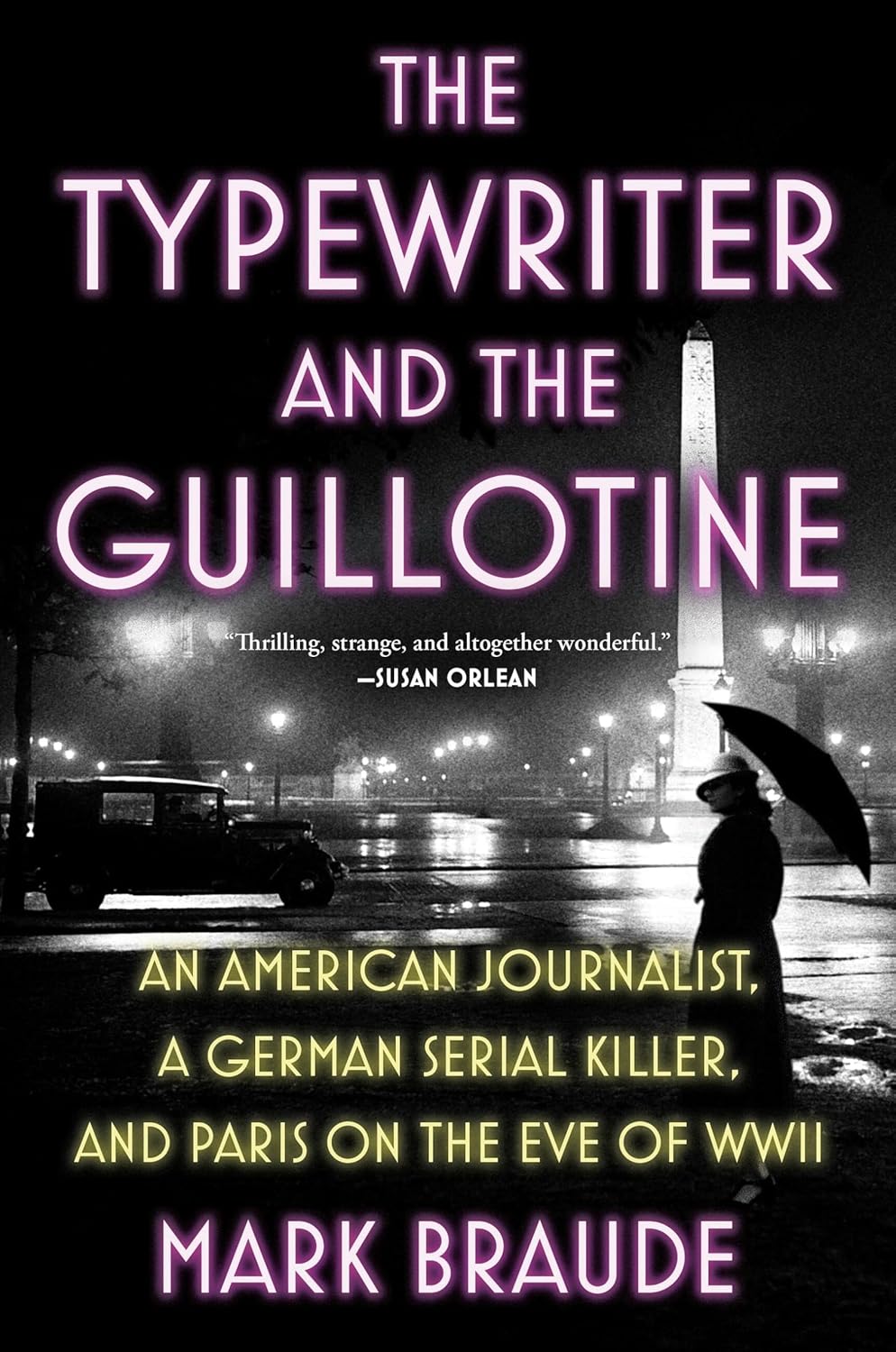
The subtitle of The Typewriter and the Guillotine zeroes in precisely on the narrative coordinates of Mark Braude’s engrossing new book about prewar Paris. The story’s principals: the New Yorker’s pseudonymous European correspondent Janet Flanner and the German-born spree killer Eugen Weidmann, the final prisoner to be publicly beheaded in France. It’s an expansive chronicle, to be sure, touching on a dazzling clutch of Flanner’s Paris companions and literary colleagues, mostly expats, as well as a colorful assortment of Weidmann’s victims, criminal associates, and 1939 trial lawyers.
Braude opens with an evocative set piece: a reconstruction of the night leading up to Weidmann’s 3:30 a.m. execution in Versailles. As he describes the scene, raucous parties in nearby apartments are echoing across the rooftops surrounding the square below, where technicians, in darkness, are assembling and fine-tuning the guillotine. Drunken fights have broken out in neighboring streets. A lorry has been pulled up to block the view of oglers:
“A woman tried to slip behind the police cordon to take her place among the 160 invited guests who stood in a semicircle a dozen feet from the guillotine. She’d disguised herself as a man, as no woman, aside from the German’s favorite lawyer, had been invited into his inner sanctum of spectators. She was found and arrested.
“Another woman, immaculately dressed, approached the cemetery official charged with transporting the body. She pushed a handful of bills into his hands. She wanted to buy the dead man’s head. She was also arrested.”
Flanner is covering the spectacle onsite, following up on the assignment she’s had for at least part of Weidmann’s trial. In Braude’s retelling — beyond these climactic moments in the condemned man’s legal dénouement — there’s no evidence that the pair had ever crossed paths before then. So, the author appears to be using Flanner and Weidmann for counterpoint in a broader portrait of 1930s France, loosely interweaving their respective activities during the decade-and-a-half between Flanner’s arrival in Paris and the Nazis’ 1940 takeover of the country.
Braude puts more emphasis on Flanner’s part in his equation. He provides a thorough and sensitive biographical account, a likely result of his painstaking attention to available sources (as his endnotes bear out impressively). Weidmann’s saga is more of an entertaining true-crime narrative — sensationalism in a minor key — propelled by the eccentricities of the people in the killer’s immediate circle. If there’s any socio-cultural analysis intended, it’s submerged, begging the conclusion that Braude’s coverage of Weidmann is meant mainly to “juice up” Flanner’s more staidly exhaustive portion of the narrative.
Flanner — with her acute observer’s eye and her same-sex intimates and traveling companions — is the star of the show here. The New Yorker magazine is barely months old in 1925 when its editors dispatch her abroad to file periodic “Letters from Paris” under the pseudonym Genȇt. Flanner files this column regularly, and her geographic range expands to other European capitals as war rumblings increase.
At first, Flanner’s letters — as her editors insisted, in keeping with their stateside target audience — are gossipy, thousand-word cultural bagatelles, flighty and breezy, from the metropolis the New Yorker’s readers seem to view as the embodiment of sophisticated, worldly life. The gregarious Flanner proves an ideal chronicler of the liberated spirit of the city, and she fits in seamlessly with the artistic expatriates resident there: Hemingway, Stein, Joyce, novelist Djuna Barnes, and even fellow New Yorker contributor James Thurber.
But as the Nazi threat gathers momentum in the mid- to late 1930s, Flanner’s columns turn more serious, darker, minatory, even as the prevailing view in the States and — more stunningly — in France itself, is steadfastly isolationist and blithely pacifistic. We see this drift first in Flanner’s private communications, and later in her columns. And this represents a signal change in editorial stance for the magazine, too, a harbinger of its coming evolution into a prominent voice on world affairs.
Just one disappointment lingers for this reader. Although Braude quotes extensively from Flanner’s letters to her editors and intimates, excerpts from her New Yorker writings are sadly lacking here. Even so, the author’s endnotes and bibliography cover the gap: Look to them to close the circle if you’re intrigued by this remarkable on-the-scene observer.
Bob Duffy reviews frequently for the Independent.