The Valley of Vengeful Ghosts: A Novel
- By Kim Fu
- Tin House
- 240 pp.
- Reviewed by Emily Hall
- March 12, 2026
A woman grapples with the trauma of her mother’s death.
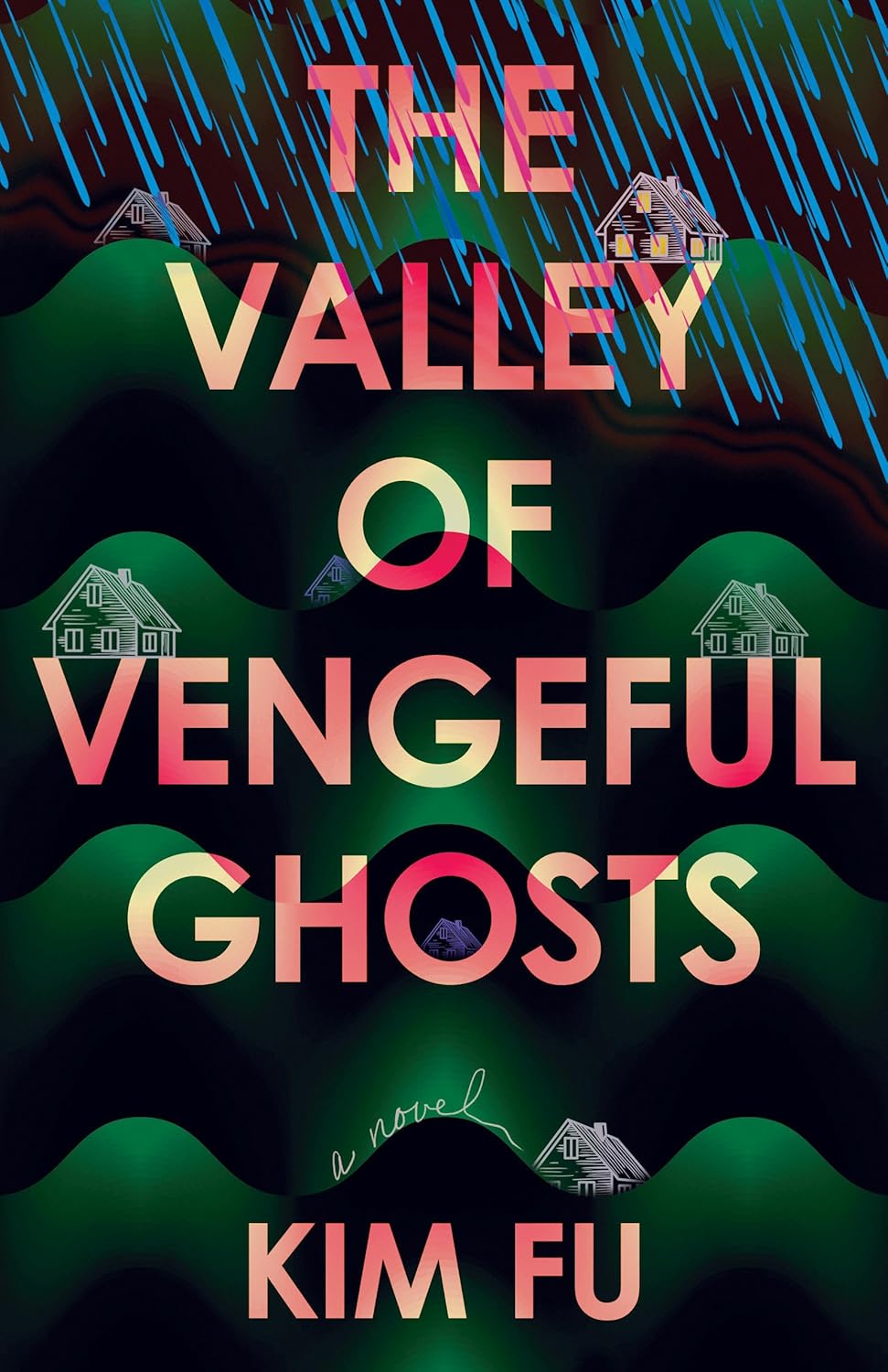
A harrowing work of psychological horror, Kim Fu’s third novel, The Valley of Vengeful Ghosts, explores the complexities of caretaking. The story begins after its protagonist, Eleanor Fan, has lost her mother, Lele, to cancer. Following Lele’s last wishes, Eleanor uses her inheritance to buy a house. Although Eleanor is initially excited by this purchase, she soon realizes that the house is in disrepair. Overwhelmed by home ownership and still grappling with grief, she struggles to take care of herself.
The story’s action focuses primarily on Eleanor’s day-to-day decisions. She moves out of her old apartment, manages repairs on the house, and meets former colleagues for drinks. While these are fairly mundane tasks for most, they’re crippling for Eleanor, who’s never made her own choices. Lele always chose where her daughter lived and how her money was spent, even though Eleanor works full time as a therapist. Thus, when Lele dies, Eleanor feels like she’s “five years old” and has been “abandoned…in a parking lot.” In her mother’s absence, she looks to real-estate agents, handymen, and friends to guide her decisions.
Through flashbacks, readers understand why Eleanor came to rely on Lele so heavily, and their relationship is written with remarkable depth. Lele wasn’t necessarily controlling but rather convinced that Eleanor was incapable of being self-sufficient. This infantilization escalated after Eleanor was sexually assaulted by her graduate-school mentor, Dr. Culver. Lele invited her daughter to come back home after Eleanor’s university sided with Culver’s claims that nothing criminal happened. Devastated, Eleanor leaned into her mother’s over-the-top caretaking, allowing Lele to “hand-feed” her as she “abdicate[d] ownership” over herself.
Lele’s tendency to treat Eleanor like a child has tragic consequences, though. When Lele’s cancer becomes too painful, she asks Eleanor to help her die, a monumental request that her daughter is ill-equipped to handle. As such, when Lele finally passes, Eleanor loses touch with reality because of her guilt. She begins to hallucinate, first imagining Lele sleeping in bed with her in a “pleasant, lucid-feeling dream,” and later envisioning her cleaning the floors “on her hands and knees, with a rag and a bucket of soapy water.”
Whenever Eleanor feels incapable of making a choice, she simply transfers it onto the ghostly version of her mother, while simultaneously ignoring how the spectral Lele is turning into a “sicker, older, more deranged” version of herself.
In the midst of Eleanor’s breakdown, her house also falls apart. It sits on “a vast trapezoid of razed land, seemingly arbitrarily out of the forested valley.” Ironically, the house is the model home in what is supposed to be a planned community. As soon as Eleanor moves in, flooding rains begin to fall. The water erodes the boundaries of her house, breaking her front door and pouring through her windows.
In many ways, the house symbolizes Eleanor’s fragile mental state. For instance, when the water damage becomes too severe, a handyman removes a window and places over it “[a] translucent plastic sheet…[that] flexed noisily in the wind, like Foley thunder.” Conjuring the image of a flimsy bandage over a gash, the hole evokes Eleanor’s barely suppressed trauma. No wonder ghosts with gruesome injuries begin to appear on the other side of that sheet.
Notably, there are few meaningful side characters in Fu’s story, but this works well because it magnifies Eleanor’s isolation. For the most part, she either talks to herself or to Lele’s ghost. Occasionally, she interacts with her clients during their online sections. They appear largely as disembodied heads on the other side of her laptop screen, and Eleanor admits that the physical distance between her and them makes it easy not to invest in their issues. If she dislikes a client or doesn’t wish to help them, she can “terminate the relationship with a bloodless click of her mouse, a canned pop-up.” Eventually, she imagines their faces distorted — nothing but pixelated shadows.
All these elements — Eleanor’s psychological struggles, and the supernatural and environmental terrors she endures — culminate in an impressive, climatic finale. As the rain batters her house and triggers a mudslide, Eleanor finally begins to unpack the conflicts plaguing her. She admits that she never wanted to be a therapist, as she “expected to be a researcher,” a dream that was derailed when she chose not to fight Culver’s lies. She also addresses her tendency to “regress into uselessness” and her overreliance on Lele.
Eleanor’s confronting of these issues isn’t pretty; it’s as ugly as the mud spilling into her home. But the messiness illuminates the novel’s most powerful message: that taking care of yourself is hard, dirty work.
Emily Hall is a freelance writer whose prose has appeared or is forthcoming in Passages North, Portland Review, Necessary Fiction, Blood Orange Review, Cherry Tree, 100 Word Story, the Ancillary Review of Books, and elsewhere. She’s a prose reader for West Trade Review, has a PhD in English from the University of North Carolina at Greensboro, and lives in North Carolina with her husband.