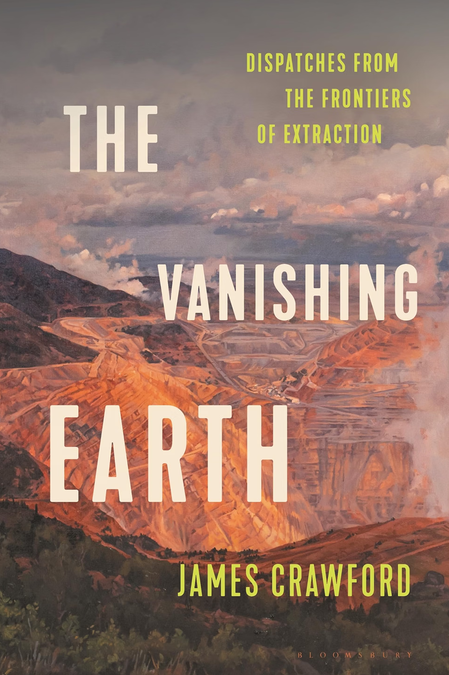
The Vanishing Earth: Dispatches from the Frontiers of Extraction
- By James Crawford
- Bloomsbury Publishing
- 448 pp.
- Reviewed by Julie Dunlap
- September 18, 2026
Our planet’s wounds are gaping but not yet fatal.
One night on Chile’s Atacama salt flat, author and broadcaster James Crawford turns his back on the lithium mine he came to investigate. The cold desert air helps him forget, or at least briefly ignore, an expansive, ancient landscape permanently despoiled in pursuit of a soft, white mineral essential to the digital age.
In this hyper-arid place, Crawford envisions the Milky Way arching overhead as a river, “its waters shining a soft purple from billions-dense clusters of cosmic matter: stars, gas, nebulae, planets.” Lithium, he marvels, was created along with hydrogen and helium within 20 minutes of the Big Bang. “It preexisted even light itself.”
Such reveries of natural wonder buoy The Vanishing Earth, a consummate exposé of the pumping, blasting, stripping, felling, and leaching of what remains of the material planet. Crawford’s previous book, the richly historical The Edge of the Plain, explores how the human obsession with borders has shaped our societies, politics, and even destiny as the climate alters and destabilizes. Here, the task undertaken is also epic. The Vanishing Earth “is a kind of odyssey, or pilgrimage,” says Crawford, “to the literal and ideological frontiers of extraction — and their fast-approaching limits.”
Some of the most shocking tales collected along his journey reveal extractive capitalism at the edge of the law. A recurring theme is baneful abandonment. In Florida’s Bone Valley, mining companies gouge out trainloads of fossil rock to crush, and then chemically harvest the embedded phosphate for fertilizer production. But when a rock deposit inevitably plays out, firms declare bankruptcy and disappear. Left behind are towering plateaus of radioactive acidic waste. As a local water advocate tells Crawford:
“These are wastelands that will be wastelands for generations to come.”
Other operations are blatantly criminal. The author traces the origins of one sand grain until, through innovation he calls “true alchemy,” this most common of natural resources might help form a window, mobile phone, turbine blade, fracking solution, or, most likely, concrete. Spurred by insatiable global demand and shrinking supply, poachers in 2008 stole 500 truckloads of white coral sand off a beach in Jamaica. In fast-growing Singapore, the needs for sand for construction and island expansion are met through imports from less affluent countries. And a 2018 study indicates that less than five percent of 80 million metric tons of sand from Cambodia was exported legally. Writes Crawford: “The incredible extent of shoreline and coastal development” driving such colossal sand heists “is a kind of willful madness.”
The most heartrending stories unfold largely within legal boundaries. In the 1860s, prospectors who sifted gold from local creeks built Butte, Montana, and the boom persisted (despite dwindling gold) after the discovery of silver and other ores. Technology intensified extraction over decades, especially when electricity enabled access to a deep, pure dome of copper, one-sixth of the world’s then-known supply. Electric elevators lowered miners into dimly lit shafts to play their part in “an inexorable, irrevocable process: to take a mountain, tunnel into its depths, and empty it out.”
Operations continued despite the disaster on June 8, 1917, when 168 miners suffocated in the worst underground rock-mining accident in United States history. Competition with Chilean mines in the 1920s forced brutal new efficiencies: removal of the mountaintop and carving of “a giant, spiraling terraced hole” that swallowed the center of Butte “like an extractive Mobius strip.” Where once stood houses, businesses, churches, and schools is today the Berkeley Pit. Since the main mine’s closure in 1982, the former “Richest Hill on Earth” has filled with caustic, arsenic-laden water so dangerous that air cannons boom to stop migrating geese from landing in it.
A Superfund site since 1983, the infamous abyss draws waste-management experts from around the world. “In China,” reports one visitor, “there are thousands of Buttes.” Throughout the book, vivid descriptions of the scope and scale of destruction rival those in David Wallace-Wells’ The Uninhabitable Earth. Crawford, in fact, more forcefully portrays the pace and permanence of ruination. Extraction sacrifice zones, accumulating especially over the past half-century, “are the dark side reality of economic growth and political expediency,” he says. “And they are everywhere.”
Thankfully, the author also quests after solutions, though often with a modicum of doubt. A lithium-mine executive Crawford meets defends damage to Atacama ecosystems and Indigenous communities as an unfortunate but temporary consequence of the green-energy transition. Stefan Debruyne, a “lithium evangelist, a technoprophet,” envisions advanced methods that someday enable hyper-efficient metal recycling and extraction without freshwater consumption. “Right now, we are increasing the footprint,” Debruyne admits. “But this is an investment in our future.” A skeptical Crawford likens the viewpoint to “the original alchemist’s dream,” with technologies as saviors, if we can only find the right ones.
More promising alternatives comprise the book’s vital last section, “Repair.” Interviews with carbon-capture engineers, rebel architects, conservation biologists, and climate-lawsuit litigants signal that the “anti-extraction movement” is diverse and growing. The son of a fossil-fuel engineer, Crawford writes movingly about an Indigenous-led campaign to stop oil drilling in an Ecuadorian rainforest, where saving giant otters, spider monkeys, 567 bird species, and trillions of insects is as important as supporting villages and reducing carbon emissions. In 2008, the effort culminated in the world’s first constitution to recognize rights for the natural world. To Crawford, that victory represents a perceptual shift toward understanding that “not extracting could be worth as much as extracting.”
But healing centuries’ worth of extractive damage will require a colossal values change. Curative repair depends on a unified willingness to live amongst the ruins — like the residents of Butte who manage the pit instead of moving on — and an intergenerational commitment to rebuilding for tomorrow, a kind of collective “forever stewardship.”
Are most of us capable of such long-term thinking and fidelity to the planet and each other? Crawford hunts, he says, for “a fragile, incomplete map or schematic of some possible, viable future.” But readers may close the book wishing for one more investigation, perhaps grounded in interviews and writings by psychologists. In the face of so much anthropogenic devastation, we long for evidence that humans can relinquish the values propelling extractive capitalism, that society can shift in a new and permanently habitable direction. In 1864, George Perkins Marsh wrote: “Man is everywhere a disturbing agent. Wherever he plants his foot, the harmonies of nature are turned to discords.” Why have we not absorbed this lesson and at least slowed the plunder?
Though its solutions are sometimes more aspiring than convincing, this book is nonetheless timely and profound. It sheds light in innumerable directions on our obdurate looting of resource-rich splendors from the Andes to the Boundary Waters to the deep-sea floor. The Vanishing Earth is essential reading for anyone who might carry a cellphone, purchase a car, heat a home, sip water, or vote on data-center zoning. In it, James Crawford brilliantly lays bare the landscapes we have riven to extract their treasures and the wonders remaining in urgent need of rescue.
Julie Dunlap writes and teaches about wildlife ecology, environmental history, and climate change. She co-edited the nature anthology Coming of Age at the End of Nature: A Generation Faces Living on a Changed Planet (Trinity University Press).