The Visionaries: Bretton Woods, the Marshall Plan, and the Making of the Post-World War II Order
- By James Holland
- Atlantic Monthly Press
- 320 pp.
- Reviewed by Jonas Vaicikonis
- September 9, 2026
A look at the creation of the former “New World Order.”
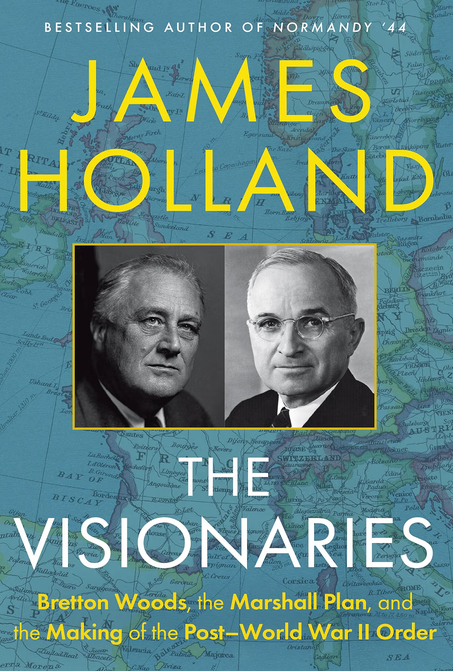
James Holland has built his reputation as one of Britain’s most prolific historians of World War II. His latest book, The Visionaries, appears to mark a departure, promising an examination of the statesmen who helped construct the postwar international order. Yet the author remains most interested in the war itself, and that is both the book’s greatest strength and its central weakness.
Holland is an excellent military historian. His analysis of both the First and Second World War is a highlight of the book and is lucid, absorbing, and frequently insightful. The problem is not the quality of the history but its relationship to the book’s advertised subject.
The title suggests the book’s thesis concerns Bretton Woods and the Marshall Plan, when those subjects are mostly the destination rather than the journey. Holland is far more interested in the failures of the interwar period and the devastation of WWII as a catalyst for why Franklin D. Roosevelt and Harry S. Truman believed a different approach was needed after the war than he is in the mechanics of the institutions that followed.
One of his more compelling arguments links American protectionism after the 1929 stock market crash to Germany’s worsening economic crisis and increasing support for extremist politics. Holland notes that in the second half of the 1920s, Germany joined the League of Nations, provided education for all children, introduced an eight-hour workday, abolished press censorship, and introduced paid maternity leave. In the 1928 election, the Nazis won just 2.6 percent of the vote, even with the young and charismatic Adolf Hitler increasingly becoming the face of the party.
But when the United States tried to offset the effects of the economic crisis by passing the Smoot-Hawley Tariff Act in 1930, the increased tariffs led to a global trade war that caused hardship throughout Europe. It was especially bad in Germany when compounded by the heavy reparations that country was paying for its role in WWI. Production there halved by 1932, and more than a third of the population lost their jobs. Hitler became chancellor in 1933, setting Germany on a path that would cause great suffering in Europe and across the globe for decades.
For Holland, these failures provide the backdrop for the book’s true heroes: Roosevelt and Truman. The author contrasts U.S. protectionism and the imposition of reparations on Germany after WWI with the actions of the two commanders-in-chief near the end of WWII. Both leaders consciously tried to shape a postwar world that would include assistance to both victors and vanquished to avoid the kind of resentment that fueled the rise of Hitler.
This thinking led to the Bretton Woods economic conference in 1944 that saw the creation of the World Bank and the International Monetary Fund — which pegged many global currencies to the U.S. dollar — in an effort to provide tools to prevent another Great Depression. Truman himself initiated the Marshall Plan in 1948, which provided U.S. financial assistance to 17 European countries (the Soviet Union declined to participate). This aid is credited with speeding up Europe’s economic recovery from the war, limiting the appeal of fascism or communism due to rising living standards, and beginning to bind Europe together economically and politically in ways that laid the groundwork for the European Union.
Holland writes with the confidence and clarity of an historian who knows his material intimately. But the book hints at fascinating questions it never fully explores. Many contemporary debates over globalization, sovereignty, foreign aid, and America’s role in Europe were already visible in the late 1940s. Holland touches on these issues but rarely lingers long enough to explore them in detail. A deeper examination of those fault lines would’ve made the book even more relevant to modern readers.
The Visionaries succeeds as a concise, highly readable account of the world wars and of Roosevelt’s and Truman’s efforts to avoid repeating the mistakes of the interwar years. What it does not provide is the sustained assessment of Bretton Woods and the Marshall Plan that its title suggests. Bretton Woods does not enter the narrative until more than halfway through, in fact, while the birth of the Marshall Plan is examined only in the closing chapter. Readers interested in these two subjects will likely finish The Visionaries wanting a fuller treatment.
Jonas Vaicikonis has long been fascinated by Europe’s history and culture. All statements of fact, opinion, or analysis expressed are those of the author and do not reflect the official positions or views of the U.S. government. Nothing in this review’s contents should be construed as asserting or implying U.S. government authentication of information or endorsement of the author’s views.