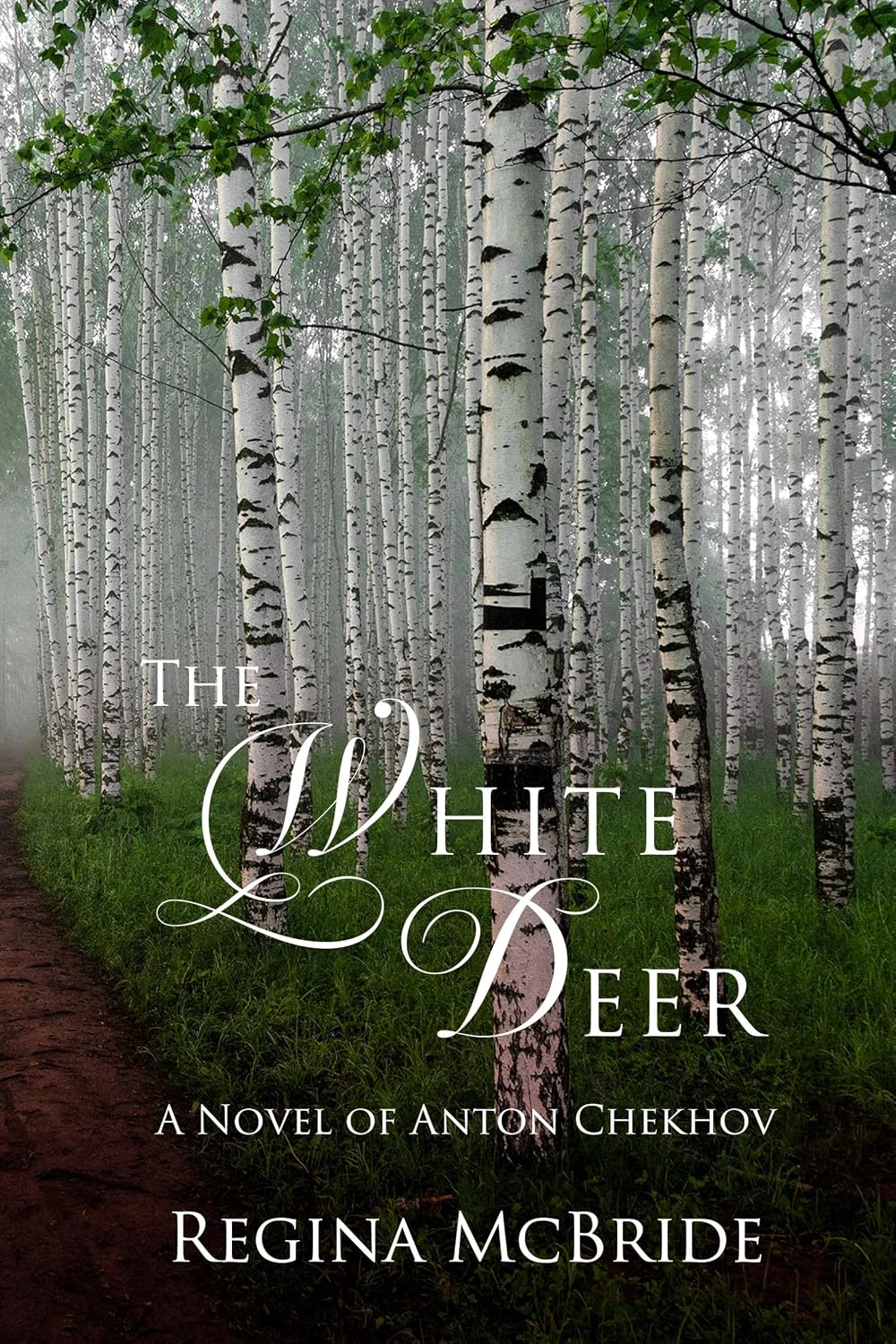
The White Deer: A Novel of Anton Chekhov
- By Regina McBride
- Green City Books
- 380 pp.
- Reviewed by Ashlee Green
- October 20, 2026
In 19th-century Ukraine, young love isn’t for the weak.
Born into the aristocracy on Volkhov, her family’s financially “doomed” rural Ukrainian estate, Vera Denisova was taught from a young age that in order for women to “do something with [their lives],” they had “to wait for something to happen [to them].”
Armed with both a powerful imagination and an optimism — obliviousness, really — that’s reserved for the privileged, “landed” classes, she rebels, determined to make that something happen by her own hand. She sets in motion a half-baked plan to get her secret lover, Petya, a talented artist and member of the servant class, a drawing apprenticeship in nearby Kiev, thereby freeing him from a life of poverty.
Vera’s father, Sergei Denisov, lives in the city part time, and ultimately, she reasons, Petya’s “sudden change in fortune” and proximity to Volkhov will allow her to regularly rendezvous with him in public. She imagines them taking “carriage rides,” having “dinner in the evenings,” and, eventually, marrying and living together in Kiev.
Her plan backfires, though, when Petya is instead sent to a place that’s both far away and subjectively “uninteresting,” where Vera has “no family connections.” So, she’s back to square one, “always outside somewhere wandering the grounds” with a mind that is “engaged with the invisible,” when she is auspiciously presented with two new distractions: a rare (and symbolic) white deer on her family’s property and the arrival of Anton Chekhov, an aspiring medical student and visiting friend of a neighbor down the road. Soon, Vera and Anton forge a bond of their own.
The White Deer is captivating in both style and structure. The entire book — which isn’t a short one — takes place over the course of a single summer, but author Regina McBride holds a magnifying glass to each day, each hour, each passing emotion and bodily sensation, thereby expanding the sense of time — and the spaciousness of Vera’s inner world — on the page.
On the surface, the novel is a straightforward coming-of-age tale. Digging deeper, it’s an analysis of time itself and a testament to the importance of being present in life’s small moments. As Vera reflects:
“The future was something unknown, for both Anton and me, but when we searched for the white deer, life became filled with possibility.”
This manipulation of time is a trick borrowed from theater, a major presence in the book. Vera’s grandmother was an actress, and her father is in the business, too. In the theater, as Sergei explains to Vera and Anton one night after “too many glasses of Lafite,” even time itself is an illusion. “Time is devilish...We live inside time. It carries us and we cannot see it or get free of it.” But on the stage, he adds, time is contained:
“You feel you can grasp time in a play better than the way it moves in life. Even though years can pass between acts in a play, or even between scenes.”
Throughout the story, enchantment and wonder exist alongside deception and denial, like the two sides of a coin. The world of acting is the most deliberate example, but take the book’s trees, too: There are the old, wild ones spanning Volkhov’s nearly “two versts” (roughly 1.2 miles), which served as Vera’s childhood playground. “These trees are my family members,” she says, “I have known them all my life.” And then there are the overgrown ones that make up the property’s neglected peach orchard, a “bad omen” for the fate of the estate.
And the deer? It’s an excuse, mostly, for Vera and Anton to spend time together, but it’s a symbol, too — of what, exactly, depends on who’s glimpsing it at a given moment.
Anton Chekhov isn’t the star of this book, but he’s its raison d’être, and in it, we absorb details about his real life more easily that we would from, say, a traditional biography. And the backstory on Vera’s mother, used to explain Vera’s “mystical” nature, is also educational. It includes sweeping overviews of the Old Believers, who were religious dissenters in the Russian Orthodox Church, as well as of Siberian geography and mythology.
The final, epistolary chapter, which features imagined letters between Vera and the now-ailing Anton about their time together at Volkhov, is a creative way to give readers a sense of hope and closure. Overall, The White Deer is an immersive novel both for Chekhov fans and for anyone interested in stories of Russia and Ukraine that go deeper than the 24-hour news cycle.
Ashlee Green (they/she) is a writer, critic, and zinester based in Washington, DC. They were named a 2025-26 DC Commission on the Arts and Humanities Fellow, a 2023 Alan Cheuse International Writers Center Travel Fellow, and a 2023 Inner Loop Woodlawn-Arcadia Writer-in-Residence. Green writes about travel, architecture, binaries, the body, and mental health. Their work can be found in NPR, Thrillist, HuffPost, the Rumpus, and the Independent. They are at work on their first book, an experimental travelogue about Scandinavian sauna culture, art, and body-based healing. Find them on Instagram at @ashleegreenwrites.