They Kill People: Bonnie and Clyde, a Hollywood Revolution, and America’s Obsession with Guns and Outlaws
- By Kirk Ellis
- High Road Books
- 312 pp.
- Reviewed by Diane Kiesel
- March 6, 2026
Once upon a time, onscreen crime was more scandalous than the real thing.
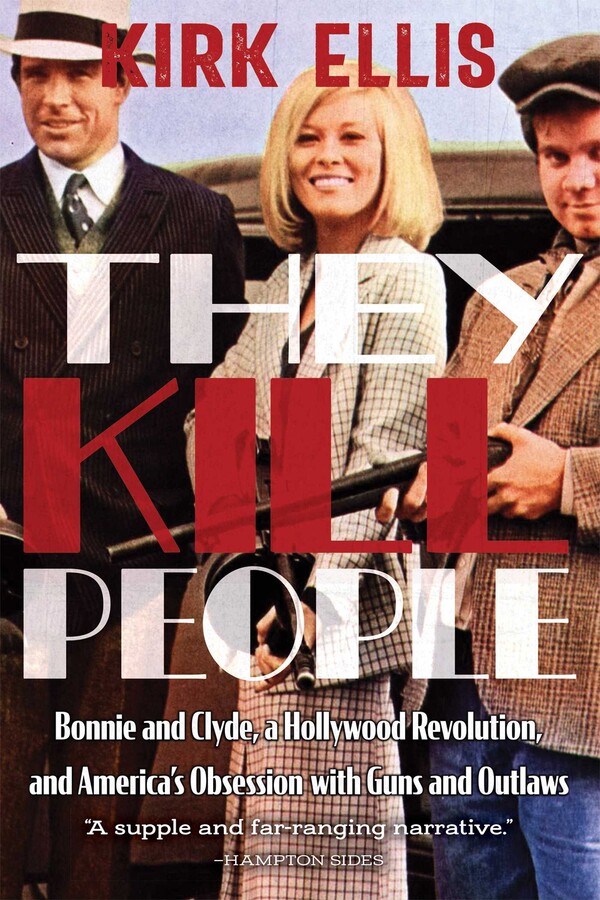
Americans have deified their outlaws since at least 1881, when Sheriff Pat Garrett gunned down escaped murderer Billy the Kid, and when the Earp brothers, along with Doc Holliday, took on the Clantons at the O.K. Corral. In his new book, They Kill People, screenwriter and author Kirk Ellis does a masterful job exploring America’s love affair with bad guys, guns, and violence against the backdrop of the making of the 1967 hit movie “Bonnie and Clyde.”
Ellis’ book segues between the real-life story of Depression-Era celebrity outlaws Clyde Barrow and Bonnie Parker and the quotidian challenges faced by director Arthur Penn and producer/actor Warren Beatty as they tried to live within their skimpy Warner Bros. budget and buck the outdated Hollywood Production Code — which sought to ensure movies’ morality — to make a realistic film about the murderous couple. And, like a skilled director who smoothly cuts to the next scene, Ellis slips in grim facts about the mind-numbing prevalence of gun carnage in 1960s America.
The real Bonnie and Clyde, despite old photos showing them cavorting in stylish clothes, were a pair of dirt-poor losers from West Dallas, Texas. Between 1932 and their violent deaths in 1934, the Barrow Gang tore through the Midwest, robbing banks, stealing fast cars and powerful machine guns, and leaving nine dead lawmen in their wake.
Bonnie was a 19-year-old married housekeeper when she met 20-year-old Clyde, already on the run from the law. Their romance solidified when Bonnie facilitated his escape from a Waco jail by smuggling in a Colt .38 in the front of her dress. Captured soon after, Clyde was sentenced to 14 years in prison, but he escaped after two years and embarked on a 17-month crime spree with his gal-pal and a roving band of followers. It all ended in less than half a minute on the morning of May 23, 1934, in Bienville Parish, Louisiana, when a seven-man posse pumped 41 bullets into Bonnie and 17 into Clyde as he drove a newly stolen 1933 Ford V-8 convertible down Highway 154.
“Death did wonders to restore Clyde Barrow and Bonnie Parker’s reputation,” writes Ellis. Curiosity-seekers, after snatching souvenirs from the death site, formed a 200-car convoy to accompany the bodies to the coroner’s. An estimated 10,000 people in their Sunday best showed up for Clyde’s funeral; twice that number came to pay their last respects to Bonnie.
Thirty years later, a pair of young, hip, New York journalists, Robert Benton and David Newman, sought to resurrect the gun-toting couple with a screenplay they pitched to avant-garde filmmakers François Truffaut and Jean-Luc Godard. The edgy French “New Wave” cinema was all the rage at the time, and it was also the era of Andy Warhol’s infamous claim that, one day, we’d all have our “15 minutes of fame.” Bonnie and Clyde were about to get theirs thanks to Beatty, who paid $75,000 for the rights to the script.
After the French auteurs passed on it, Arthur Penn, a New Wave fan and director of such wide-ranging stage and film fare as “Wait Until Dark,” “The Miracle Worker,” and “The Chase,” took it on — albeit reluctantly. When Beatty first showed him the script, Penn said, “I don’t really want to do a film about a couple of bums.” But Beatty did a hard sell, and Penn came to see the project as “a through line from the 1930s to the 1960s in the disparity between rich and poor in America and widespread generational alienation.”
The ensuing movie, which starred Beatty as Clyde and newcomer Faye Dunaway as Bonnie, was bankrolled as a B-movie to the tune of $1.6 million by the aging Jack Warner, who wanted it shot in just 61 days. Although the Hollywood Production Code was on its last gasp, its chief fired off missives to Beatty complaining about the film’s “gross animalistic” sex and “unacceptably brutal” violence.
Nonetheless, “Bonnie and Clyde” pushed the envelope with a pivotal scene in which Clyde fires through a car window directly into the face of the bank official who has jumped onto the vehicle’s running board. Before that, Penn explained, when an onscreen villain fired a shot at a victim, “You have somebody shoot over here and you cut to somebody getting hit over there.” The window shot changed “the trajectory of the film — and of American cinema,” writes Ellis.
Jack Warner measured the quality of a movie based on how many times he needed to empty his bladder while watching; the fewer, the better. When Beatty showed the finished product to the studio head in his private screening room, Warner got up several times. Later, he grumbled that “Bonnie and Clyde” was a “four-piss picture.” It opened on August 13, 1967, in just two New York theaters. Two months later, after sinking very little money into it for publicity, Warner Bros. stopped booking it altogether.
But after receiving 10 Oscar nominations in February 1968, the movie was re-released and grossed over $70 million worldwide. The year 1968 saw the Tet Offensive and the My Lai Massacre in Vietnam, the assassinations of Martin Luther King Jr. and Robert F. Kennedy, and the rioting at the Democratic National Convention in Chicago. Gun homicides had increased by 51 percent over the decade. A film that ended with a pair of 1930s gangsters getting blown away by cops seemed tame in comparison.
Diane Kiesel is a retired judge. She is currently an adjunct professor of law and author. Her latest book, When Charlie Met Joan: The Tragedy of the Chaplin Trials and the Failings of American Law, was published last year by University of Michigan Press.