This Land Is Your Land: A Road Trip through U.S. History
- By Beverly Gage
- Simon & Schuster
- 352 pp.
- Reviewed by Paula Tarnapol Whitacre
- April 14, 2026
An affecting look at pivotal moments past and present.
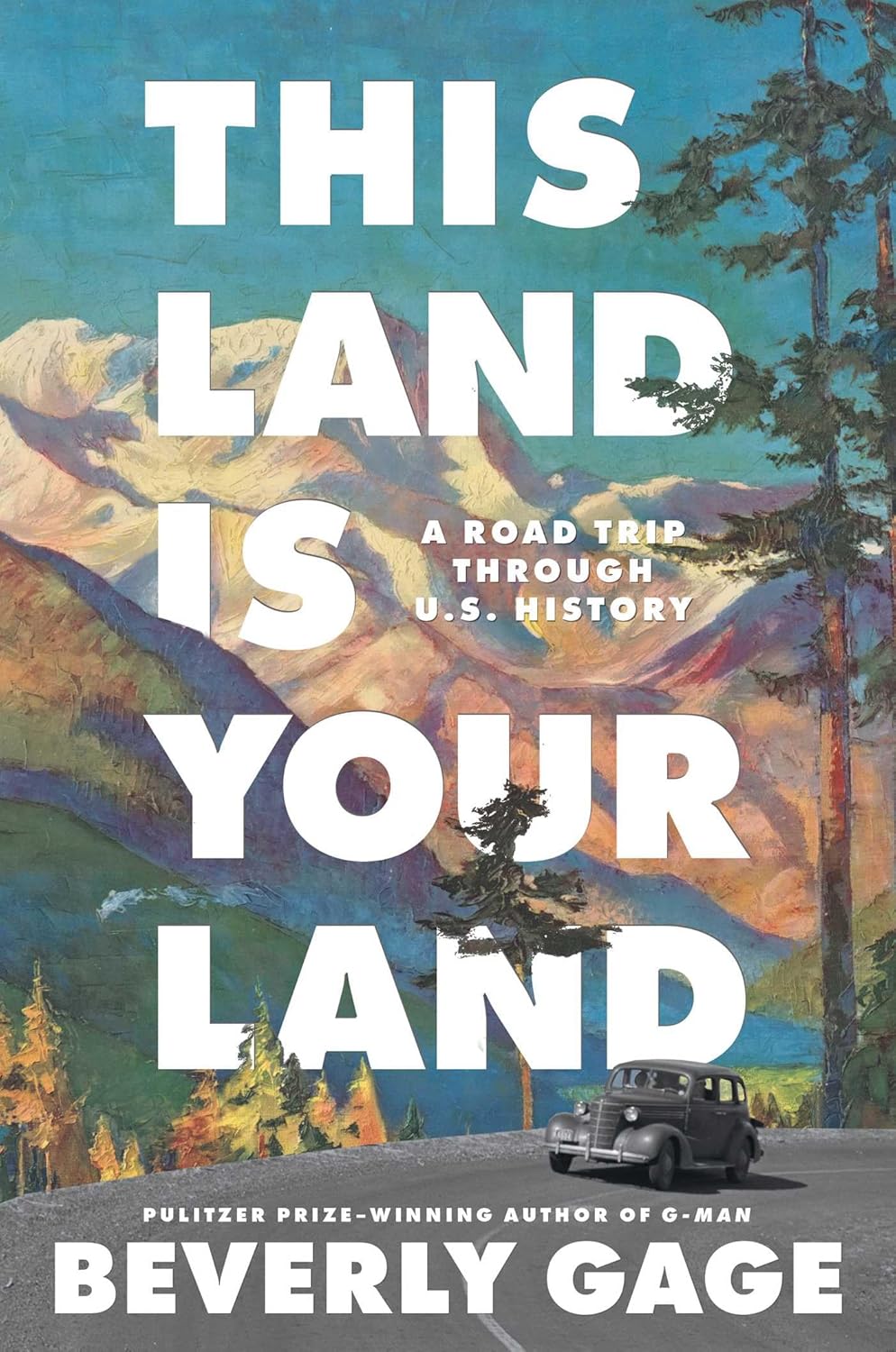
I’d like to ride shotgun on Beverly Gage’s next road trip. She’s flexible when faced with traveling snafus, packs light, and will do more than her share of the driving. Best of all, she’ll add her two cents (worth way more) about the historic markers and docent-led tours we encounter along the way.
Gage’s This Land Is Your Land is subtitled “a road trip through U.S. history,” but it’s actually 13 separate trips (from 2023 and 2024) undertaken for a book published to coincide with this year’s semiquincentennial — the “semiquin,” as she shorthands it, and “America 250,” as it is now branded. Gage doesn’t present the trips in the order she took them or as a logical route on a map but instead weaves them together to form a narrative “to cover the major debates, conflicts, and transformations of the American past, beginning in 1776 and ending in the present.”
The book starts in Philadelphia to discuss the origins of the nation — and the author’s own origins as a budding historian growing up in a nearby suburb. Her trips span Charleston, Upstate New York, Detroit, and other places, ending in California. She purposely avoided the usual suspects, like Washington, DC, and Manhattan, and visited others that didn’t make the final cut, such as the LBJ library outside Austin and Graceland in Memphis. Linking travel past and present, she begins each chapter with a short account of an historical figure who also visited the place, and her table of contents features the kind of subheadings that were part and parcel of early travelogues (e.g., “I walk back in time” and “The Southwest has secrets”).
Gage sometimes traveled with a companion but was usually alone. A self-described middle-aged woman, she was purposefully unobtrusive during her trips: “rental cars, hotel rooms of varying quality, obedient strolls behind tour guides.” She took notes, asked questions of the guides (mostly volunteers and park rangers), read exhibit labels, and visited gift shops. She worried about her health and whether she’d make it to her next stop before it closed, like any of us would.
Unlike most of us, however, what she brings to travel is “my background as a historian, which I hope allowed me to see and understand some things that others would not.” She may have told a few of those guides that she’s a history teacher, but she didn’t share her full credentials: Gage is a professor at Yale who wrote, among other works, a Pulitzer Prize-winning biography of J. Edgar Hoover.
On each stop of her journey, Gage first offers an account of the place’s past people and events. She then explores how subsequent generations interpreted and continue to interpret those same people and events. As one example of many, she spent time in Tennessee, where Andrew Jackson’s home, the Hermitage, sits outside Nashville. Jackson, she notes, was revered for almost two centuries as an up-from-nothing hero before the early 21st-century recognition of his brutality in the treatment of Native Americans (culminating in the Indian Removal Act of 1830). Today, he enjoys renewed glorification thanks to President Donald Trump, who visited the Hermitage to celebrate Jackson’s 250th birthday.
The property, Gage reports, duly addresses Jackson’s history as an enslaver but had “just a small display, and an apologetic one at that” about his ruthlessness toward Indians. She then drove to the Sequoyah Birthplace Museum and Cherokee Removal Park in eastern Tennessee, both of which provided a counterweight to the myth presented at the Hermitage.
In addition, as she does elsewhere, the author places the specific matter — in this case, the forced removal of Indians from their ancestral lands — in the broader context of U.S. history. While Jackson pushed for removal, thousands of everyday citizens signed petitions and otherwise protested the policy in “the first great civil mobilization in American history.” Moreover, as a harbinger of things to come, “the process took advantage of the government’s growing bureaucratic capacities. Indian removal was carried out through tallies, charts, and numbers as much as guns and bayonets.”
When Gage launched her book project, she didn’t foresee the Trump administration’s assault on history, including its March 2025 “Restoring Truth and Sanity to American History” executive order that aims to censor information provided to the public. She addresses this issue in her epilogue. “No doubt some of the places in this book already look quite different from when I visited in 2023 and 2024,” she writes, although I wish she’d revisited them to confirm that fact.
In the end, Gage remains hopeful about the state of the union. “The good news is that history is hard to suppress, once people know it’s out there.” In 1940, Woody Guthrie wrote the song “This Land Is Your Land” as both a glorification and critique of America. Nearly a century later, Beverly Gage has written This Land Is Your Land with both love of country and honesty about how it can do better.
Paula Tarnapol Whitacre writes about history, with a focus on 19th-century social history. She is currently working on a book about the Civil War and Reconstruction focused on Alexandria, Virginia, under contract with Georgetown University Press.