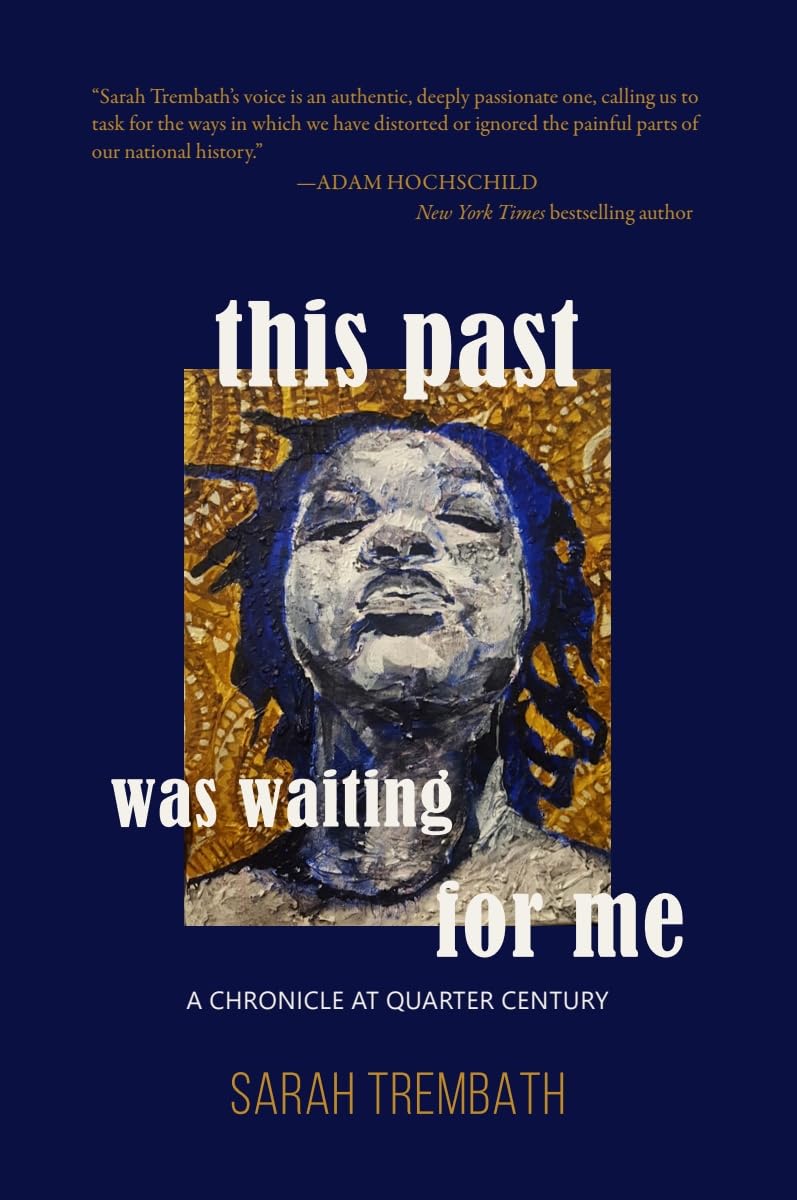
This Past Was Waiting for Me: A Chronicle at Quarter Century
- By Sarah Trembath
- Lazuli Literary Press
- 396 pp.
- Reviewed by Michele L. Simms-Burton
- July 29, 2026
An astute, multi-genre analysis of gentrification’s destructiveness.
In 1982, Gloria T. Hull, Patricia Bell-Scott, and Barbara Smith edited the groundbreaking anthology All the Women Are White, All the Blacks Are Men, But Some of Us Are Brave, which shifted the way that Black women inside and outside of academia addressed the intersection of race, class, gender, and sexual orientation in their writing. The anthology not only laid the foundation for Black feminist studies, but its nontraditional publisher, the Feminist Press, also provided space for academics to consider more lucid methods to address systemic violence in the United States for a wide-reading audience.
Its success created subsequent generations of scholars who understood that works read only by their colleagues had little value in fostering the change that would benefit the most vulnerable populations. These scholars recognized there were presses that would support their visions of what publishing by academics could look like when not hamstrung by jargon. Scholars like bell hooks vowed to write books that were accessible to the widest audience possible. She even eliminated the “back matter” of her books to attract more readers.
While Sarah Trembath’s This Past Was Waiting for Me: A Chronicle at Quarter Century contains “back matter” endnotes, her multi-genre and visually appealing book carries forward the tradition of Hull, et. al., and hooks with its style, format, and accessibility. Comprising seven essays, six poems, and multiple images, it examines the violence of gentrification in Washington, DC, and how miseducation perpetuates inequality. Trembath then provides suggestions to ameliorate these ills.
Her approach to writing about gentrification and displacement challenges our orientation toward inhabiting shared spaces, education, and the roles of teachers in ensuring a more tranquil union. With a doctorate in education policy and leadership, Trembath is aware of how education in this country is not only skewed to present a benevolent narrative about the nation’s founding, but also how narratives tend to sanitize their own crimes against humanity.
From the opening essay, “Swaying with Wicked Grace,” to the closing one, “Afterword and Acknowledgements,” the author hits hardest when addressing the “state sponsored violence” of gentrification. Labeling gentrifiers the “gentry,” she likens their attitudes to the mentality of European colonizers, whose violent displacement of Indigenous people often involved the changing of place names, the prohibiting of cultural practices, and the cordoning off of public spaces. She regards the gentrification of Washington, DC, as evidence of Euro-Americans’ unabashed “take-over bug,” one in which “aversive racism is prevalent.” The gentry’s behavior has caused deaths.
The throughline from the lies told to students (from kindergarten to college) about slavery and America’s founding to the attempts by the current administration to cleanse the land of anyone who is not white, professional class, and economically stable is evidence of a nation unable to face its past. Trembath’s analysis of the National Park Service’s (NPS) African American Heritage website — which, she says, “advance[s] a very Eurocentric Black heritage” — demonstrates how the highest levels of government continue to suppress this history.
By failing to provide documented recollections from Black Americans about their heritage and ethnography — which are obtainable via the government’s own archives, including the Works Progress Administration’s oral histories and the interviews of formerly enslaved individuals conducted by the Federal Writers’ Project from 1936 to 1938 — the site, like the powers-that-be who run it, perpetuates the myths and lies that foment violence.
To correct the record, Trembath draws directly from the more than 2,300 first-person accounts available through a 17-volume collection titled “Slave Narratives: A Folk History of Slavery in the United States from Interviews with Former Slaves,” digitized and accessible online through the Library of Congress’ “Born in Slavery” collection. Given the existence of such a repository, one can only conclude that the elision by the NPS is purposeful and political.
Correlating U.S. imperialism abroad and at home, Trembath also pays homage to the devastating similarities between Ferguson, Missouri, during the protests over the killing of Black teen Michael Brown and the Palestinians’ struggle for sovereignty. Amid an ongoing genocide, she asserts, miseducation fosters misinformation, fuels a lack of empathy, and fails to inform Americans that Palestinians are indigenous to the land from which they are being forcibly removed.
In an historical moment when facts remain contested, propaganda has become normalized, and the ills of a capitalist society are treated as a fait accompli, This Past Was Waiting for Me bears witness to the power of resistance and provides remedies for combating the behaviors that undermine democracy, self-sovereignty, survival, and cultural awareness. Add this book to your must-read list. I suspect Trembath has an act two on her hard drive.
Michele L. Simms-Burton, Ph.D., is a writer, scholar of African American and Africana studies, and a retired tenured professor. She is the 2026 recipient of the Naomi Long Madgett Poetry Award. Broadside Lotus Press will publish this award-winning collection, Madame Céline Alvarez Baà, in 2027.