Those Who Are About to Die: A Day in the Life of a Roman Gladiator
- By Harry Sidebottom
- Knopf
- 416 pp.
- Reviewed by Peggy Kurkowski
- April 23, 2026
Russell Crowe was good, but this book is even better.
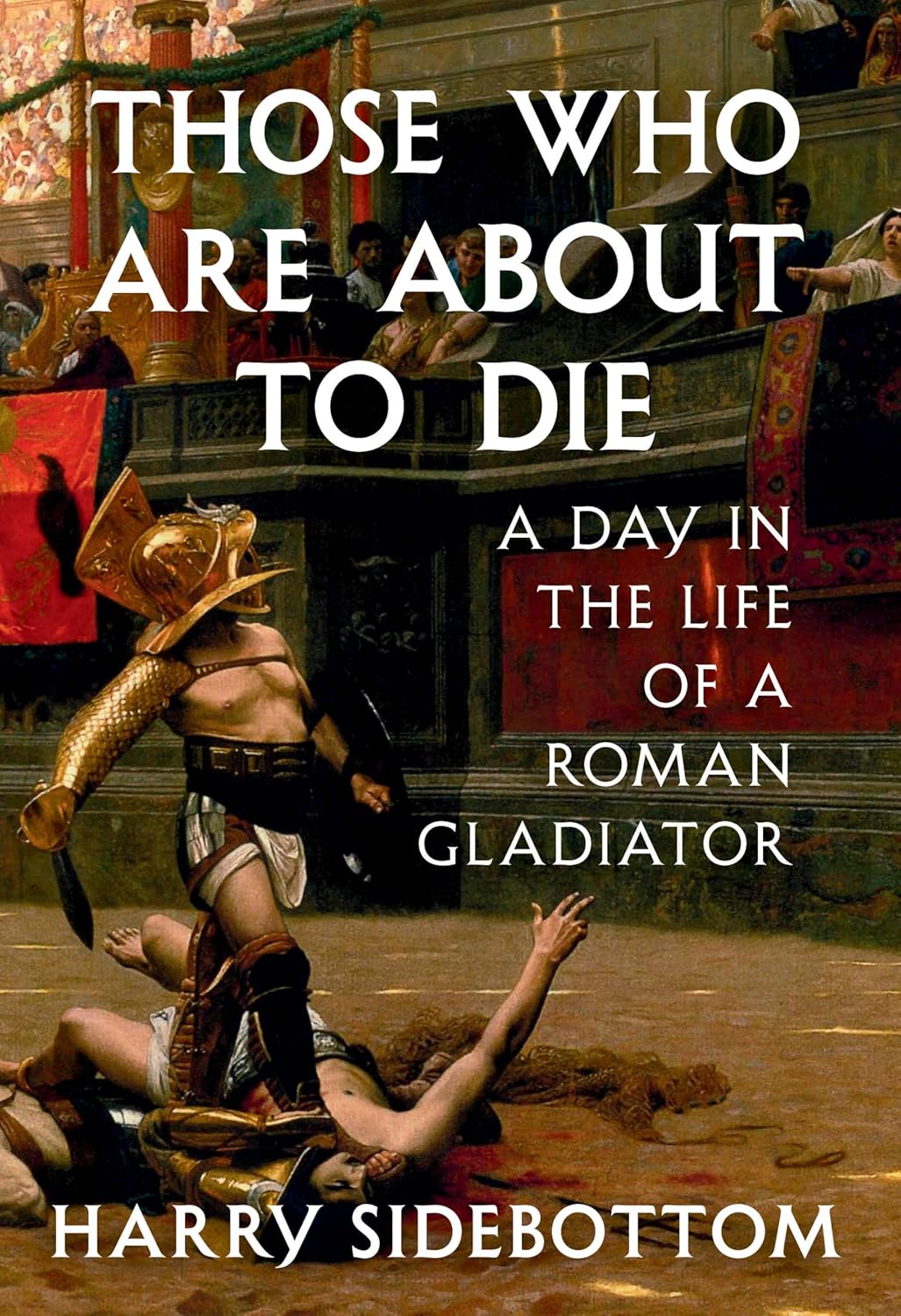
Are you not entertained? You will be — and endlessly so — by Harry Sidebottom’s Those Who Are About to Die, a singular look at a routine “day in the life” of a Roman gladiator.
What most people know about the art and business of gladiatorial combat can be measured within the confines of Ridley Scott’s big-screen blockbuster “Gladiator.” But there are worlds of meaning wrapped up inside ancient Rome’s most famous “sport,” and in this stunningly innovative work of research and reconstruction, Sidebottom turns over every stone to get to the heart of the controversial entertainment that embodied and reflected the society that birthed it.
To enter this complex topic, the author uses a simple convention: Over a 24-hour period, broken down into the time of day according to Roman timekeepers — e.g., Vesper, Prima Vigilia, Secunda Vigilia, etc. — he creates a composite portrait of a typical gladiator’s experience before, during, and after a battle in the Colosseum. But the actual fight is just the tip of the spear; Sidebottom also uses each chapter to explore facets of Roman life from the 1st century BC to the 2nd century AD.
Gladiators were “at the heart of Roman culture…even though socially they were the lowest of the low,” he writes. Their ranks included prisoners of war, criminals, slaves, and the puzzling free men who volunteered to fight for pay in the arena, the auctorati. One misconception Sidebottom pierces immediately: Forget ripped abs and flawless, sculpted muscle; real gladiators were often overweight, with bad teeth and scarred bodies reflecting long years of combat and repeated physical training. As he explains, “fat gladiators made a better visual spectacle” because their carbohydrate-rich diets produced a thick subcutaneous layer of fat that shielded vital organs. Despite flesh wounds, these big brawlers could continue the fight — and the people’s entertainment.
He reveals how gladiators trained, and their physical stances and movements in combat, as well as their weaponry and shields. The business of gladiatorial schools was exactly that, a business, which also punctures another Hollywood trope: gladiatorial combat “was not a slaughterhouse,” Sidebottom contends, and the risk of death in a bout was perhaps “one in eight.” The Roman justification for gladiator games, which were “extraordinarily unchanging and long-lived,” was to prepare people for war. Thus, the gladiator served a higher political purpose in his matches but remained a “deeply ambiguous figure, by turns reviled and idealized.”
From the rousing to the ribald, Sidebottom hews closely to ancient Greek and Latin sources and, like a seasoned codebreaker, unlocks long-ago texts to bring their wit, grit, and humanity to his narrative. The level of scholarship is impressive and multifarious: from eyewitness accounts and tombstone inscriptions to sculptures, frescoes, and excavated mosaic pieces, Sidebottom explains what is happening in a given image or inscription in a direct yet playful way that’s easy for contemporary readers to absorb and enjoy.
As he moves into the main event, the author shows how each day of the games would begin: a procession to the Colosseum at first light (Prima Lux), then wild-beast hunts in the morning, executions at midday, and gladiator matches in the afternoon. The “elaborate stratified seating” of the amphitheater was yet another statement of Roman order. Writes Sidebottom:
“When the gladiator gazed up at the stands, he saw Roman society: ordered, hierarchical, and stratified in stone. It was a society from which, perhaps by his own choice, he was excluded.”
Sidebottom takes a non-linear approach to his tale that moves freely but keeps the clock ticking. Each new chapter (hour) opens a new window into the Roman mind, and Sidebottom is an exquisite tour guide throughout. Never have the ancient Romans seemed so close to us: in their sleeping and eating, drinking and dreaming, carousing and joking (even potty humor abides in the public latrines). Sidebottom somehow makes a book about gladiators into a delightful and revealing Rome 101. Those Who Are About to Die is a panoramic and expertly written tell-all about the iconic fighter and the cultural soil from which he emerged.
Peggy Kurkowski is a professional copywriter for a higher-education IT nonprofit association by day and a major history nerd at night. She writes for multiple book-review publications, including Publishers Weekly, Library Journal, BookBrowse Review, Historical Novels Review, Foreword, Shelf Awareness, and the Independent. She hosts her own YouTube channel, “The History Shelf,” where she features and reviews history books (new and old), as well as a variety of fiction. She lives in Colorado with her partner and four adorable, ridiculous dogs.